

Show Caption
- Residents of a Port Wentworth neighborhood believe chemical dust from a nearby International Paper mill is causing health concerns and property damage.
- Many residents reported shared health symptoms, including sinus issues, burning eyes and coughing.
- Despite resident complaints and visible white powder on cars and homes, the Georgia Environmental Protection Division has not found the mill in violation of its permits.
As darkness descended on a sleepy residential neighborhood in the shadow of what was International Paper's Port Wentworth mill, the plant at 1 Bonnybridge Road seemed to awaken. Bright white lights and the sounds of whooshing steam intermittently filled the sulfur-scented air, often waking residents in the middle of the night.
But of all the disruptions, it's the seemingly innocent white flakes drifting through the air like snow that weigh heaviest on residents' minds.
Nearly 20 residents gathered at a pavilion about a half mile away from the plant on the evening of Nov. 5, 2025 to discuss with Savannah Morning News their shared observations of the white powder covering their homes, children’s toys, pool covers, vehicles—and themselves.
The Savannah Morning News collected dust scraped off of one resident's car about 700 feet from the mill and sent it to third-party lab Eurofins for testing. Eurofins stated that most of the sample was likely calcium carbonate, a white to tan odorless powder, a major component of lime mud. The International Paper mill generates lime mud, according to its operating permit.
Calcium carbonate causes irritation of the eyes, skin, cough, sneezing, rhinorrhea (discharge of thin nasal mucus); lacrimation (discharge of tears), according to the Center for Disease Control.
And it appears some area residents exhibit many similar symptoms.
By a show of hands, 12 of 17 people reported sinus issues; 10 said their eyes burned; nine experienced a sustained cough; and seven had difficulty breathing.
Longtime residents who have lived in the community for over four decades said they have seen the white powder on and off over the past years. But since last year, it has been worse than ever before. The Georgia Environmental Protection Division (EPD) has received three formal complaints from residents in the past four years about white dust, according to its database. But in response to the complaints, the EPD has not confirmed any violations after visits to the mill.
"I love the neighborhood and the people,” said one-year resident Camden Coleman. “But the factory really makes you just want to leave.”
With paper, comes limestone
One of the world’s largest paper companies, International Paper made headlines when it announced the closures of its Savannah and Riceboro mills in August of 2025. While the news rang alarm bells for the paper and timber industry across the state, it seems to have passed the baton when it sold its Global Cellulose Fibers (GCF) division to American Industrial Partners (AIP) for $1.5 billion in the same month. Then on Jan. 23, 2026 GCF bought the plant for over $40 million.
"The Port Wentworth Mill has not had any operational changes due to the sale. The processes and products at the Port Wentworth mill remain the same,” a GCF spokesperson wrote in an email.
GCF converts wood into pulp for products such as diapers. After receiving logs and chipping them into finer pieces, the mill soaks the wood in chemicals. The process generates calcium carbonate, or lime mud (which is not a mud, but a dust).
One of the products in the reaction is also lime dust, which was not detected in the sample. According to an operating permit issued by the EPD in 2021, there are several avenues for lime mud powder to escape from the kilns and storage units, where IP must take certain “special precautions to prevent fugitive emissions of lime,” the permit states. Those precautions detail an extensive to-do list, such as checking for dust leaks at least once per day and wetting areas when excess lime could be emitted.
GCF stated it filed appropriate permit submittals under the mill’s new company name.
“Inspectors visually inspect fugitive dust sources and view records of maintenance checks (or) cleanups to determine compliance with these conditions,” wrote EPD Spokesperson Sara Lips in an email. And in 2024 and 2025, inspections found no deviations from standards.
Cars drove the complaints
Still, something in the air is settling on the neighborhood.
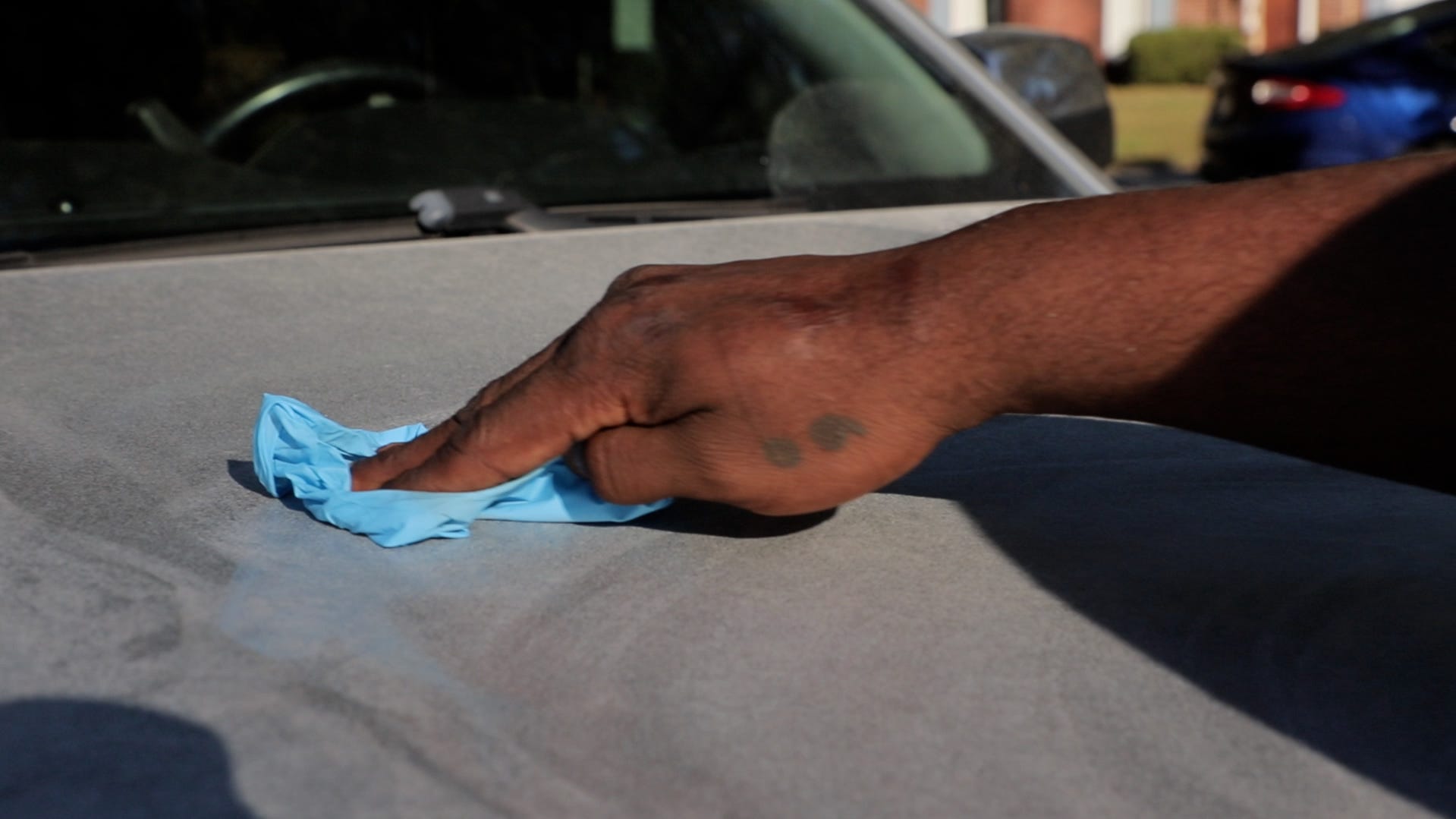
Residents first noticed the sticky white powder on their vehicles accumulating more rapidly last year. Especially when facing the sun, residents say they are not able to see through their windshields.
“I almost drove into the ditch,” Coleman said.
In 2024, residents received car wash certificates from IP as a "good-will gesture," according to EPD's report. A North Carolina paper mill owned by Evergreen Packaging and Blue Ridge Paper Products responded similarly in 2022 when residents reported sticky white powder difficult to scrape off their cars, ABC-13 reported.
The North Carolina Department of Environmental Quality (DEQ) tested those samples and confirmed that the dust contained calcium, and narrowed down the likely culprit to the mill's lime kiln.
"It was challenging to determine where in this process the dust may be coming from," wrote Public Information Officer Shawn Taylor in an email. "DEQ’s Division of Air Quality was still investigating the source of the off-site dust when the facility announced it was shutting down in 2023. Once the mill began shutting down its processes, there were no complaints received regarding off-site dust."
The DEQ received three years of complaints about the dust from 2021 to 2023. During that time, the department issued repair orders at the Evergreen Packaging mill for apparently inadequate scrubbers, leaky filters, and intermittently malfunctioning kilns, amounting to a combined penalty of over $9,000 for five violations.
Port Wentworth residents have found that attempts to rinse the dust from their vehicles often exacerbates the issue, as adding water to lime mud creates a paste that hardens it.
"A regular car wash doesn't get it out,” Coleman said. Brushes and sponges didn't seem to work either. Some are now experimenting with a Windex and vinegar solution. A car wash about 20 minutes from the mill charges $85 for a vinegar wash, but every time they go through it, it strips the car of its clear coat, one resident mentioned. Remedying that by reapplying car wax after the wash is up to an extra $150.
“That stuff's on the windshield of my truck every day,” said resident Jim Dunigan. "There's hardly any paint left on it."
Then, it was more than the cars
While they saw the dust on each other’s cars, they didn’t realize they shared symptoms. Residents within six blocks of the IP plant complained of constant runny noses.
"I just moved here a year ago," Coleman said. "I never had drainage in the morning, but every morning I wake up now, it's literally coming down."
Upon waking, “I have to blow my nose with five tissues to just breathe for a second," said another one-year resident, Joseph Stepp.
“I can't go anywhere without a Kleenex,” said Margaret Haupt.
"I've had a chronic cough for the past year," said resident Debbie Riley.
In separate conversations with the Savannah Morning News, resident Michelle Durden said her breathing and coughing issues first began in 2025 and continued for months.
In April 2025, "I got put in the hospital for two days... I couldn't catch my breath," Durden said. "I have never had so many breathing issues until this year."
Dogs, too, seemed to be having some difficulty. One person said white gunk oozed out of their dog's eyes, and another suffered from eye irritation. Ten residents raised their hands when asked if their pets were sick.
While some doctors can attribute these ailments to environmental factors, most cannot pinpoint a cause, residents said.
The powder has just... fallen from the sky?
There appears to be a lack of effort from regulators to determine just what exactly the powder is—or at least a lack of bandwidth.
"EPD does not take samples for [compliance] investigations due to lack of resources given the number of complaints EPD receives," wrote EPD Spokesperson Lips.
In an email to a resident, EPD Environmental Engineer Whitney DeMoor apologized for a lack of visitation to inspect their cars citing inconvenience traveling from Atlanta, where the EPD headquarters are located.
The regulatory agency and the mill have had at least two years to figure it out.
Complaints to the EPD about a fine white powder landing on vehicles and residents began in November 2023, first filed by resident Shannon O’Berry.
And the mill's previous owners, International Paper, would not confirm nor deny the allegations that the white dust in the neighborhood originated from its plant.
A visit to International Paper
In response to O'Berry's complaint, DeMoor requested the Georgia Department of Natural Resources (DNR) send someone to "just take a look at the surrounding area", in an email the Savannah Morning News obtained in an open records request.
On Nov. 20, 2023, DNR Environmental Compliance Specialist Michelle Dennis evaluated the lime storage area.
"While there was minimal dusting, nothing was large enough to cause issue for the observers in the area," wrote Dennis in the complaint report. "Dust was definitely not going to leave the property."
But it also could have just been an opportune moment.
“They were not loading at the time, so there was no opacity," wrote Dennis in an email to DeMoor.
Opacity—used to assess how many particulates are in the air—must be less than 20%, according to the mill's permit and the EPA’s rules for visible emissions. As long as opacity and rate of production fall within acceptable limits, the plant adheres to Georgia’s air quality control code.
While lime loading did not occur during Dennis' observations, additional lime loading did occur during the complaint period, the report noted.
“Amber did not know how they control the dust in that area during loading,” wrote Dennis in an email, referring to IP Environmental Manager Amber Johnson.
What will residents do?
The dusting issue stopped for about two months, from January to February, according to a resident, and then began again with what they considered a finer dust, like baby powder, that sticks more aggressively than in the past.
Nearly half of residents within a one-mile radius of the plant are low-income, according to EPA data. Trying to move is a tall order, but many of them are doing it anyway.
"You go somewhere out of town and the minute you come back, you know you're here," said Stanley Elkins. Breathing tightens, symptoms return.
As for whether they want to pursue litigation, residents that spoke with the Savannah Morning News are skeptical they will be able to accumulate the funds for it. SMN is not aware of any of them contacting an attorney in this manner as of April of 2026.
District 3 Chatham County Commissioner Bobby Lockett presides over unincorporated Chatham County, including this Port Wentworth neighborhood. O’Berry and the Savannah Morning News contacted Lockett in January, and have not heard back since then.
An additional complaint was filed by a resident to EPD on April 20, 2026, citing the same issues as the previous complaints — a dusting issue on vehicles, homes, dust that was clear, sticky, ash-like, gritty and difficult to remove. As of now, the EPD is investigating this most recent complaint.
While they await the results of EPD's latest investigation, residents continue to clean their vehicles, clear their throats and pray for bluer skies.
Jillian Magtoto covers climate change and the environment in coastal Georgia. You can reach her at
Destini Ambus is the general assignment reporter for the Savannah Morning News, covering the municipalities, and community and cultural programs. You can reach her at
Comments on Paper mill dust causes health concerns in Port Wentworth