
People shouldn't have to agree with their government to be heard by it. The freedom to gather peacefully and speak up is one of the ways ordinary people help keep public power accountable.
Imagine learning that a local decision may close a neighborhood service, change school arrangements, or affect access to a public meeting. Some people will write letters. Some will speak at a hearing. Others may want to stand together in a public place and make their concerns visible. None of those choices requires unanimous agreement about the best solution.
A peaceful demonstration can show how deeply an issue matters. But the real strength of civic action is not measured by how loudly a crowd speaks. It's measured in part by whether people respect one another, check their facts, and create a serious opportunity for a response.
The right belongs to people we disagree with, too
The First Amendment protects freedom of speech and the right to assemble peaceably and petition government. Those freedoms are not reserved for popular causes. People who oppose a demonstration may have speech and assembly rights of their own. Respecting those rights does not require agreeing with anyone's message.
The details of where and how a demonstration can take place matter. Public sidewalks, streets, and parks have important speech protections, but rules concerning traffic, access, safety, and permits can vary with the activity and location. Someone planning an event should check the actual local requirements rather than assume every gathering is governed by one nationwide rule.
Make the purpose clear
Suppose residents want to raise concerns about a town's treatment of accessibility requests. A responsible organizer would first check the decisions and relevant records, invite people directly affected to help describe the problem, and identify the office with authority to respond. The public message could then ask a specific question: What changes will make town meetings genuinely accessible, and how will progress be measured?
That kind of clarity helps participants and public officials know what is being requested. It also makes room for a serious reply, including evidence about costs, legal requirements, and possible alternatives.
Take care of people, not just the message
A thoughtful gathering accounts for different mobility needs, interpreters or accessible formats where appropriate, public-safety concerns, and participants' privacy. Organizers should communicate a commitment to nonviolence, discourage harassment and intimidation, and avoid presenting rumors as established facts.
There will be situations where demonstrators and officials disagree about the scope of a legal restriction. Those questions deserve accurate legal advice and careful documentation rather than confident assertions that every demand or every official instruction must automatically be lawful.
What happens after the signs come down?
Peaceful assembly is one part of civic life, not a complete reform strategy by itself. A meeting with officials, a well-supported public comment, a request for records, or a follow-up discussion can help citizens learn what changed—and what did not.
That fits the National Coalition's purpose: protecting constitutional participation while encouraging practical, lawful, and accountable reform. It also makes room for members who prefer research, writing, volunteering, or small-group discussions over attending a demonstration.
One useful step to take
Identify an issue that matters to your community. Read the relevant official decision or proposed policy. Ask who has authority to act. Consider whether a public meeting, a written comment, a lawful peaceful gathering, or a member discussion is the most useful way to contribute. Then follow the response and share what you learn.
Question for members: What turns a public demonstration into an opportunity for lasting, constructive change?
Research and further reading
- National Archives — The Bill of Rights (First Amendment text).
- American Civil Liberties Union — Protesters' Rights (general legal information).
- ACLU of Massachusetts — Guidance for Demonstrations and Protests.
American Ledger original editorial draft. Examples are hypothetical and not reports of actual Coalition events. This article is intended for civic education and discussion, not as legal advice or an official Coalition policy.
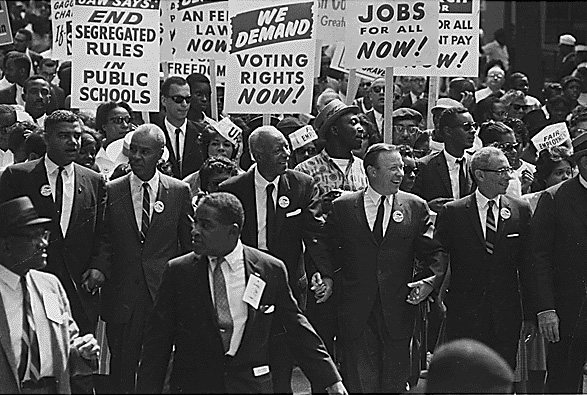
Illustrative image: Civil Rights March on Washington, 1963. U.S. National Archives, public domain.
Comments on Peaceful Protest Is a Right—and a Civic Responsibility