
Professors Discuss the Case for a State-Level Wealth Tax
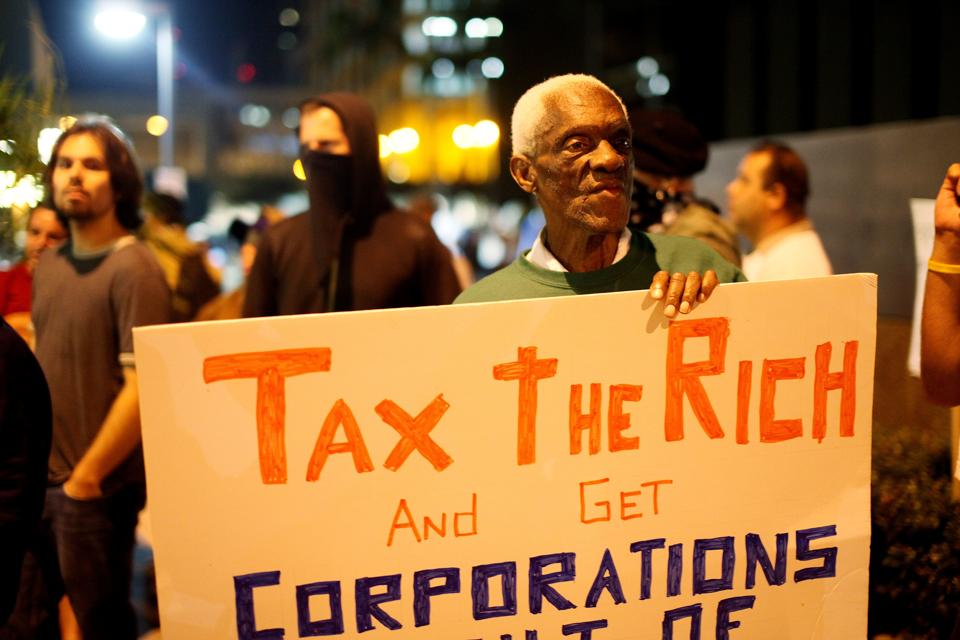
Demonstrator Randall Grey protests a taxation of the wealthy during a rally at Occupy Wall Street San Diego on Thursday, October 13, 2011 in San Diego, California. Protesters around the United States are staging rallies to protest greedy corporations, bank bailouts, taxing the wealthy and a variety of other economic issues as America's jobless rate remains on shaky ground. (Photo by Sandy Huffaker/Corbis via Getty Images)
In this episode of Tax Notes Talk, professors David Gamage and Darien Shanske discuss their recent paper, “Money Moves: Taxing the Wealthy at the State Level,” which lays out their argument for a state-level wealth tax.
Tax Notes Talk is a podcast produced by Tax Notes. This transcript has been edited for clarity.
David D. Stewart: Welcome to the podcast. I'm David Stewart, editor in chief of Tax Notes Today International. This week: a wealth of state revenue?
The idea of a state imposing a wealth tax is, to put it mildly, controversial. Detractors often argue that if a state enacts a wealth tax, high-net-worth individuals will simply move to a lower-tax jurisdiction, eroding the overall state tax base.
But will wealthy households actually move in response to increased taxes? And could a wealth tax shore up state finances while increasing the progressivity of the tax system?
Professors David Gamage, Darien Shanske, and Brian Galle explore these questions and more in their recently published paper, "Money Moves: Taxing the Wealthy at the State Level." Professors Gamage and Shanske join me now to delve into their findings. David, Darien, welcome to the podcast.
David Gamage: Thank you.
Darien Shanske: Thank you.
David D. Stewart: Darien, why don't you start us off with a brief overview of how a state wealth tax works?
Darien Shanske: Obviously there's some flexibility; there's not just one way to do it. I think the easiest way to get into what we are envisioning is that for about a hundred years, states administered something called the general property tax, which included a tax on intangible wealth as part of property tax. So the idea would be there'd be a small tax on your intangible wealth that you'd pay either at the same time as your property tax or, more likely, as part of when you pay your income tax, and that's the basic idea of building on existing tax structures and concepts.
David D. Stewart: David, how does a state wealth tax differ from a federal approach to a wealth tax?
David Gamage: Yeah. The difference is levied by the state government instead of the federal government. So most viewers are probably familiar with state-level taxes. Most states, not all, have income taxes. Most states, not all, have sales taxes, among other taxes. The federal government also has an income tax, but no sales tax.
From a "why at the state level," as opposed to how does it differ, there are a number of reasons. One reason is for a combination of political reality at the federal level and constitutional issues that exist at the federal level but not state level. It's unlikely in the near future we're going to get anything that we would consider a wealth tax at the federal level, whereas the prospects, at least in certain states, are much more promising.
But also, as a matter of policy, the way American fiscal federalism works and has always worked is that tax innovation often happens first at the states. Before we got the federal income tax, we had state-level income taxes in a number of states that spread from state to state, and we learned how to do income taxes right at the state level. That is allowing states to be "laboratories of democracy," as the phrase goes, one of the values of our fiscal federalism system, but also tailoring local policies to local preferences and local conditions. Different regions may have different appetites for progressive taxation, and states can experiment and implement policies suited to their specific needs.
David D. Stewart: So on that question of activity and taxation, Darien mentioned property taxes, including on intangible property. I come from Virginia, where we pay personal property tax on cars. How much wealth is currently being captured by state taxes overall?
David Gamage: The historic practice of general property taxes, including intangible wealth, has largely been phased out at the state level as income taxes gained prominence. However, there's growing concern that the existing taxes don't adequately capture the massive increase in financial wealth and wealth from intangibles, especially among the ultra-wealthy like billionaires. These taxes tend to be regressive, meaning those with less wealth pay a higher percentage of their wealth in taxes than the very wealthy, which is counterproductive to equitable tax policy.
For example, billionaires like Mark Zuckerberg, who live in California, pay a very small share of their wealth in state taxes, which illustrates how existing structures fail to effectively tax the wealth of the very richest.
Darien Shanske: I agree. States are also different from the federal government because they provide most frontline services and face strict budget constraints. This compels states to consider expanding their tax bases, especially as federal support dwindles and economic inequality widens. Currently, property taxes fund many state programs, but they don’t capture the full scope of the increasingly large and mobile wealthy class.
Moreover, the regressive nature of sales taxes and the limited progressiveness of income taxes in some states exacerbate this issue, especially for the ultra-wealthy who derive income from intangible assets and investments that aren't effectively taxed under current laws.
David D. Stewart: California, despite having a progressive income tax system, still faces regressivity issues. What drives that?
David Gamage: The main driver is the reliance on sales taxes, which are inherently regressive, and the fact that high incomes from financial assets often don't generate realized income subject to tax due to the realization rule, meaning they don’t trigger taxable events until assets are sold. This allows the very wealthy to defer taxes and reduce their effective tax rate, especially on wealth derived from assets whose appreciation isn’t taxed until realization.
Darien Shanske: Precisely. The realization rule means you only pay taxes when you sell an asset. Wealth accrued from appreciation isn’t taxed until realization, enabling the ultra-wealthy to defer or avoid taxes altogether, especially if they shift their wealth to states with no income tax, such as Texas or Florida.
David Gamage: This is sometimes called “buy, borrow, die” — accumulating wealth without paying taxes until death, at which point a step-up basis often avoids taxing the accumulated unrealized gains. Wealthy individuals can borrow against assets or move to states without wealth taxes, avoiding tax altogether.
Famous billionaires like Larry Ellison have used borrowing strategies to finance their wealth, enduring minimal tax burdens due to policy and legal allowances.
Darien Shanske: The distinction between mobility and exploitative mobility is key. Moving to get a new job or opportunity is normal and expected in a federal system, but exploiting the system by shifting wealth after benefiting from local infrastructure and public services to avoid taxes is unfair and undermines tax fairness.
David D. Stewart: What are the strongest arguments in favor of states implementing a wealth tax?
David Gamage: Many reasons converge: promoting fairness by taxing the rich more equitably, funding essential state programs, and improving overall efficiency. Progressive taxation on wealth reduces incentives to convert income into minimally taxed forms or to engage in tax planning strategies that erode the tax base.
Addressing the failures of current taxes, especially on intangible wealth, through reforms like a wealth tax is crucial for a fair, efficient, and sustainable tax system at the state level.
David D. Stewart: Are federal constitutional issues a barrier to implementing a wealth tax at the federal level?
David Gamage: Yes. The main challenge is the constitutional distinction between direct taxes (like property taxes) and indirect taxes (like income taxes). A federal wealth tax might be challenged on the grounds of apportionment or uniformity, especially if designed as a comprehensive tax on unrealized gains. The recent Supreme Court case Moore v. United States highlights the ambiguity around whether a federal wealth or mark-to-market income tax would be constitutional, raising uncertainties.
The constitutional hurdles involve ensuring the tax isn’t considered a direct tax requiring apportionment, and legal challenges are likely based on specific design features rather than the concept itself.
Darien Shanske: It’s also important to note that states are free to implement wealth taxes without constitutional issues, as state constitutions and legal frameworks differ. The primary legal obstacle is federal constitutional law, which is more complex and uncertain in its application.
David D. Stewart: How likely do you think states are to adopt wealth taxes in the next decade?
Darien Shanske: Political and legal realities make prediction difficult. However, under increased fiscal stress and if federal support continues to decline, the likelihood of states adopting wealth taxes could rise. Urgency and need are growing, making such reforms more plausible over time.
Thank you both for this insightful discussion.
David Gamage: Thank you.
Darien Shanske: Thank you. It’s been a pleasure.