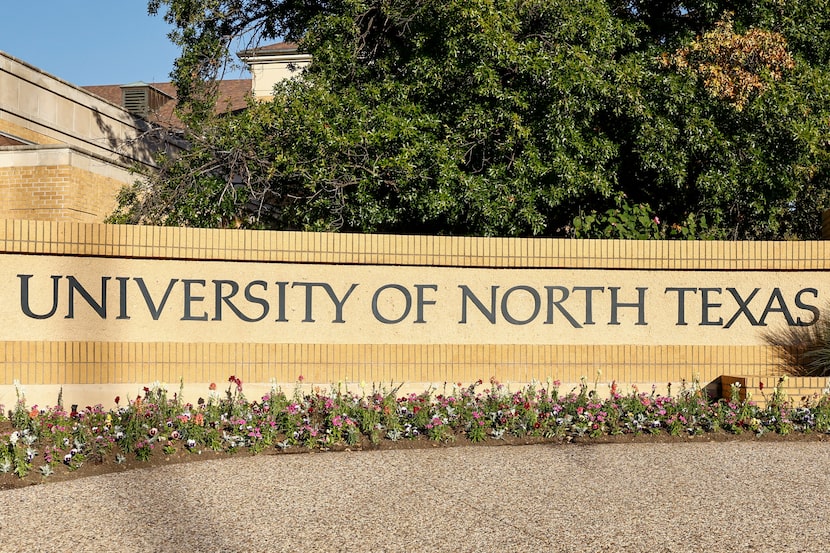
A sign for the University of North Texas is pictured Nov. 5, 2025, in Denton.
Elías Valverde II / Staff Photographer
In its latest move to address a $45 million shortfall, the University of North Texas made sweeping plans to eliminate and consolidate dozens of academic programs. A decline in international student enrollment has led to budget cuts.
The cuts will phase out four master’s programs, two undergraduate majors and 25 undergraduate minors, along with over 40 graduate and undergraduate certificates. While current students can finish their degrees, new students cannot enroll in the programs slated to close.
Here’s what you need to know about the program closures and UNT’s budget challenges.
Which majors, minors and certificates will close or consolidate?
The university will merge the linguistics department and the world languages, literatures, and cultures department, and eventually stop awarding linguistics degrees. UNT called it the most significant change, which goes into effect this fall.
Several ethnic and gender studies programs are on the chopping block, including the Latino and Latin American studies major. Undergraduate minors in Africana, Mexican American, Asian, LGBTQ, and women’s and gender studies — as well as a master’s program in women’s and gender studies — will also shutter.
UNT’s nationally-recognized arts programs will also see restructuring. Undergraduate minors in dance and new media art will close, while minors in the studio art department will be folded into concentrations in the major.
How else have budget cuts affected UNT?
The program closures and consolidations mark the latest development in UNT’s efforts to address the shortfall.
In February, Keller announced plans to move 40 courses to a hybrid learning model, combining online lectures and small in-person sections. The same month, a voluntary separation program for faculty was introduced. A month later, he told staff that smaller academic departments will realign with larger divisions or schools.
How did UNT decide which programs would be affected?
When deciding which programs to eliminate, school officials weighed factors, such as enrollment trends, instruction costs and alignment with UNT’s mission, according to Keller. For example, minors selected for closure have had an average enrollment of 20 students or under since 2021, according to the Thursday announcement.
Are other Texas universities closing programs?
The University of Texas at Austin plans to consolidate its ethnic and gender studies departments, after conservatives spent months calling to scale back programs deemed too liberal.
Texas Christian University will shutter standalone departments in comparative race and ethnic studies and women and gender studies in 2026, merging them into the English department. While the university officials pointed to finances and low student demand, some professors view the move as a part of a broader effort to appease conservative priorities for higher education, even though the private school operates outside state oversight.
Why does UNT have a $45 million shortfall?
A decline in international student enrollment has also fueled the budget shortfall, leading to a projected drop of $47.3 million in tuition revenue this fiscal year, according to an August budget document. UNT expects a $32 million reduction in state funding, which partially depends on enrollment, for fiscal years 2026 and 2027.
The decline in international master’s student enrollment was “larger than projected,” Keller said in February. International students — who often pay higher tuition rates and receive less financial aid — are a key source of university revenue.
The international graduate student population fell from roughly 6,200 in fall 2024 to just under 3,400 in fall 2025.
The drop has come amid President Donald Trump’s vow to crack down on immigration. Last April, at least 117 international students across Texas universities saw their visas terminated by the federal government. While officials later reversed course, the turmoil left many international students and visa applicants feeling targeted and fearful.
Related

Are other Texas universities facing budget challenges?
The University of Texas at Arlington started offering buyouts to faculty and staff in January, while grappling with the Trump administration’s policies on research support and immigration. About 17% of its funding comes from the federal government.
The University of Texas at Dallas lost $10 million. Last fall, it had 1,000 fewer international master’s students, but compensated for some lost revenue by tapping earmarked reserves, increasing undergraduate enrollment and implementing cost-containing measures.
Will UNT solve its budget crisis?
When unveiling his five-year strategic plan last November, Keller underscored the need to develop new revenue streams. He is focused on improving student retention and enrollment.
Related

Only 77% of UNT’s first-year students re-enroll for a second year, university data shows. To increase retention to 90%, UNT plans to invest in upgrading the first-year experience, like expanded advising models and mental health services.
UNT is also looking to build partnerships with community colleges to bring in transfer students and expand online and professional programs aligned with workforce needs.
The DMN Education Lab deepens the coverage and conversation about urgent education issues critical to the future of North Texas.
The DMN Education Lab is a community-funded journalism initiative, with support from Bobby and Lottye Lyle, Communities Foundation of Texas, The Dallas Foundation, Dallas Regional Chamber, Deedie Rose, Garrett and Cecilia Boone, Judy and Jim Gibbs, The Meadows Foundation, The Murrell Foundation, Ron and Phyllis Steinhart, Solutions Journalism Network, Southern Methodist University, Sydney Smith Hicks, and the University of Texas at Dallas. The Dallas Morning News retains full editorial control of the Education Lab’s journalism.
Latest Stories