

Show Caption
- Procter & Gamble was formed in 1837 after a father-in-law suggested his two sons-in-law, a candlemaker and a soap maker, team up.
- The company pioneered product branding, starting with its Ivory soap in 1879 and advertising it directly to consumers.
- The company sponsored early radio and television dramas, leading to the term "soap operas."
This story is part of the Iconic Brands series, a USA TODAY network project showcasing the companies and brands that helped shape the nation's identity, economy and culture. The series celebrates American ingenuity with a deeply reported examination of how brands intersect with history, community and everyday life in celebration of the nation's 250th anniversary. Find more at https://usatoday.com/usa250/iconic-brands
While Procter & Gamble today is known for icons like Tide detergent and Pampers diapers, in the 19th century, the company was first known for its original best-selling item: candles.
Founded in 1837, the company made top-quality candles that burned brightly, had a pleasant smell and were thicker, which meant they lasted longer. Some merchants displayed them in shops to consumers featuring the manufacturer’s name.
In the 1850s, company managers were alarmed to find out shipping workers were opening crates and marking P&G containers with stars to help coworkers who couldn’t read. After telling the workers to stop, the company learned that some customers were rejecting shipments because the boxes weren’t marked up – they couldn’t be the “real” P&G candles.
The company swiftly reintroduced the practice and gradually P&G’s first official logo, a moon with 13 stars (one for each of America’s original colonies), was born.
Shane Meeker, P&G's company historian, said the candles were known as "star" candles because they were rich with stearic acid, which increased burn time. The origin of its logo foretold the company's future role in creating many recognizable brands.
"This underscores the vital role branding plays in communicating product quality and building trust," Meeker said.
In celebration of America's 250th birthday this year, the USA Today network is taking a look at iconic companies that were founded and flourished in the nation.
Potential rivals team up in a bustling western city
The partnership that first formed the company owes its origins to the suggestion of a father looking to preserve peace in his family.
Cincinnati in the first half of the 19th century was a thriving metropolis, one of the United States' 10 largest cities and one of the largest in the West. Away from the Atlantic seaboard, Cincinnati was only eclipsed by New Orleans, another busy trading hub connected by the nation’s riverboats.
Alexander Norris was an Irish immigrant and successful soap and candle maker in Cincinnati. His products were made with animal byproducts from the city’s busy meatpacking industry. In 1833, two of his daughters married younger merchants in his trade: William Procter, an English candlemaker, and James Gamble, a fellow Irishman who made soap.
Wishing for his new sons-in-law not to compete with one another, he suggested they team up instead.
Procter had already established a business with its own stationery. To save money, “and Gamble” was handwritten in at the top of the correspondence, sealing the new venture’s name.
Ivory transforms the company, the industry and America
For decades, P&G grew along with the country as the founders’ children joined to help and later run the business.
Two members of the second generation developed the company’s first-ever blockbuster product, Ivory soap. The product would not only transform the company, it would help change how consumers thought about their everyday products.
At the time, P&G was experimenting more with vegetable fats and oils. Cincinnati’s robust meatpacking industry had shrunk significantly since the 1850s after railroads connected Chicago to the rest of America, allowing it to surpass P&G’s hometown on the Ohio River. The company’s candle business was also facing a less certain future after oil was discovered in Titusville, setting off an oil rush in Pennsylvania and popularizing kerosene lamps nationally.
James N. Gamble was a trained chemist who developed a soap from a combination of lye, cottonseed, palm and coconut oils. He was looking to create a cheaper, vegetable-based soap that would compete with luxury castile soaps made from olive oil and often imported from Europe.
As was common for many soaps at the time, it could be used for both the body and for laundry. The soap also featured one other attribute the company isn't sure was intentional or an accident: the bars were made with tiny whipped air bubbles in them, which allowed them to float in water – a huge convenience for people bathing in a river or pond or washing clothes in a deep tub.
Harley Procter, who headed the company’s sales operations, thought the new soap was so revolutionary that it called for bold new ideas to sell it. At a time in America when consumers bought most products as interchangeable commodities, like a pound of dried beans or bacon, Procter didn’t just want to sell the company’s new soap as its latest “white soap”− he wanted to give the product a unique name.
After hearing a sermon in church that quoted Psalm 45 mentioning “ivory palaces,” Procter decided "Ivory" was the right name.
Procter designed ornate packaging for the soap bars that prominently displayed the Ivory name and only mentioned P&G. In 1882, Procter took another unprecedented step by increasing advertising spending to a lavish $11,000 to publicize the Ivory brand directly to American consumers in popular magazines.
The product was a hit behind slogans that sung its praises as “The soap that floats” and “99 and 44/100% Pure” based on an analysis at the time that determined low impurities in bars.
"Ivory was one of the first packaged goods that led the branding revolution," said Jason P. Chambers, an advertising professor at the University of Illinois at Urbana-Champaign. He noted brands emerged in the last decades of the 19th century as the manufacturing industry surged after the Civil War.
Not only did the economy get bigger due to growing steel, railroad and oil industries, but American consumers changed as well, Chambers said. As more laborers worked in factories, not farms, they had more money, but less time. Consumers were more inclined to buy items that a previous generation would have made themselves - from clothing to crackers to soap.
Research, advertising and selling more soap
In 1924, P&G leaders suddenly found themselves pondering a key question about their product that they hadn’t figured out.
Consumers were using Ivory soap for bathing, washing their hands, washing clothes and dishes. But how did they use it for the most and how much did they use it on the other tasks?
The question and the lack of an answer made its way to William Cooper Procter, the founder’s grandson and the last family member to lead the company.
“Well, maybe you should go find out,” he told his researchers.
That year, the company created its market research department to focus on consumer behavior. The company pioneered consumer insights by sending legions of researchers to conduct in-home surveys on how families used and what they liked about P&G products. Their initial findings discovered 40% used Ivory for bathing, 31% for hand washing and 12% to wash dishes.
"This brought in the consumer perspective, which allows them to not just rely on their experts in the room," said Ed Timke, an advertising professor at Michigan State University.
Knowing what customers want and how they use products led to stronger future innovations, he said. "They started doing consumer-based design before it was a buzzword."
By this time, P&G was not only the company that made Ivory, but it had other soap brands like Camay. Another major product was its shortening brand Crisco. It was also starting to dabble in brands specifically targeting laundry only.
In 1931, a junior advertising executive at P&G, Neil McElroy, authored an influential internal memo urging the company to reshuffle its management to include teams dedicated to managing specific brands. “Brand management” became not just a company practice but an industry tenet. McElroy eventually became the company's president for a decade starting in 1948.
Reaching consumers in new ways on the airwaves
New technology transformed consumers’ habits and hobbies as radio in the late 1920s and later television in the 1950s took over family rooms. P&G soon followed by sponsoring popular dramatic serials.
In 1933, P&G’s Oxydol laundry detergent sponsored the popular "Ma Perkins" broadcast, which led to the new genre dramas becoming known as “soap operas.” A few years later, "Guiding Light" would debut on radio and later transition to television. P&G later sponsored several other popular TV soaps: "As the World Turns," "Search for Tomorrow" and "The Edge of Night."
David Nottoli, an advertising professor at the University of Colorado Boulder, said broadcasting on radio and television allowed P&G to familiarize America with its products in a way printed ads couldn't.
"They were shaping what this new medium would become," Nottoli said. "It was a new way of communicating between brands and consumers."
Science leads to the creation of a new raft of iconic products
As the 20th century progressed, social sciences helped P&G become more sophisticated in reaching consumers. But the company also was putting natural science to work to develop new innovative products.
In 1933, the company introduced the first synthetic laundry detergent, Dreft, which cleaned lightly soiled clothes and produced bubbles even in common hard water and didn’t leave soap scum residue on garments. But it wasn’t very effective for heavy-duty cleaning for households with messy kids or adults with hard, dirty jobs. Dreft was mostly good for delicates or baby clothes.
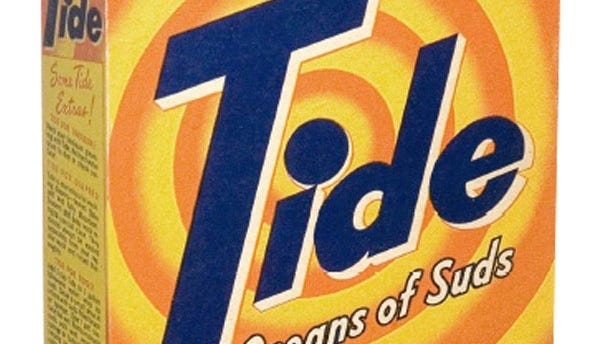
All that changed when P&G introduced Tide in 1946 with a more effective cleaning formula. Dubbed “Project X,” Tide was developed by a P&G chemist named David “Dick” Byerly, who spent more than 14 years experimenting with it – more than seven of them after being ordered to abandon his research.
Tide, combined with washing machines that became popular in the post-war era, meant “laundry day” for millions of women was no longer a full day of scrubbing clothes on washboards. Marketed as the “Wash Day Miracle,” Tide was the No. 1 detergent in the U.S. within three years of its release.
More icons introduced
After Tide, a wave of innovation led to a raft of new products that would become household names, including:
- Crest, the first fluoride toothpaste that effectively prevented cavities, introduced in 1955.
- Pampers, disposable diapers that were both affordable and effective, launched in 1961.
- Head & Shoulders dandruff shampoo, also debuted in 1961.
- An upgraded toilet paper, marketed under the Charmin brand acquired in the 1950s, launched in 1965.
- Bounty paper towels, also introduced in 1965.
- Always feminine pads, launched in 1983.
- The Swiffer duster, first hit the market in 1999.
Now well into the 21st century, P&G continues to innovate, having introduced Crest White strips that whiten tooth enamel and unit-dose Tide pods for laundry, as well as several upgrades to its acquired Gillette razors and platforms that permit closer and more comfortable shaves.
How the list was chosen
The Iconic Brands 50 identifies American companies that most profoundly shaped the nation’s identity, economy and culture. Selection emphasized historical significance, industry-building innovation, measurable economic influence and lasting cultural impact. Brands were chosen for transforming daily life or becoming enduring symbols of American values. Long-term relevance and sustained national influence carried greater weight than short-term financial performance or recent popularity.