
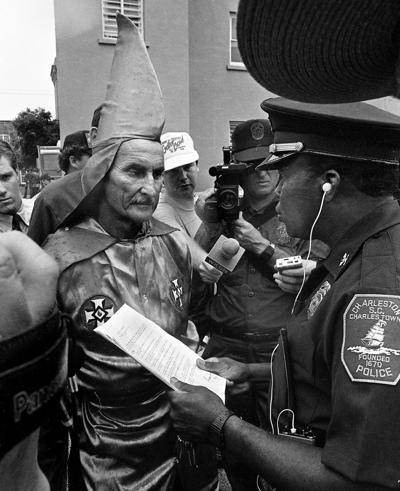
In 1987, Charleston Police Chief Reuben Greenberg allowed the Ku Klux Klan to parade through Charleston, but insisted he lead them. So the white supremacists marched down Meeting Street forced to look at a black, Jewish man and a horse's rear end.
File/Stephanie Harvin/StaffWhen the State Museum pulls a KKK pamphlet from an exhibit, there’s usually only one salient question:
OK, was the person who complained a left-wing snowflake or a right-wing snowflake?
Honestly, these days it could be either, because everyone is … Just. So. Sensitive.
As The Post and Courier’s Nick Reynolds reported, the State Museum in Columbia recently, and clumsily, removed a 1956 Ku Klux Klan brochure from an exhibit recounting South Carolina history as part of its celebration of America’s 250th anniversary.
First things first: It’s entirely justifiable that the museum — which is great, by the way — uses KKK artifacts in an exhibit about South Carolina history. Those bedsheet boys played a significant, and nefarious, role in our state for a century or so.
It’s also not unreasonable for the museum to move, or remove, this one specific thing. That isn’t necessarily censorship. Context matters, and trust me, there’s no shortage of material.
Of course, we shouldn’t edit or obfuscate history simply to placate anyone’s feelings or political beliefs … you know, like some folks pretty regularly try to do with public school history lessons. Doesn’t mean that’s the case here.
Museum officials told our reporter the pamphlet was taken down to give visitors “a clearer and more historically accurate” depiction of the state during the Civil Rights era. Which is a diplomatic way of saying that someone called them out for hanging the pamphlet right next to a photo and quote from Strom Thurmond.
Ouch.
Anyone who knows 20th century S.C. history recognizes the museum had a thematic display. Thurmond and the Klan were both major storylines in the 1940s and '50s civil rights era.
The Klan was operating in South Carolina by the late 1860s. These were yahoos — yes, some of them former Confederates — determined to stop black people from having basic rights. They were only slightly less violent than the Red Shirts, a similar group with ties to two of the state's biggest 19th century politicians, Wade Hampton and Ben Tillman.
The Red Shirts faded, but the Klan came and went. It had a resurgence in the 1940s, when black people demanded their right to vote in Democratic primaries. For good reason.
See, Democrats then were what the Republican Party is now — a monopoly. If you didn’t vote in their primary, you had no say in elections. And, like today’s GOP, those Dems didn't want people they didn't like voting in their primaries.
After Charleston U.S. District Judge Waties Waring outlawed the closed primary nonsense, the Klan went after him ... and black people. And when Waring later orchestrated the U.S. Supreme Court decision Brown v. Board of Education, integrating schools, the Klan really went bonkers.
The pamphlet is an artifact of those days.
Thurmond has connections to that, but like everything about him, it's complicated. As governor in the late 1940s, Thurmond actually fought the Klan and tried to convict the folks behind an Upstate lynching, who were at least Klan sympathizers. The NAACP even honored him for those efforts.
But when the voting thing became a big issue (like immigration today), Thurmond used it to propel himself into the 1948 presidential race. He beat the drum for segregation, like the Klan, but never actually embraced the boys in the hoods.
All this is more complicated than white people knew then, because Thurmond also had a black daughter (which is waaay more complicated than we can get into). Strom once told her to ignore his public rhetoric; it meant nothing, he just had to “represent the views of the voters.”
Which is how modern politicians privately dismiss their public support for some of today's lunacy. History, as they say, repeats itself.
That brings us back to this museum hoopla. Too often today, people across the spectrum have different motives for wanting to sanitize history. The left wants to judge the past by today's standards; the right wants to hide our less-than-flattering hijinks.
Neither is right, but the bottom line is you don't ignore it. As North Charleston state Rep. JA Moore told our reporter: “We can try to pretend that these evils did not happen. It doesn't change the fact that they do.”
“Do” as in present tense. Because history repeats itself still, and ignoring the past increases the likelihood of that repetition. So, this is — as the kids say — a teachable moment. Don't censor history, but do provide the context to make sure everyone gets the full picture.
Because, truth is: History doesn’t care what anyone thinks. It is what it is. The quicker we recognize that, the better chance we have of not repeating all the bad parts.
Brian Hicks is The Post and Courier's metro columnist. Reach him at
