
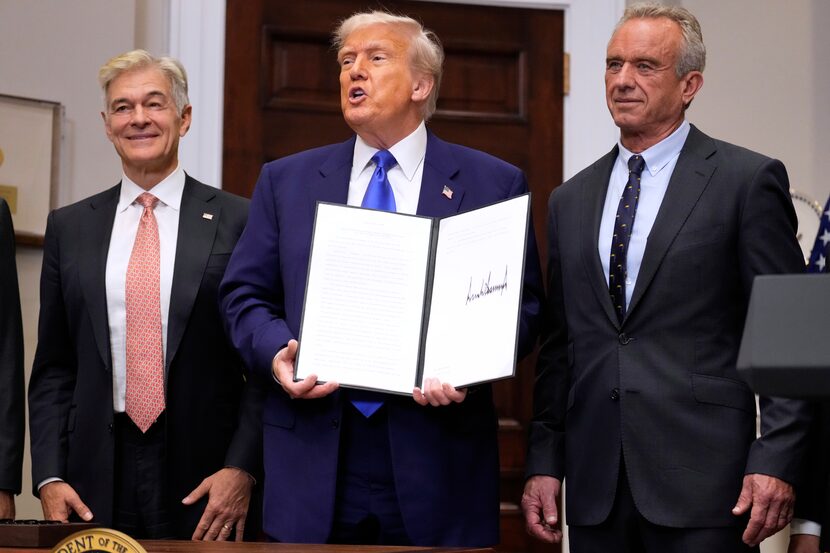
Recently, the White House issued an executive order that could eventually tie U.S. drug prices to the artificially low, government-dictated prices in other countries. Some of my former colleagues in Congress are already pushing to codify this approach into law.
That would be a serious mistake.
Those countries’ socialized health care systems achieve their lower prices, in large part, by negotiating prices which results in routinely delaying or denying access to new therapies. Older adults, people with disabilities, and patients with complex or rare conditions often lack access to lifesaving medicines in those systems.
Adopting other countries’ prices would mean far fewer medical advances, and ultimately lead to the same access restrictions that patients face abroad.
Importing foreign price controls mirrors the approach taken in the Inflation Reduction Act, which allowed government bureaucrats to allow Medicare to negotiate prices of certain medicines but left intact everything patients hate about their health insurance: high copays, coverage denials, narrow formularies, and endless prior authorization red tape. To say nothing of the expansion of the size and cost of government.
Worse yet there is nothing to fix the real drivers of high out-of-pocket costs. Each year, pharmacy benefit managers and large insurers collect around $170 billion in fees and rebates, meaning close to half of every dollar spent on drugs goes to companies that don’t make medicines, according to an industry report.
Meanwhile, the federal 340B program allows hospitals to purchase drugs at steep discounts and then mark them up by 500% or more. Originally designed to help a few dozen safety-net hospitals, 340B has morphed into a money printer for some of the country’s wealthiest hospital systems. It has fueled hospital consolidation and the resulting higher prices while doing little to reduce patients’ out-of-pocket costs.
If lawmakers are serious about lowering prices, they should start by reining in middlemen and tightening accountability in the 340B program, not importing price caps from countries where patients often can’t get the newest therapies. Redirecting those hundreds of billions back to patients would do far more to close the gap between U.S. and foreign drug prices without putting future cures at risk.
Codifying the proposal into law would also threaten one of America’s most economically vital sectors. Since President Donald Trump took office in January, pharmaceutical companies have announced more than $200 billion in new U.S. investments. That money funds research, expands manufacturing, and creates high-paying jobs. Imposing foreign price caps on cutting-edge medicines puts those investments and the ecosystem that supports them in jeopardy.
At the same time, China is aggressively scaling its pharmaceutical industry. With one of the world’s fastest-growing drug pipelines, many experts expect it to overtake the United States by the end of the decade. Undermining American innovators while China supports its own is a strategic error we cannot afford.
During my time in Congress, I supported policies that expanded access and lowered costs without abandoning market-based principles. In 2023, I co-sponsored the Protecting Patient Access to Cancer and Complex Therapies Act to address coverage problems created by Democrats’ Inflation Reduction Act. I also warned that the act’s price controls would discourage drug development and delay innovation.
Those warnings are already playing out. At least 24 promising drug candidates have been pulled from development due to the Inflation Reduction Act. According to University of Chicago research, the law could result in 135 fewer new therapies over the next 15 years.
It’s true that other countries aren’t paying their fair share for American innovation, and that U.S. taxpayers are effectively subsidizing government-run health systems overseas. But the solution isn’t to copy their policies. It’s to press for better trade terms and demand our allies contribute more, just as we have done with military spending and other global priorities.
We can reduce costs and preserve access. But locking in a flawed, foreign-style pricing model is the wrong path for American patients.
Michael Burgess, an obstetrician-gynecologist, represented Texas’ 26th Congressional District from 2003 to 2025.
Submit a letter to the editor
We welcome your thoughts in a letter to the editor. See the guidelines and submit your letter here.
If you have problems with the form, you can submit via email at