
OPINION
Cathy Young is a writer for The Bulwark.
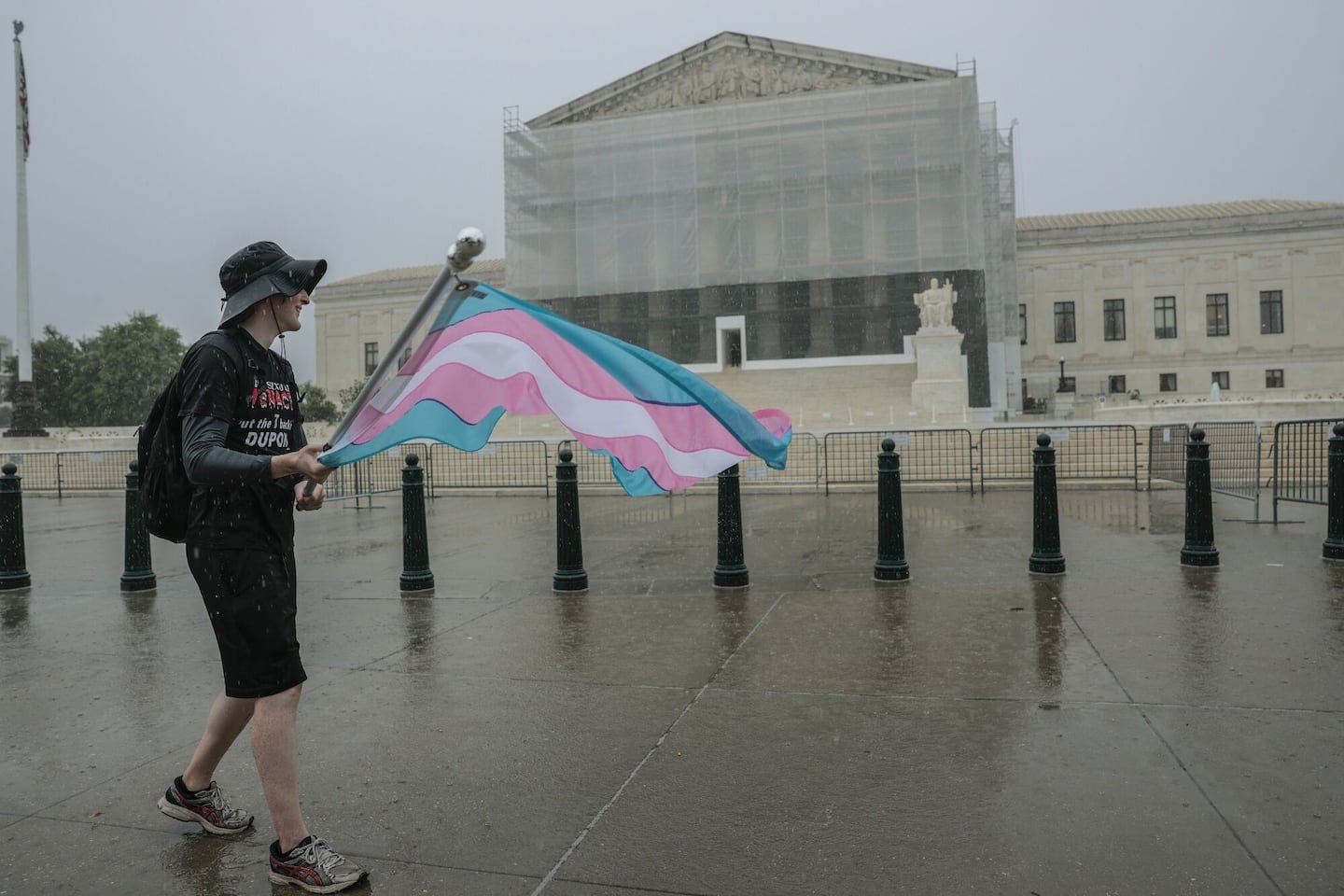
The recent Supreme Court ruling in United States v. Skrmetti, in which a 6-3 majority upheld a Tennessee law banning hormones and puberty blockers for minors seeking gender transition, is the latest development in the ongoing battle over transgender rights. Where some see a terrifying backlash against civil rights for a vulnerable population, others see a pushback against a misguided and dangerous attempt at a social revolution.
The tensions are especially high given the political polarization in America in 2025 — and the growing authoritarianism on the right, where the Republican Party under the leadership of President Trump has both harnessed and driven the opposition to transgender advocacy. But as polls suggest, the majority of Americans — on this as on many other social issues — would much rather find a middle ground between the extremes of either affirming or denying all claims of transgender identity.
While the Supreme Court’s ruling has been denounced as an assault on civil rights, it is broadly aligned with the opinions of the majority of the American public. A New York Times/Ipsos poll in January found that 71 percent of Americans said that no one under 18 should have access to transgender care, which includes puberty-blocking drugs or hormone therapy. Despite partisan differences, a majority in every group — 90 percent of Republicans, 54 percent of Democrats, and 61 percent of independents — agreed with that statement.
Advertisement
For many people, it’s simply common sense that children too young to vote should not be allowed to make a life-altering medical decision based on what may be a phase or a childhood fantasy. Others feel just as strongly that kids who say they are transgender know exactly who they are.
Advertisement
The reality is, as often happens, more complicated. Severe and persistent childhood gender dysphoria does exist; even some critics of pediatric gender medicine, such as science journalist Jesse Singal, have acknowledged that underage transition has benefited some patients. But there is also evidence that some gender-distressed children who do not get affirming medical care eventually revert to a sex-congruent identity, while some who transition later regret it. (Last December, a “detransitioned” former patient sued a leading youth gender medicine practitioner, Dr. Johanna Olson-Kennedy — whose Los Angeles clinic is about to close due to financial and legal pressures from the Trump administration — over an allegedly rushed transition that included a double mastectomy at age 14.) Meanwhile, a number of pediatric gender care specialists have echoed concerns about inadequate counseling and safeguards. And the frequently made claim that pediatric gender medicine prevents teen suicide has been acknowledged as baseless by the activist attorney who argued against the Tennessee ban in Skrmetti before the Supreme Court.
Youth gender medicine is just one aspect of a larger controversy over what some regard as activist overreach — and sometimes, reckless government policy — on transgender issues. This view doesn’t always align with political or social conservatism.
Advertisement
While gender transitions in the United States began in the 1950s and gained growing acceptance in the 1970s, ’80s, and ’90s, the transgender activism that emerged about 10 years ago pushed for new and dramatic social changes. Activists argued that self-identification should be enough for legal recognition of gender identity, with no medical certification and often with no medical procedures; that position was effectively endorsed by the Biden administration in 2021 via a series of orders that required prisons, schools, and various government agencies to treat gender identity as equivalent to sex.
Claims that the “gender binary” — the division of humanity into male and female — was an artificial, oppressive construct trickled down from academic discourse to far broader left-of-center circles, with such concepts as “sex assigned at birth” becoming common even in the mainstream media. “Nonbinary” identities beyond male and female proliferated. Universities and some corporations tried to normalize the exchange of pronouns as part of introductions (in 2019, then-presidential candidate Kamala Harris once introduced herself with “she/her” pronouns at a town hall meeting). Efforts at inclusiveness resulted in awkward phrasings like “pregnant people” and even “menstruators.”
All these changes moved forward with little if any mainstream debate. Those who argued for protecting single-sex female spaces or opposed the participation of biologically male athletes in women’s and girls’ sports were routinely accused of bigotry — including people with strong progressive credentials like author J.K. Rowling and pioneering lesbian athlete Martina Navratilova. Psychologists were sidelined if they warned that transgender identification among teenagers, which had risen dramatically, often seemed linked to peer influence as well as mental health conditions or developmental disorders unrelated to gender, such as autism or depression.
Advertisement
Fear of questioning advocacy narratives caused sloppy journalism: Thus, a 2022 incident at a Los Angeles spa involving a complaint about a naked male in the women-only nude sauna was roundly derided as a “transphobic hoax” until the individual, a registered sex offender, was charged with indecent exposure. (Media coverage subsequently acknowledged recurring problems at local spas with anatomically unaltered male customers using female-only nude facilities — as state law allows if they are legally recognized as women.)
The result is a widespread sense that the transgender rights movement, enabled by various institutions, has gone off the rails — with effects that range from relatively trivial (the erasure of women from language about pregnancy) to clearly damaging (a transgender prisoner housed in a women’s facility impregnating two inmates). “This is crazy” is not a bigoted reaction.
Yet the backlash, emboldened by the movement’s setbacks, has its own excesses. Alongside people with legitimate concerns, there are anti-trans advocates: right-wingers who see any deviation from traditional sexual norms as degenerate, or radical feminists who associate biological maleness with entrenched evil. Alongside thoughtful critiques of transgender advocacy, there are efforts to undo the level of legal and social trans acceptance that existed 30 or even 40 years ago and calls for a ban on medical transition at any age. There are claims that transgender identity should always be regarded as either mental illness or sexual fetishism and assertions that “trangenderism must be eliminated from public life entirely.” The hostility extends to accommodations for transgender women and men who present (and “pass”) as the sex they identify with. Even outspoken critics of trans advocacy extremism have been viciously attacked from anti-trans quarters — some for being transgender, such as Massachusetts video game developer and Democratic political activist Brianna Wu, and some merely for using transgender people’s preferred pronouns, such as science journalist Benjamin Ryan.
Advertisement
These illiberal and cruel attitudes are reflected in some of Trump’s executive orders — ones that, for instance, interpret transgender identity as a form of deception.
Blanket bans on transgender youth care of the kind that has been upheld in Tennessee may also be too extreme. But it is important to recognize that such bans are in part a response to shoddy practices and shoddy science (as documented in “The Protocol,” a recent podcast series by The New York Times). They also reflect an international trend: Many European countries now ban or severely restrict medical gender care for minors, while sometimes — unlike the Tennessee ban — allowing such treatments in clinical trials.
A course correction should be based on common sense, solid facts, and respect — respect for the humanity of transgender people but also for people who dissent from various aspects of transgender-advocacy dogma. That’s extremely difficult to achieve in a toxically polarized political environment. Open and civil dialogue is a place to start.
Advertisement