
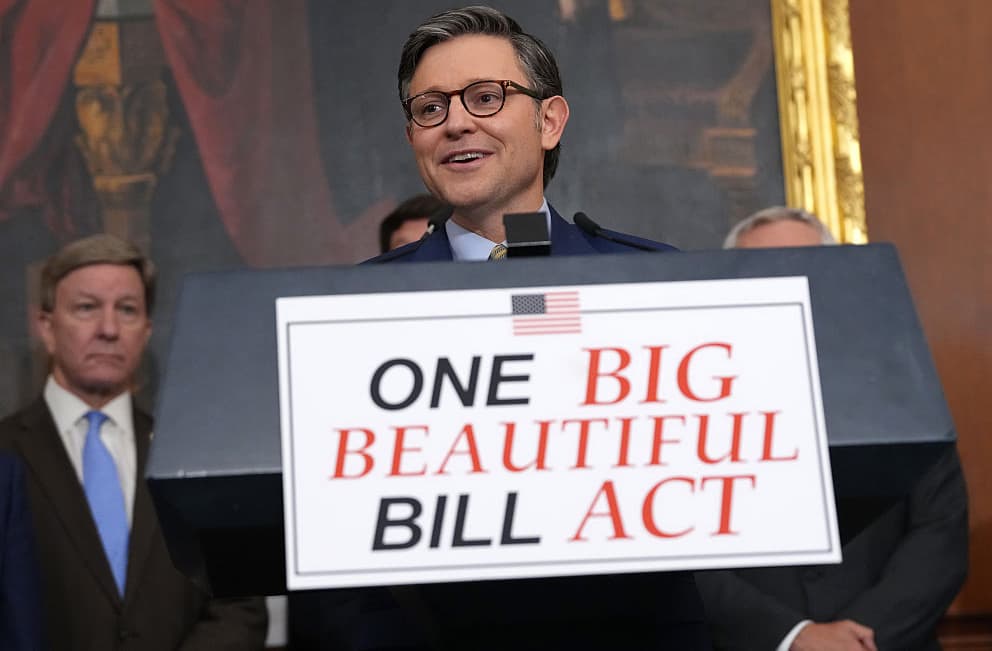
The article discusses the proposed One Big Beautiful Bill Act, highlighting its significance for small businesses through expanded tax policies and incentives. The bill aims to promote economic growth, support business reinvestment, and build on the successes of previous tax reforms like the 2017 Tax Cuts and Jobs Act. Examples include extending the small business deduction, restoring R&D expensing, and easing estate taxes on family businesses. Experts believe these measures will lead to increased investments, higher wages, and job creation nationwide.
One Big Beautiful Bill Act is a win for America's small businesses
Small businesses make up 99.9% of all American businesses, but they are too often ignored in Washington, and the debate around the One Big Beautiful Bill Act is no exception. While there has been discussion about the bill’s price tag and spending cuts, less attention has been paid to how the bill’s tax policies will help small businesses.
Small businesses across the country, including the wholesaler-distributors and equipment manufacturers that we represent, have been hit by high prices and economic uncertainty and are in desperate need of policies that will help them grow. The “big, beautiful bill” achieves exactly that by enacting numerous tax policies to help businesses reinvest in their workforce, expand their operations, and grow the economy.
Key Tax Policies Supporting Small Businesses
For instance, the legislation makes the 199A small business deduction permanent and expands it to 20%. This will provide relief and certainty to over 25 million businesses, according to IRS data. Since it was first enacted in 2017, the deduction has helped support 2.6 million jobs, $161 billion in annual employee compensation, and $325 billion in GDP, based on research by EY.
The legislation also includes key provisions that will help small businesses invest, such as the restoration of immediate expensing for research and development costs and a 100% bonus depreciation for investing in new equipment. Restoring R&D expensing — a policy that existed for 70 years until it expired in 2022 — will help businesses innovate, adopt the next generation of technologies, and stay competitive. Similarly, 100% bonus depreciation will help businesses invest in new equipment and machinery by allowing them to deduct these costs immediately, rather than depreciate them over many years.
In addition, the One Big Beautiful Bill Act expands and makes permanent the estate tax exemption, providing relief for family-owned businesses. Currently, family-owned businesses must pay the 40% death tax every time they pass the business down from one generation to the next. These businesses are often asset-rich but cash-poor. Instead of taking out loans, liquidating existing assets, or deferring new investments in technology or equipment, this bill would enable more family-owned businesses to invest more in themselves.
Economic Impact and Examples
There is clear evidence that these policies and other tax cuts will help workers and small businesses across the country. According to a report by the Council of Economic Advisers, over the next four years, the bill will increase long-run GDP by as much as 4.9% and raise annual real wages by as much as $7,200 per worker, or $10,900 for a family with two children.
This will build on the success of the 2017 Tax Cuts and Jobs Act, which helped create the strongest economy in modern history. Thanks to these tax cuts, the unemployment rate hit 3.5% in 2019, a 50-year low, while real median household income increased by $4,400 in 2019, or nearly 7%.
As a direct result of the TCJA, small businesses could expand or invest in new factories and warehouses, hire new workers, increase pay for existing employees, and offer new career development and benefit programs for the workforce.
Business Examples
In Salisbury, North Carolina, Power Curbers invested in R&D to develop a new highway paving machine, thanks to the tax incentives from the TCJA. Without these incentives, the machine would not exist today.
Forward Look
If history is any indication, enacting pro-growth, pro-small business tax policies in the One Big Beautiful Bill Act will allow businesses to make even more investments that support workers and the economy. With the passage of the big, beautiful bill, lawmakers will demonstrate their commitment to helping America’s small businesses thrive and to helping the economy grow.
Kip Eideberg is the senior vice president of government and industry relations for the Association of Equipment Manufacturers. Alex Hendrie is the senior vice president of government relations at the National Association of Wholesalers-Distributors.