
Find this story in your account’s ‘Saved for Later’ section.
Photo: Jack Califano

Photo: Jack Califano
Photo: Jack Califano
It’s a few hours before polls close in Michigan, and Rebecca Katz is alone in front of the stage at the Majestic Theatre in Midtown Detroit, pacing. Her candidate, Abdul El-Sayed, is scheduled to have his Election Night party here, and over the last week of the race, his campaign has expressed extreme outward confidence. Polls show him likely to win in a blowout against Representative Haley Stevens in the Democratic primary for Michigan’s open U.S. Senate seat. The expectation is a short night and a victory speech early in the evening.
But Katz looks miserable, hunched over her phone, twitching, texting reporters and campaign staff, trying to keep an even keel as press file into the auditorium. Michigan is one of the last contested primaries of the year, one of the final places for the left wing of the Democratic Party to stake its claim. Control of the Senate next year, as well as greater checks on Donald Trump’s powers, could hang in the balance. And El-Sayed’s numbers are not looking great. Katz knows if things hold and he does not win easily, with a broad coalition, the party’s trust in his ability to win the November general election will be shaken.
The child of Egyptian immigrants, El-Sayed has campaigned for the Senate on his support for Medicare for All, abolishing ICE, and ending military aid to Israel. If elected in November, he has suggested he would not support Senator Chuck Schumer’s bid for Democratic leader of the body. The idea that El-Sayed could win the nomination would have been laughable a few years ago — when he ran for governor in 2018, he lost in the Democratic primary by 22 points.
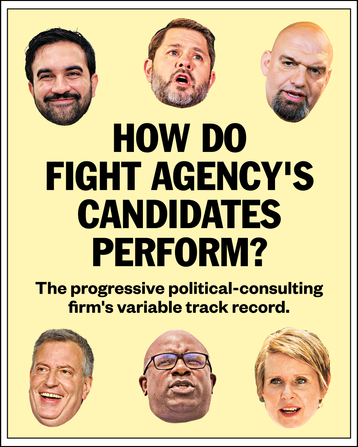
Schumer and most of the rest of the Democratic Establishment lined up against him, as they have against Katz’s clients throughout her career: Graham Platner, the upstart progressive from Maine who chased a governor out of the Senate race; Jamaal Bowman, a former Bronx principal who defeated a 16-term incumbent congressman; Senator John Fetterman, the Hells Angels look-alike whom elected Democrats disregarded; and even Mayor Zohran Mamdani, who did not receive the endorsement of party leaders until well after he had secured the Democratic nomination.
In all of those cases, Katz’s candidates won, and she provided crucial strategic advice. However, while there have been a lot of victories, there have also been a number of high-profile disasters. Fetterman has become the Democrats’ No. 1 troll, a Fox News regular who has distanced himself from the party. Bowman lost his reelection bid after a series of blunders, which included pulling a fire alarm during a vote in the House of Representatives. Accusations of sexual assault against Platner, which he denies, have put the Democrats’ hopes of taking the Senate in jeopardy.
El-Sayed is running in Michigan, a traditional home of the working-class, lunch-bucket Democrat and a state President Trump has won twice. It is close to mandatory for Democrats to succeed here. In the Majestic Theatre, no one — especially not Katz — needs to be reminded that there is a lot riding on her unorthodox ideas about who can win a big election in a purple Rust Belt state.
Ever since the Platner implosion, Katz has laid out to me her theory of politics, why it is not crazy to bet on El-Sayed — in fact, why it would be wrong to do the opposite and assume an Establishment candidate could win. She has done it over the course of weeks in near-daily phone calls and texts. Between arguments about why her formula would help Democrats win, she would also make a case for why I shouldn’t write an article about her. When we meet in her office in a tower in Downtown Brooklyn overlooking the Manhattan skyline, the pattern continues. I take out my phone and laptop; she says, “I am not sure I am agreeing to this.” And then Katz proceeds to talk for the next three hours. Often, she interrupts herself to ask who else I was talking to and what they were saying; she asks what the story would really be about. “How about the tension in my own soul?” she suggests, half in jest.
But the reason I am talking to Katz is obvious. Fight Agency, the political-consulting firm she co-founded a little over a year and a half ago with veteran ad makers Tommy McDonald and Julian Mulvey — later bringing in, among others, the 27-year-old wunderkind of left-wing politics, Morris Katz (no relation) — seems to have unlocked a secret for unlikely victories in American politics. For the midterms, the agency has orchestrated the campaigns of underdog and outsider candidates who have won key Democratic Party primaries. Fight’s victories have left the Establishment in a funny position. Despite many of them inveighing against her candidates for months, Democrats now need Katz’s theory of the electorate to work to win back Congress.
Some in the Establishment worry it is a foolish bet on novices aligned with an insurgency from the Democratic Socialists of America. Fight’s roster represents the left edge of the possible in American politics. The candidates chosen are in many cases making their first run for political office. Before the campaign, Platner was an oysterman who had served in the military; El-Sayed was a county public-health official; Dan Osborn, another Fight client mounting a second independent candidacy for a Senate seat in Nebraska, was a mechanic. Bob Brooks, a Fight client hoping to flip a congressional seat in Pennsylvania, was head of a firefighters union. In her work, Katz is explicitly looking for normal people who come from normal backgrounds, not carefully groomed career politicians. “The era of the perfect candidate is over,” she says, repeating a line she often uses when pitching her work. “You’re not looking for a candidate with perfect hair and a perfect life.”
The idea is a direct challenge to strategic orthodoxy in American politics. The way running a campaign is usually understood is that you need to convince some portion of the people who voted for the other party last time to vote for you this time. It’s why Democratic leaders have been optimistic heading into the midterms; as the president’s approval rating sags, Democrats just need some regretful Trump voters to flip. So party leadership has tried to recruit candidates who reassure persuadable Republicans — candidates who aren’t too woke, too left, too radical. Candidates who make people feel they can safely vote for a Democrat and it won’t mean prisons will be abolished, borders eliminated, or the internal-combustion engine outlawed.
Fight’s operating theory is sometimes described as the belief that the true path to victory lies in left-wing populism. But the fact that these candidates are all on the left is, Katz tells me, not her focus. She is far from a wild-eyed socialist or a fire-breathing revolutionary, despite having spent almost a decade and a half pulling the party in a more progressive direction. Katz says her choices are instead based on a belief that Democrats keep getting in their own way by nominating milquetoast candidates who play in the familiar battle lines of partisan politics.
“It’s harder to get candidates who are more in touch with their communities out of primaries,” Katz told Campaigns & Elections, a magazine that covers the political-consulting industry. But “those candidates are out there. They might just not have people who take a serious look at them.” Katz’s unique skill is finding and presenting these candidates to the public. “This is Rebecca’s superpower,” says one rival political operative. “Her ability to brand candidates and create a story around them and a protective marketing bubble and myth and mythology is unmatched.”
Katz’s critics view this “superpower” differently. They say Fight is undermining the work of national Democrats and local parties. “I am not saying these people aren’t smart, but they are playing this political game backward. It is the candidate’s job to find the consultant and not the consultant’s job to find the candidate,” says Jim Kessler, the executive vice-president of policy at Third Way, which supports moderates in the Democratic Party. “You take someone like Platner, and here is this person who looks like he is lifted from central casting, who is handsome and charismatic and articulate, who seems unafraid and who farms oysters, and to the consultants who pluck him out, he is perfect. But it’s just a con.”
Katz thinks such D.C.-brained complaints miss what is actually happening out in the electorate. “The leaders of our party don’t recognize their own toxicity and that there are many different stories to be told and many different kinds of candidates,” she says in her office. “I bet you that Chuck Schumer thinks that Zohran Mamdani is more toxic to the Democratic brand than he is. That is the problem.”
-
-
-
-
-
-
-
-
-
-
-
Photographs by Getty Images


The stereotype of a top political operative is a hard-drinking, fast-living man with mercenary instincts and expensive habits. Katz is the opposite. She is a ball of New York neurosis and chaotic energy whose self-appointed task is saving the Democratic Party from itself. With her, there is no sipping of bourbon or talking about shadowy deals. She is a Brooklyn parent, and when we talk, it is easy to pick up the sounds of her making dinner or shuffling her two teenage boys out the door.
Katz’s first major job on the Hill was with Harry Reid Jr., the pugnacious but soft-spoken majority leader of the Senate. She had grown up in Philadelphia, the child of a social worker and a professor, one of the few white kids in her kindergarten class, and graduated from Central High School, among the city’s elite public high schools. Before her time with Reid, she had worked a job with John Edwards’s presidential campaign, then ran communications in the Pennsylvania operation for an outside spending effort trying to elect John Kerry president.
After the Republicans’ success in Swift-boating Kerry, Reid was determined to find a way for Democrats to go on offense. He acted on Hillary Clinton’s suggestion to create a “war room,” a centralized hub that could push back on Republicans’ attacks. The person he originally hired, Katz says, abruptly quit just before his start date. Katz — broke and directionless after Kerry’s loss — got the job instead.
Reid was a mentor and surprisingly understanding as a boss. Katz is dyslexic and suffers from an undiagnosed attention deficit disorder. One day, she was sitting by Reid with a list of phone numbers from Nevada radio stations he was supposed to call for a series of brief interviews. Katz kept telling him the wrong phone numbers until Reid finally asked, “Do you have a learning disability?” She nodded “yes,” afraid she would be fired. Instead, Reid responded, barely above a whisper, “Well, you must have had to work twice as hard to get where you are.”
“I loved him forever after that,” Katz says.
While her disabilities made working through a call sheet harder, an inability to focus on any one thing for very long has served Katz well as a campaign consultant. She doesn’t read The New Yorker. The Sunday Times arrives with a thump to her doorstep but goes untouched. Books on politics, even ones where she is mentioned, are unopened, and podcasts are too long and boring. Instead, Katz gets her news the way she thinks most voters do, scanning X and TikTok all day, figuring anything worth seeing will show up in her feed.
“She has an acute sense of where the news cycle is at any given moment,” says Lauren Hitt, a former spokesperson for Kamala Harris’s presidential campaign who has worked on several races alongside Katz. “It is very much driven by an idea that it is a waste of time to walk into the day with the same plan you had yesterday. She is comfortable in chaos.”
The close attention to vibes online helps Katz figure out the trajectory of campaigns quickly. In the most recent California gubernatorial primary, she was working for Tom Steyer, the billionaire former hedge-funder, a client who led some of Katz’s detractors in the political-consulting business to claim hypocrisy; Katz told me Steyer convinced her he was the most progressive candidate in the race. After Eric Swalwell dropped out, Steyer briefly looked like the front-runner. But Katz saw the eventual Democratic nominee, Xavier Becerra, gaining steam online before polls and conventional wisdom caught up. She got the campaign to focus on him, an operative who worked on the race tells me. Steyer still lost.
The operative says Katz’s advice helped but there were limits to her formula. “Everyone out here thought Steyer was going to win,” another operative tells me. “But you can’t just show up in California and run a Mamdani-style campaign and call yourself a Bernie Sanders kind of billionaire and expect to win. It was style over substance, and people didn’t buy it.” Katz will soon have another shot in California: Fight has been hired to help DSA member Nithya Raman in her upstart campaign for mayor of Los Angeles.
After a couple of years working for Reid, Katz began to tire of life among Democratic senators. It was a job that consisted mostly of men jostling for attention. She made her way to New York and moved in with her fiancé (now husband), James Katz, whom she’d met on the Edwards campaign. Soon after, she started working with Bill de Blasio, who eventually put together a run for City Hall.
The de Blasio approach set the template for future Katz campaigns: He announced weeks before everyone and ran as an unapologetic progressive. Katz candidates are now known for entering before others, catching the supposed front-runners by surprise, and moving with aggression. The seminal moment of that campaign, Katz says, is when de Blasio spoke at the Association for a Better New York breakfast and told attendees, including some of the city’s elite, that he would raise taxes on the wealthy to help pay for universal pre-K.
But Katz quickly grew disillusioned with de Blasio’s imperiousness, serving only 15 months in his administration. In 2015, she traveled to Braddock, Pennsylvania. A struggling town trying to refashion itself as a haven for artists priced out of New York, Braddock had a six-foot-eight, 300-pound, heavily tattooed mayor who supported Bernie Sanders for president and was contemplating a run for the U.S. Senate. The party was lined up behind Katie McGinty, a former environmental regulator turned lobbyist, to face off against Republican incumbent Pat Toomey in the 2016 general election. But Fetterman seemed to be able to generate real enthusiasm. There were standing-room crowds and hundreds of thousands in small-dollar donations. Katz took him on.
It was hard to convince others to see Fetterman’s potential. Katz accompanied him to Washington, D.C., where officials from the Democratic-campaign Establishment made clear how little they thought of the mayor. “‘We hear you want to legalize heroin,’ they said, and he said, ‘No, you know, I just think that we have a drug crisis in America. I see it in my community, and I think we have to rethink drug policy,’” Katz recalls.
As the race went on, the Democratic Party rallied behind McGinty, including the sitting governor. Former president Barack Obama cut a radio ad for her. Even Sanders didn’t support Fetterman. But Katz, who had a growing rolodex of national political reporters, made her candidate into a brand by steering the media to Braddock to get a look at Fetterman. She framed him as an outsider antidote to the problems of politics.
Fetterman was a graduate of Harvard’s John F. Kennedy School of Government, the son of a successful businessman, and supported by his family well into adulthood. But few of those facts made it into the stories beyond a passing mention. Fetterman was instantly recognizable as something more in line with the needs of the media: a man of forgotten America with a lefty’s heart of gold.
In the 2016 Senate primary, Fetterman would come in a distant third place, but he had established himself in the national consciousness. Six months later, McGinty would lose the general election to Toomey, helping the GOP keep a narrow majority in the Senate.
After Fetterman fizzled out, Katz found herself back in New York, adrift. Trump was president, and, as she saw it, Democrats were too quickly moving on from what happened in 2016, too ready to believe Trump was a fluke. “Democrats lost their way when they stopped being curious about what voters were saying,” she tells me. “They asked no questions about why Hillary Clinton lost. There was no audit, nobody questioning if that playbook was the correct playbook. And if we had just taken a beat to look at the war within the party, to look at why people were excited by Bernie in the first place, and figure out where those Bernie voters went in ’20 and ’24, I think we’d all be better off.”
Young voters, radicalized by Trump’s presidency, were joining the Democratic Socialists of America and forming groups like Justice Democrats, Run for Something, and Sunrise Movement, all of which tried to pull the Democratic Party to the left. Katz was more than a decade older than the senior leadership of these groups but became a mentor to young political operatives, showing them how to deal with the press and how to drive narratives.
“It was like, ‘Oh, you just call these people and paint a story and make it easier for them to write?’” recalls one person who worked with her then. “None of us had any rolodex or relationships, and she came in with this sense that you needed conflict to drive a story further.”
In 2018, Katz became a primary strategist behind the actor Cynthia Nixon’s quixotic run for governor against Andrew Cuomo. The campaign is mostly remembered for how Katz turned something that would typically be hashed in closed-door negotiations — the room temperature for their debate — into a national story that spawned think pieces. (“Can a Room Temperature Be Sexist?” read one headline.) “Ninety percent of the reason I ran was that nobody else would run because everybody was so scared of Cuomo,” Nixon tells me. “And it was very hard to get people, particularly people of her caliber, to work on the campaign because everybody was running scared — and she wasn’t even scared a little bit.”
Katz did worry about her business prospects after taking on the notoriously vindictive Cuomo. But she was also growing more distant from the Establishment and could not hide her frustration. In 2019, the national Democratic Party’s congressional-campaign arm announced that any consulting firm that worked with someone challenging an incumbent would be blacklisted. “I just wanted them to be curious about what works in politics and where all this energy was coming from,” she says of party leaders. “And they just wanted to end my career.”
In 2022, Fetterman again ran for the Senate, and the party Establishment, believing him to be a weak general-election candidate, again supported a rival. This time it was Representative Conor Lamb, who, with his square jaw, earnest mien, and military background, looked like the perfect fit to defeat the Republican candidate, the TV personality Mehmet Oz.
But something had shifted between 2016 and 2022. Maybe the party Establishment didn’t have the power it once did. Or maybe Democratic-primary voters had caught up to what Katz had been pushing the previous six years. Fetterman won by more than 20 points.
“My model for that race was really the Obama campaign,” Katz says. “Everybody keeps learning the lessons of Bill Clinton over and over again, but they think it’s about triangulation when it’s really two things: ‘It’s the economy, stupid’ and ‘I feel your pain.’ It was Obama who really showed us how to run a populist campaign, criticizing Mitt Romney for how many houses he has. It’s the kind of thing that’s sticky.”
Fetterman won by five points, despite running in a general election that was supposed to be a difficult environment for Democrats and, more importantly, despite the fact that he had a stroke right before the primary and struggled to speak for much of the race.
Katz was thrilled. She and Fetterman had been friends for nearly a decade, and this was proof her way of doing politics could succeed in a swing state — that Democrats could run nontraditional, pathbreaking candidates who popped on social media and connected with voters in ways the stuffy mainstream could not. Fetterman’s candidacy didn’t doom Democrats, Katz believed; it saved them from almost certain defeat. After the win, Katz bought her own ticket to a fundraiser for Bob Casey, the other Pennsylvania Democratic senator, who was gearing up for his own challenging reelection campaign. There, she buttonholed him on the work she and some of her colleagues had done for Fetterman and tried to pitch him on the same approach.
“I said, ‘This is going to be a hard race, and I think you need to punch him in the fucking face,’” Katz recalls. The genteel Casey, the scion of a Pennsylvania Democratic dynasty, demurred. “And he was like, ‘Oh, that’s so kind of you.’ He was so polite. And I said we could put together, like, a team and we could go hard. Like, ‘I think you have to go hard against the Republicans.’” Casey declined. He went on to lose.
Instead of another job in Pennsylvania, Katz went to work for Ruben Gallego, a progressive Arizona congressman who was raised by a single mom before deploying to Iraq and eventually making his way to Harvard University. Gallego talked like a regular person, encouraging Democrats to stop using terms like “economic stability” and instead recognize that most voters, especially men, just wanted a job, a place of their own, and “a big-ass truck.” Gallego followed the Katz playbook: He announced early, blitzed the state, and chased the recently independent sitting senator, Kyrsten Sinema, out of the race. He won in 2024 and outperformed Kamala Harris in the state.
Afterward, Katz and some veterans of the Fetterman campaign decided to start their own agency. ARE YOU A FIGHT CANDIDATE? read a rubric the group created when it was first forming. “Can you have a conversation that doesn’t sound like talking points?,” one prompt read. “Can you tell me why you are running for office in one sentence? Do you have a connection to the working class?” If you answered “yes,” then you were ready for Fight. If you answered “yes” to the question “Were you voted most likely to be president in your high-school yearbook?,” Fight would hustle you out the door.
“The idea was to go on offense. We wanted people who weren’t scared of their own shadow all the time,” says Kipp Hebert, a longtime associate of Katz’s. “One thing we always say is that Democrats should stop apologizing for being Democrats. The Republicans are confident in who they are, and their party leaders don’t spend all their time talking about how some of their candidates are liabilities.”
As much as Fight has been painted as the political-consulting firm of the rising left, that is not quite right. Fight is not associated with the DSA, and the agency did not help every candidate associated with the organization this cycle. Katz’s firm, for instance, did not work with Francesca Hong, the legislator and chef who lost a gubernatorial primary in Wisconsin.
Fight’s idea is not to support so-called regular people — regular people don’t run for office; it is to support real people, those who have personality and are confident in who they are. Conventional wisdom in Washington has maintained that the key to Trump’s rise was his willingness to moderate and break from Republican orthodoxy on issues like Medicare and Social Security; Katz and the team at Fight don’t buy it. Trump wins because, as Hebert puts it, “he talks about the elite that you hate while Democrats talk about how we are going to make your life incrementally better in a way that you won’t even notice. Trump is saying ‘Let’s tear the system down,’ and Democrats are saying ‘Let’s make the system better with 100 small ideas’ but not paint a picture of a better future.”
The primaries haven’t always borne out the idea that the Democrats are simply too cautious. In Michigan, the result was far closer than the polls had it. The race was not called, as expected, that night. It took until early the following morning, long after the Majestic had emptied for the evening. El-Sayed eked out a victory by a single percentage point. If those moderate Democrats who voted against El-Sayed in the primary prove unwilling to support him in the general against the relatively centrist Republican Mike Rogers, the race will be hard to win.
And for all the talk of working-class politics, El-Sayed actually did far worse among those voters than Stevens. Likewise, Platner was performing poorly among working-class voters in Maine when he dropped out. “Fight folks have this idea that poor people are closet leftists, and they are just not,” says a former top Democratic official. “The people who come out for them are college-educated people who like the videos they see on social media.”
When Fight began in early 2025, it seemed to have a growing track record in statewide races. It had already helped elect two straight-talking lawmakers from swing states in Fetterman and Gallego. But Bowman had imploded and Fetterman had broken ties with the progressive wing, and in a few months’ time, Morris Katz was traveling to Maine to recruit Platner for his doomed run. It began to look like a pattern: Fight could pick people to win elections in the Trump era — the problem was what happens next.
Rebecca Katz, ever the comms pro, doesn’t much want to talk about what has gone wrong with some of her candidates. She thinks October 7 had something to do with it in two cases — it pushed Fetterman right and Bowman further left while also making the latter less responsive to the concerns of his constituents. “I do think there’s something about the way that campaigns are today,” Katz says. “They are all-encompassing and suffocating, and it comes at you from every angle. And they don’t just go after you; they go after the people you love. And I think it does alter the brain chemistry a little bit.”
The Fetterman case is clearly a wound. She considered him a friend, enjoyed his company, and spent a decade trying to get him to the U.S. Senate. Then he got there and became a different person. In her view, the darkness he had kept at bay seemed to have overtaken him. It nags at her. What if Fetterman switches parties after Democrats take the chamber? Worse, what if he does only after El-Sayed wins just as a way to get back at Katz?
Platner is different. He went through multiple tours in Iraq, and she believes it left a mark. “Fetterman’s life was hard from inside,” she told me. “I think Graham’s life was hard from the outside.” Katz and her team at Fight still stand behind the idea of Platner — at the beginning, he was a good candidate and forced a sitting governor from the race. But, as Katz says, “if he committed sexual assault, he should not be a U.S. senator. It’s as simple as that.”
It’s a dilemma, then, for both Katz and for the Democratic Party. She keeps finding candidates who are exciting to voters. But that formula can lead to blowups and reversals that endanger the broader prospects of the party.
“Our whole theory of the case has been that basically people don’t care if their candidates are broken because they are a little bit broken too,” Katz says as the sun is setting outside her office window. “They don’t care if their candidates are flawed because everyone is flawed, right? You are looking for someone who has been through what you’ve been through and they understand you and they see you. That is the theory.”
“I don’t think I should be responsible for all of my candidates’ worst decisions,” she adds. “I am hired to win races.”
Things you buy through our links may earn Vox Media a commission.

politics
The Hasan Piker Michigan Mess Isn’t Going Away
Once again, Senate hopeful Abdul El-Sayed is facing questions about his associations with the divisive streamer.

tremendous content
Trump’s ‘Lake America’ Threat to Canada Is Just Lazy
Instead of coming up with a creative new way to bully our neighbors, he’s giving Lake Ontario the “Gulf of America” treatment.

the city politic
A Democratic Power Grab in Brooklyn
Rodneyse Bichotte Hermelyn is forging ahead with committee expansion plans despite stiff opposition from reformers and party leaders.

the law
Trump’s Ballroom May Be Built Before the Law Can Stop Him
The president bet that if he acted fast enough, no one would be able to beat him in court before it was too late. He was likely right.

early and often
Hakeem Jeffries Picked a Bad Time to Cozy Up to Jared Kushner
If Jeffries becomes Speaker, talking with President Trump’s son-in-law might make sense. But it can wait until after the midterms.

politics
Trump Wants a Bunker, But the White House Already Has One
A new report reveals that Trump’s security-based argument for his beloved ballroom isn’t exactly airtight.

magalopolis
Who Is Natalie Harp? Trump’s Most Ardent Aide, Explained
Trump’s “human printer” has reportedly unnerved colleagues by sending him devotional letters and crafting his most unhinged Truth Social posts.

politics
Politicians Are Now Competing to Prove Who Hates Data Centers the Most
As voters’ opposition to data centers continues to grow, midterm candidates on both sides of the aisle are desperate to keep up.

just asking questions
The Enormous Stakes of the Federal Case Against Meta
A novel legal argument could wreak havoc on the company — but it may contain a fatal flaw.

sports
The Pay-to-Play Childhood
Private travel leagues have made youth sports expensive, hypercompetitive, and all-consuming for families. At least investors are making a killing.

early and often
Bill Clinton’s Party Needs a ‘Different Kind of Democrat’ Again
The 42nd president’s legacy has diminished, and many of his policies now seem misguided. But his revival of the party holds lessons for 2028.

instant gratification
I Can’t Stop Watching This Amazon Drone Drop Someone’s Package in Their Pool
Are incredibly loud flying wind machines that dump our impulse buys into our swimming pools really the future we want?

early and often
Despite Primary Whiffs, Poll Haters Are Still Wrong
Yes, there have been some misfires in 2026 primary polling. But ignoring data isn’t the solution.

politics
Supreme Court Gives Trump Temporary Pass for His Ballroom
The ongoing construction can continue while the full court considers Trump’s appeal of a lower-court decision ordering him to stop.

politics
Navy Might Rename Aircraft Carrier After Trump Instead of Black War Hero
Doris Miller received the Navy Cross for his heroism during the attack on Pearl Harbor. Donald Trump likes having his name on things.

early and often
AOC and Ossoff Are Young. Why Rush to Run in 2028?
Either of the Democratic 2028 prospects would be the youngest president ever. Unlike fellow millennial J.D. Vance, it may be smarter for them to wait.

the approval matrix
The Approval Matrix: Chanty Beluga, Meet Pablo Pledgescobar
Our guide to what’s highbrow, lowbrow, brilliant, and despicable.

the sporting life
The Shmancification of the U.S. Open
Is the new Arthur Ashe just another members’ club for the elite?

just asking questions
The Communist Conspiracy Theory Consuming the Right
For conservatives, “cultural Marxism” is a shape-shifting, decades-old bogeyman. Aja Woods’s latest book traces its origins.

encounter
The Man Taking Mamdani to Court
If anyone’s going to stop the mayor’s pied-à-terre tax, it’s probably Randy Mastro.

tremendous content
Melania ‘Doesn’t Like’ Natalie Harp Chatter? You Don’t Say!
The First Lady is back at the White House after a monthlong disappearance. And she isn’t thrilled with all the talk about her husband’s aide.

family business
The Sibling Drama Surrounding Lakers Sale to Josh Kushner and Bob Iger
Team governor Jeanie Buss is refusing to sell her family’s stake.

politics
Outgunned Ken Paxton Needs a Trump-Musk Bailout
The Texas Senate race is now a toss-up, and Paxton may finally get some much-needed cash.

early and often
Midterm-Convention Trump-fest May Backfire on GOP
Republicans are putting their unpopular president at the center of their midterms pitch. Democrats should enjoy the show.
Related to this story