
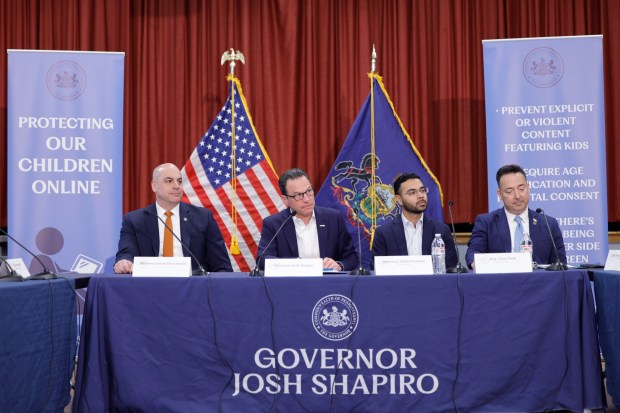
WEST CHESTER — Gov. Josh Shapiro took a good, hard look at AI in a bid to better protect children and Pennsylvanians, as he listened to students, parents, legislators, educators and experts discuss the newer technology at the West Chester Community Center.
The governor brought along state Attorney General Dave Sunday to the March 19 roundtable discussion to learn how to keep bad actors accountable and Pennsylvanians, especially students, safe when using artificial intelligence.
The governor also announced the launch of an AI literacy toolkit and, with the attorney general, the creation of an AI Enforcement Task Force. Two thousand residents have explored the toolkit in just a few weeks since it was launched, and the governor seeks feedback.

Talk centered around the health of the students. The governor and father of four said that he has received a “real wake-up call.”
The state has already funded mental health to the tune of $300 million in over 800 schools.
He called AI “unregulated” and “dangerous,” in part, because students sometimes don’t know they are interacting with “almost human” and not real people, but bots.
AG Sunday referred to AI as insidious since crimes that harm children sometimes take place in bedrooms.
Shapiro called for legislative, regulatory, educational and prosecutorial approaches.
West Chester East High School student Hannah Dean talked about the loneliness and about finding the truth.
With a smile, the governor said that one of his children said that he looked like an “idiot” in an internet photo.
“It’s not me,” he told his offspring. It was a fake picture.
A Henderson student said that a photo could look funny, but it’s not funny. He called for taking those to court and consequences for those who post fake photos of classmates.
Parent Adam Dorfman noted that he didn’t grow up with an iPhone and he needed to learn from the kids.
“Education starts with parents,” he said.
Shapiro admitted that everyone is on their phones too much, including the governor. He said that a bill that would require phones to be put away at the start of the school day until the buses leave for home was being considered.
Devon Prep student Andrew was in favor of keeping phones out of classrooms, but when asked to represent his fellow classmates, he voted to be able to keep his phone.
“When not on the phone, you might as well listen to the teacher,” he said.
Kareem Bell is an educator at Harriton Middle School.
He said that taking away phones would lead to a lot of pushback at first, but would lead to a decline in stress and anxiety.
Kids will say, “I can focus on class.”
Parent Audrey Dorfman said that parents have to make the decisions and put up the guardrails.
Hanna said that having a phone on her in class is a safety issue.
“I have a little bit more responsibility for my safety,” she noted.
Dr. Roger Harrison, of the Children’s Hospital of Philadelphia, said that there is fear in the school hallways.
Students: “I don’t know if I’m going to be safe when I’m in school. My phone helps me to feel safe.”
State Rep Pielli and the governor said that was certainly something to consider.
Pielli referred to AI as possibly the biggest cataclysmic change in humanity since the Gutenberg Bible.
He is considering legislation like the storing of phones–Bell to Bell–but understands that phones might be available at recess, for medical reasons, and for first responders.
“We can do things within reason,” the state rep said. “We need to catch up.”
Pielli then addressed the students.
“We have to take responsibility, not to throw it on you,” he said. “We are just starting. You teach us.”
Pielli talked about AI after the roundtable discussion.
“There is no greater precious resource than our children. So, when we hear that AI is simulating romantic relationships, initiating in sexually explicit conversations, advising not to seek professional help, and even offering to write suicide notes for our children, it’s time to act. We cannot expect our children to navigate these dangers alone, and it is incumbent on us to protect them,” Pielli said.
“For this reason, Rep. McNeil and I have introduced legislation (HB2215) that would require AI to verify a user’s age and would prohibit a minor from accessing or using an AI companion. Furthermore, AI chatbots would be prohibited from soliciting minors to engage in, describe or transmit images of sexually explicit conduct and would be prohibited from encouraging suicide, self-harm, or physical or sexual violence.”
Harrison discussed “bed rot,” where students sometimes stay up until 2, 3, or 4 a.m. on their phones and then get up at 6 or 7 a.m. The students receive insufficient sleep, which creates overall mental health consequences, with most parents unaware of the lack of sleep.
Parent Audrey Greenberg’s daughter was a victim of AI. Greenberg said the police and school didn’t know how to respond and there was no centralized reporting system. She called for sympathy and empathy for the victims, not isolation.
Several times, the governor asked how to address the problems with AI. Should it be through assemblies and “Back to School Night,” and who should the students meet with?
Hanna suggested that people want to hear it from people who are in their lives, and people want to have a conversation, such as with parents and teachers.
To access the AI toolkit and a wealth of information, go to pa.gov/aisafety