
“Bring your laptop and all the boring tasks you’ve been avoiding. Cancel subscriptions, book appointments, clear your inbox, sort bills. Way less painful when you’re not doing it alone.”
The invitation, posted on Meetup, was intriguing, though not entirely persuasive—it felt like being invited to a get-together to floss your teeth. The event was held on a chilly Sunday, from 2 to 7 P.M., in Dumbo, Brooklyn. I came with my to-do list (abridged, annotated, and redacted):
1. e-mail SS, SP, KK, JD, R
2. notarize comptroller form
3. return spray bottle buy other spray bottle
4. Lithgow tix
5. unsubscribe ████’s Substack
6. memorize S Amer [project to memorize world map, one continent at a time; not yet begun]
7. smell yogurt
8. tell ██████ not to tell ██████ about ██████
9. smoke detector!
10. turn off airplane mode
11. consolidate to-do lists
12. I prefer UPS less salty [don’t know what this means]
13. write will [on list for eighteen years; maybe it’s keeping me alive]
14. write to-do piece!
Each of us has about a hundred and fifty tasks to deal with on any given day. So say the psychologist Roy F. Baumeister and the journalist John Tierney, who have co-written a book titled “Willpower: Rediscovering the Greatest Human Strength.” But not all hundred and fifty make it onto our to-do lists, Tierney—whose to-do list includes a yearly reminder to celebrate Pi Day—told me in an e-mail.
Lists promise containment. Thank God for Smithsonian magazine’s “Five Volcanoes to Watch” list—just when you were overwhelmed from worrying about all the volcanoes you needed to monitor. In a 2008 survey by the market-research company Kelton Global, seventy-three per cent of Americans said that they found keeping a to-do list “calming.” O.K., but is it an effective way to get things done or merely a storage unit of guilt? Consider these numbers from the productivity company iDoneThis: forty-one per cent of items on to-do lists are never crossed off, and only fifteen per cent of completed tasks were ever on a to-do list.
Yes, you could hire an assistant to assist you, but then you’d have a hundred and fifty-one tasks. You could also leave the unwashed dishes stacked in the sink, let the bank foreclose on your house, and tell the dog to walk itself. Or you could do what a growing number of people are doing these days, especially, it seems, Gen Z-ers and millennials: meet up with other chore-beleaguered types as you each grapple with your respective to-do list. Misery loves company—if there are snacks.
These gatherings, like the one in Dumbo, are commonly called Admin Nights, a term coined, in 2019, by the journalist Chris Colin, who began hosting such events for his friends at his house in San Francisco. “We were all lonesome and all overwhelmed, and I saw a connection,” Colin told me. “I realized there’s this new category of busyness. Not work busyness, not domestic-life busyness, but this third thing. This busyness is so dumb and banal that we don’t really talk about it. It’s the way you’ve been meaning to reconnect your Bluetooth speakers for two months, but you can’t figure that out till you conquer higher-tier items—bank stuff, doctor stuff, phone stuff, car stuff, school stuff, D.M.V. stuff, other stuff—and those require insane hold times, or eye-stabbing chatbot conversations. I felt that if we could tackle this deranged administrative sprawl together, we would hang out more.” (If you have time to read this, you probably don’t need an Admin Night.) Colin also had a political agenda. “I wanted to shine my light on what’s happening—that life has become unsustainable,” he said, “and have people talk about why this is happening and who profits.”
In the past few years, Admin Nights have been proliferating, sometimes christened with new names that try to jazz up drudgery: Get Shit Done Days, Motivation Madness, and Death, Documents, & Donuts. (Purpose of that one: getting one’s “affairs in order.”)
Are these Admin Night-like gatherings as productive as attendees claim? (“I answered my aunt’s text I’d been avoiding for weeks!” “I created a list of ‘Valentine’s Day Gifts Your Boyfriend Would Get You If He Hates You’ for my TikTok feed and wrote a screenplay!” “I filled out Form 86B!”) To find out, I sampled a bunch.
Ten millennial moms sat around the kitchen island of a town house in Carroll Gardens, eating crudités, nachos, and popcorn. They’d brought their chores: medical bills to be paid, shopping lists (one woman’s son had just told her he was supposed to wear a purple shirt to school), and children’s birthday parties to be planned, including one for a six-year-old girl who’d requested that the theme be a combination of rock climbing and American Girl dolls. One woman intended to use the time to order electrolytes online, another was seeking earring backs, and a third needed to find a male babysitter, as well as a summer swim program, for a four-and-a-half-year-old who is afraid of the water. (What luck! Someone had a lead on a manny.) There was discussion about the price of helium-filled party balloons (four-fifty each). Only one man was present. He’d come with his wife on a fact-checking mission: “The idea of a party where you’d actually bring health-care forms sounded so absurd. I thought she was joking.” The night was organized by Laura Cunningham, a co-founder of a startup called Ava, a name that focus groups found evoked “happy, useful emotions.” Ava’s mission, Cunningham said, is to “tackle the mental load of motherhood.” Besides sponsoring free “community building” events such as this Family Admin Party, the group was developing an A.I.-enabled app that will fill out forms, schedule medical appointments, and handle other administrivia that we’d rather avoid. For many of the attendees, the ninety minutes in Carroll Gardens was also a rare opportunity to see friends. “It’s so hard to schedule a social dinner, but this doesn’t seem frivolous,” one woman with perfect teeth said. “I can justify it. While I’m being productive, I can have wine and decompress.” She divided her admin time between finding female-founded ventures to invest in and looking for programs to enroll her kids in “during the one-day school break that comes annoyingly a week before the long school break.”
The Brooklyn evening was raucous compared with the San Francisco Community Nights’ Zoom session I attended next, which was like the quiet car of Admin Nights. For most of the online session, Geo Morjane, a director at the software company Kaseya, and a woman named Natasha sat in companionable silence in their Zoom squares, parallel-playing like an old married couple, as I scribbled notes. Natasha spent the two hours trying to switch her QuickBooks account from annual to monthly billing, while Morjane worked on his taxes and edited a podcast. Toward the end of the evening, they compared tax-filing systems and discussed C.S.V. files—text-based files with comma-separated values. (Do you want to know more? I thought so.) When I asked Natasha if I could schedule an interview with her to talk about why she liked the concept of Admin Nights, she declined, saying, “I came here to get things done, not to add things to my to-do list.” I might as well have brought a boom box to a Quaker meeting.
If a study hall had a soundtrack, it would be Focus Lab. At this co-working session, held in the back lounge of FourFiveSix, a groovy Williamsburg restaurant that could be the set of a Brooklyn-based sitcom, Akshay Bhasin blended synthesizers and ambient noise to create live music. Attendees could listen to these “sound journeys” (his term) through headphones, available free of charge to anyone who signed up. (Sessions have a sliding-scale cost of around fifteen dollars.) Periodically, Bhasin interrupted the sounds of birds, rain, and jungle life to offer encouraging words to his audience—a small group, nestled on mismatched sofas and chairs, and a couple who’d wandered in for some soup. “Maybe let’s just do a quick little check-in with ourselves,” he murmured after thirty minutes. “Are we still working on what we want to be working on?” Rachel Lee, a twenty-six-year-old community organizer and artist, was working on job applications, a task that was higher up on her to-do list than drawing the family dog for a poster that her mother plans to hang in the family bathroom. (Caption: “Welcome to the bathroom. A dog will be with you shortly.”) Daniel Gomez-Seidel, a thirty-eight-year-old self-described freelance “post-disciplinary strategist” who keeps bilingual to-do lists, was preparing material for a media aggregator that he is creating aimed at the Latin American diaspora. He has not missed one of the four Focus Labs held to date. “Knowing my friend Julia’s over there gives me the serotonin of belonging without us having to interact,” he told me.
Before there were Admin Nights, there was body doubling, a productivity technique that keeps you focussed and motivated by having another person close at hand. The term was coined in 1996 by Linda Anderson, an A.D.H.D. coach, and inspired by the experience of one of her clients. In an article Anderson wrote at the time, she said that the client had told her, “You know, it seems that, sometimes, if I just have my wife sitting in a chair nearby, I can accomplish more than if I’m alone.” The idea has caught on. One woman on a Reddit forum about A.D.H.D. said that she asks her work-from-home husband to bring his laptop into whatever space she’s organizing. Once, he fell asleep in a closet.
Why does body doubling work? Anderson offered a few explanations, among them: the body double functions as an “improved mirror” reflecting a less anxious version of the self; the distracted person may feel obligated not to waste the body double’s time; and, borrowing from Eastern philosophy, the body double “contains the flux of energy and thought in the A.D.H.D. brain at risk of spilling out into the chaotic universe.” Or take your pick from other theories: dopamine surge, the audience effect, polyvagal calm. Let’s go with “they don’t know,” shall we?
Before there was body doubling, there were quilting bees, Trappist monasteries, and, presumably, colonoscopy-prep parties.
And, before there were those things, there was Leonardo da Vinci, who left behind notebooks full of notes to self: “Describe the tongue of a woodpecker”; “Calculate the measurement of Milan and suburbs”; “Get the master of arithmetic to show you how to square a triangle.” Michelangelo’s to-do lists, on the other hand, were really get-the-servant-to-do lists. And, because the servant could not read, the artist illustrated the lists. For instance, a grocery-shopping list consisted of a sketch of stewed fennel, four anchovies, and other must-haves.
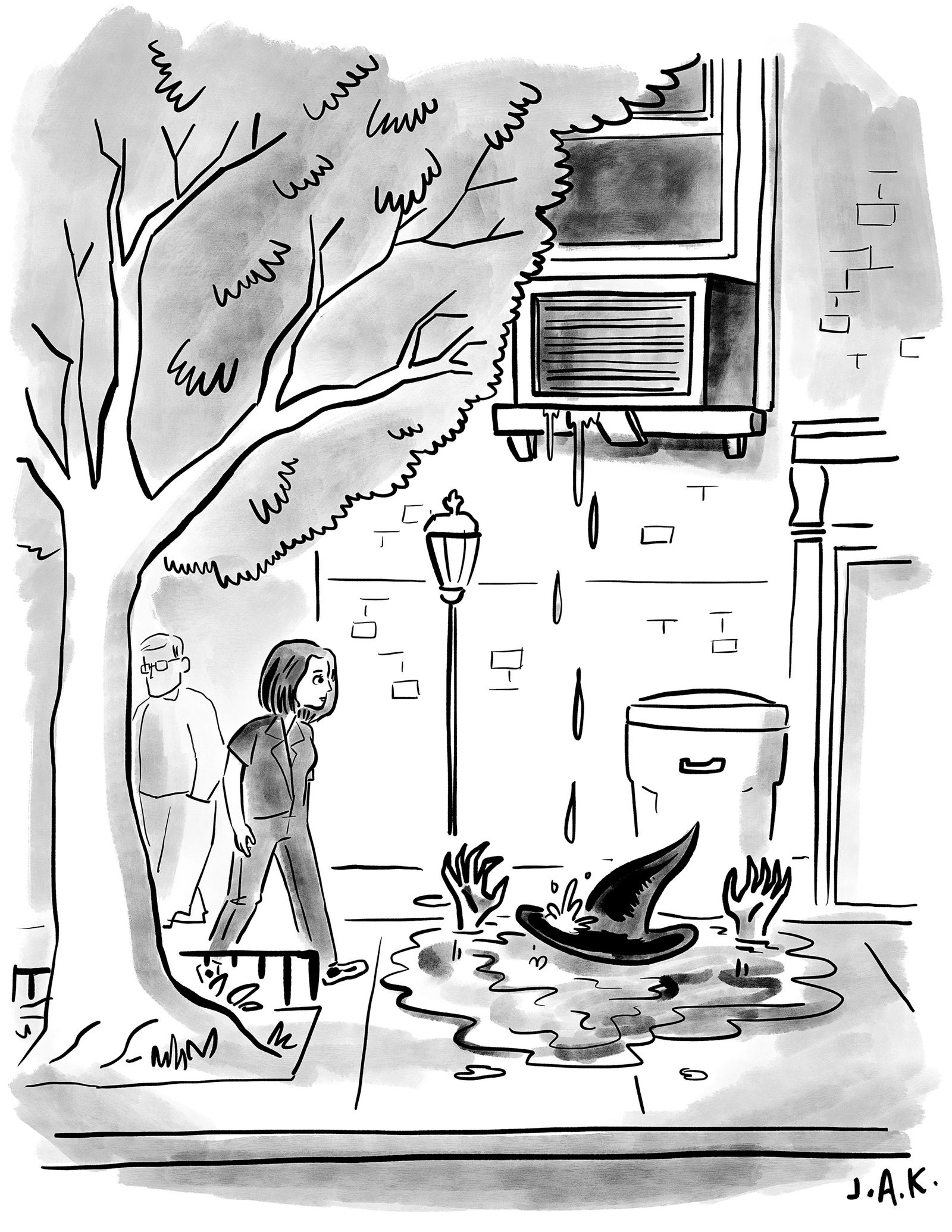
Cartoon by Jason Adam Katzenstein
At twenty, Benjamin Franklin set out on a “bold and arduous project of arriving at moral perfection,” striving to attain one virtue a week for thirteen weeks. He ultimately failed; humility was virtue No. 13 (“Imitate Jesus and Socrates”). A list that Thomas Edison made titled “Things Doing and to Be Done” totalled a hundred and eight items, among them “Ink for blind” and “Butter direct from milk.” One of John Lennon’s to-do lists included a desire to purchase “Swedish bran bread,” a request that his assistant “check my hair dryer for cancer,” a reminder about Yoko’s dentist appointment, and “shave your legs for the U.N. ‘Year of the Child.’ ”
Of the Admin Nights that I sat in on, here in 2026, the ones that felt least like excuses to hang out were the three at which most of the attendees were neurodivergent. All three were over Zoom, and all were tightly structured. Meredith Schultz has been captaining virtual “Body Doubling Sessions” every weekday morning, from eight to nine, for the past four years. “I do it because I need it,” Schultz told me, from Denver, explaining that although she’d been diagnosed with A.D.H.D. only a few years ago, her mother had figured it out early on. “If she sent me to my room to clean it, I’d make it worse,” Schultz recalled. “But, if she lay on my bed reading her trashy romance novels, I’d dutifully clean everything up.” Of her own Zoom sessions, she said, “I would never be in my chair at 8 A.M. if I didn’t have twenty-five people waiting for me.” (The Weight Watchers effect?)
One morning several weeks ago, I shared the gallery view with, among others, Janine, who wanted to use the session to request death certificates for her grandparents; Jeremy, who needed to research out-of-body experiences and eat lunch; and Charon, whose first task was to put on her socks so that she’d remember to put on her shoes so that her back wouldn’t hurt.
“We’re going to stay onscreen, on mute, in focussed attention together,” Schultz said, with a smile that seemed permanent. “I will stop us midway through for that mandatory two-minute break, and we will meet up at the end.” Schultz set a timer for twenty-five minutes. This kind of interval training for accomplishing whatever you’re avoiding derives from the Pomodoro Technique, from the late nineteen-eighties, which was developed by Francesco Cirillo, a university student who named it after the red tomato-shaped kitchen timer he used. During the session, I set about doing my taxes, which required me to sit on the floor and sort my big jumble of papers into smaller jumbles of papers. When I returned to my computer, there was a stern note to me in the chat from Schultz: “Hi Patty! Staying on screen is part of the social contract! Message me when you’re back :)”
Cameras were optional at the next two sessions I attended, the Procrastinatables Productivity Party, led by Tracey Young in Essex Junction, Vermont, and the Get Stuff Done Party, run by Christie Flora in Melbourne, Australia. But most participants chose to keep their cameras on. At both meetups, there was a preponderance of tidying—children’s rooms, offices, spare rooms, digital photo libraries, inboxes. “People do tend to suddenly feel the urge to clean up their cat boxes when someone else is around,” Young told me. But one man at Get Stuff Done devoted two hours to painting a miniature Warhammer action figure, not even stopping during the break. “Kyle’s still got his head down working on his Warhammer piece. Looking good!” Flora said, as if she were an announcer at a sporting event.
Flora noted that, during a previous session, one woman had painted a room in her house. “Things aren’t as scary as we think they will be,” Flora told her group, reassuringly.
“Sometimes they are,” an attendee named Terri replied. She’d been going through a backlog of e-mails.
The idea that people work better when other people are around is called social facilitation. As early as 1898, the American psychologist Norman Triplett observed that children working in pairs wound fishing reels faster than children working alone. If you’d rather ignore and be ignored by just one person, instead of by a group, the video-based platform Focusmate will match you with someone somewhere in the world so that the two of you can work together online on mute. (Three free sessions a week; after that, it’s eight to twelve dollars a month.) Could it be that George Orwell was too gloomy about Big Brother?
“You know how people get that groove between their eyebrows when they’re stressed out?” Young asked. “When the hour is over, you can see the relief on their faces. I call that the Botox of completion.” The converse—that we remember and are tormented by unfinished tasks more than finished ones—is also true. It’s called the Zeigarnik effect, first studied by the Soviet psychologist Bluma Zeigarnik in 1927, after her professor observed that waiters remembered the details of unpaid orders but forgot orders whose bills had been settled. One recent theory posits that uncompleted tasks live on in our short-term memory, where they linger and kvetch.
If you can’t make a dent in your to-do list, it’s not you, it’s the list—or so say time-management experts. To-do lists, they argue, are too long and not prioritized, so you knock off the trivial tasks and leave behind the more important but complicated projects. What’s the fix? (1) Break down formidable tasks into smaller, concrete steps. (Example: rather than putting “Invade Iran” on your to-do list, begin with the more feasible “Notify allies.”) (2) Set a fixed time in your calendar to do a particular task (“1:00–1:10 P.M.: Learn Mandarin”). (3) Accomplish one big task, three medium tasks, and five little tasks each day (“The 1-3-5 Rule”). (4) Narrate your efforts as if you were on a cooking show. (“O.K., let’s rinse the mug—excellent technique!”)
“A lot of what’s getting covered in the press are these large Admin Nights where adults pay bills, call credit-card companies, and sort out insurance,” said Carolyn Lanford, then a senior at Columbia University who has since graduated and who, with a handful of her classmates, has been meeting monthly at bars or in dorm rooms for the past year, in order to “wrestle with the minutiae of being an almost adult.” She typically uses the time to fill out job applications, though something else always comes up. “Students nowadays are inundated with e-mails ranging from somebody offering you a five-per-cent student discount to contracts relating to your scholarship that ask you to promise you won’t get expelled,” she said.
On a Friday afternoon a few months ago, I audited one of Lanford’s meetups, at the Arts and Crafts Beer Parlor, near campus (plant-based comfort food, exposed brick, Wi-Fi password: tipthebartender). Also in attendance were two students, Liam Downey and Rocky Rub. This would not be an ordinary meetup because, besides sundry individual tasks, the three had important business to accomplish together—namely, chartering a day-boat cruise in Puerto Rico for spring break.
From my notes:
1. boat booked, helmed by Christian
2. reviews of Christian read aloud (Rub: “ ‘Christian is a local water enthusiast.’ ” Lanford: “Oh, my God, me, too!”)
3. debate: are sand dollars alive? (yes). does drinking while afloat increase drunkenness by 50%? (unclear)
4. individual projects: Lanford, paralegal job applications; Rub, edit piece he’s writing for the Blue and White Magazine; Downey, jury-duty summons.
5. someone calls credit-card company
My research taught me that there are two kinds of Admin Nights. One is rule-bound and monastic: timers, silence, being alone together. The other is convivial: music, snacks, an excuse to get out of the house. I attended another one in Brooklyn that was the convivial kind. It was arranged by Women in Games N.Y.C., a group of “female-identifying and femme” gaming-industry workers, and organized by Yiyi Zhang, a game developer and human-rights lawyer. Ten or so attendees in their twenties and thirties settled across sofas, while a lo-fi YouTube music video was projected on a large screen, which mostly seemed to display a kitten wearing headphones. A few worked solo; most mingled as they plugged away—the Montessori approach to busywork. Why had they come? Hamna Faisal, the director of business management at Women in Games, told me, “I crave human connection, especially post-COVID, but I also need to get things done.” Alexandra Palocz, an adjunct professor of media technology at City Tech, said, “I think people feel a greater sense of existential dread now. It feels futile to order a phone case or make a big grocery list when Iran is being bombed and there’s an ICE presence in American cities. In a group like this, even if you don’t know anyone, you feel like you can keep moving forward.”
Zhang’s seven-year-old daughter, Hainen, was at the meetup. She told me, “I found out that grownups have homework, too, which is kind of funny.”
Progress Report:Write to-do piece!
Previous items: pending ♦