
The message on numerous signs was simple — put patients over profit. On Tuesday morning, the patients seemed to agree.
The honking of car horns came early and often, showing support for more than 200 people in Vallejo and more than 100 others in Vacaville picketing and protesting Kaiser Permanente’s role in safe staffing and AI protections.
The two protests in Solano County and one each in Marin and Sonoma counties were part of 22 in California representing more than 25,000 Kaiser nurses represented by California Nurses Association/National Nurses United.
“I think our main goal is for the community to know we’re out here as advocates and we’re always ready to fight Kaiser,” Raquel Benito, ED Nurse and Registered Nurse Quality Liaison with Vallejo Inpatient Nurses, said. “Our two main goals are to have better staffing and fight against AI, which is untested. We don’t want our patients to be guinea pigs. We want them to come to us first.”
Registered nurse and Quality Liaison for Kaiser Vacaville, Cristina Stathopoulos, said hearing the car horns and the support from people passing by felt good.
“The support from the community has been wonderful,” Stathopoulos said. “I think a lot of the people honking are members here (Kaiser) so they see us working really hard and try to give the best support we can under the really short staffing that Kaiser has been providing them.”
Vacaville registered nurse Maura Lewis agrees.
“Hearing the honking makes me feel really good,” Lewis said as she waved to cars passing by on Quality Drive in Vacaville. “It feels good to know that people support us and they know why we’re out here — not just for money but because we really care about our community and we want to be able to provide the best care for them in a hospital.”
Kaiser Permanente sent a statement to the Times-Herald on Monday night, saying that its nurses are “among the best-paid in California and the country.” Negotiations are scheduled to continue on Thursday, but Kaiser said in the same written statement that it, “is committed to reaching a fair agreement that continues to provide competitive pay, outstanding benefits, and professional growth opportunities for our nurses and the members and communities who depend on them.”
“A typical CNA Staff Nurse II in Northern California earns over $100 per hour, before overtime or premium pay, roughly 7 percent above the market for comparable roles at other health systems,” said Meghan Kielty-Swinford, the Regional Chief Nurse Executive, Kaiser Permanente. “At our Los Angeles Medical Center, a typical CNA Staff Nurse RN earns roughly 21 percent more than comparable roles. In Fresno and Sacramento, pay for a typical CNA Staff Nurse RN is approximately 15 percent above market. Ninety-five percent of our CNA-represented nurses in Northern California and 93 percent at our Los Angeles Medical Center choose to remain at Kaiser Permanente year after year — one of the highest retention rates in the industry.
“Technology at Kaiser Permanente supports our nurses in doing what they do best — caring for patients and applying their clinical expertise,” Kielty-Swinford continued. “It does not interfere with their clinical judgment or replace them in the delivery of patient care. To be clear, these principles are already written into our contract with CNA — which we’re happy to share. We meet and often exceed California’s state-mandated nurse-to-patient ratios. Staffing is adjusted shift-by-shift based on patient needs, using a patient classification system developed collaboratively with our CNA-represented nurses and nurse leaders.”
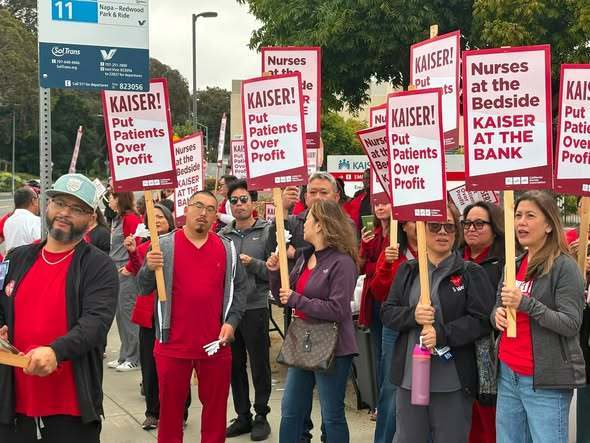
Picketers, meanwhile, are concerned with the increased use of AI in the majority of Kaiser hospitals in California.
“We want humans taking care of humans,” Lewis said. “At the end of the day, a robot can’t provide compassion. They can’t provide touch and be understanding of human emotions.”
Stathopoulos agreed.
“Patients don’t like AI,” she said. “They want to talk to people. When you call now for mental health, you are screened by AI. The AI then deems whether or not you are transferred over. That should be a human. That shouldn’t be AI.”
Benito said her patients are often asking questions concerning why unit assistants have been removed from checking people in for appointments. Benito said that hasn’t taken place in all 22 Kaiser locations in California, but most of them.
“When checking in, now there’s a screen for them,” Benito said. “Kind of like what they are putting in restaurants more and more. People hate it there, so of course they hate it here. They want that human touch. They want to be able to speak to someone when they’re confused and want assistance. Someone to help them when they can’t read, or they are proficient in a certain language. And so removing the human from that process hurts our community.”
Benito said she is also concerned about the lack of a tele sitter — the human who would be sitting down with a patient when they are confused.
“Now that’s replaced by a camera,” Benito said. “So you have one person watching 12 different rooms. That’s a concern because it puts our patients at risk.
The nurses are in early stages of negotiations on a new union contract and say they want Kaiser to agree to a contract that provides protections against untested and unregulated implementations of artificial intelligence technologies, all to prioritize patients over Kaiser’s billions of dollars in income, investments, and reserves.
Joseph Catindig is a registered nurse on the bargaining negotiating team for Vallejo. He said the two groups usually meet in Berkeley and Oakland, but in the dozen or so meetings since July, the conversations have been “disappointing to say the least.”
“It’s disappointing because all of our proposals have been rejected so far,” Catindig said. “Kaiser is a billion-dollar company. They have the money to make this happen. They have been cutting staff and slowly been integrating AI over the last year and a half.”
Benito also wasn’t optimistic about the negotiations.
“Negotiations have started, but I will tell you they have not been great,” Benito said. “We want to believe that Kaiser will bargain with us in good faith, but we haven’t seen that happen yet.”