
At the end of January, Havana was struck by a frente frío, a cold front that blew off the ocean and plunged the island into unaccustomed wintry weather. As high winds sent waves crashing over the seaside promenade, the city’s inhabitants wrapped themselves in whatever warm clothing they had, or else huddled inside against the chill.
On the afternoon of the twenty-ninth, a group of senior Latin American diplomats were among those taking refuge from the weather. They had met at an ambassador’s residence, to discuss a new executive order from Donald Trump that declared Cuba a threat to “the national security and foreign policy of the United States.” The diplomats were shocked by its contents. “The perversion of the language is incredible,” one said. “Word by word, it’s harsher than the language that Kennedy used to talk about the Soviet missiles”—the crux of a standoff, in 1962, that brought the world close to a nuclear conflagration.
Trump’s order had asserted, without any evidence, that Cuba “destabilizes the region through migration and violence,” promotes schemes “to harm the United States and support hostile countries,” and provides sanctuary to Hamas and Hezbollah. He vowed to cut the island off from oil imports and warned that any other nation that sought to supply fuel would be punished.
For most Cubans, the order meant that their already difficult lives were about to get considerably worse. For months, the island had faced daily electricity blackouts owing to a lack of fuel, along with severe shortages of food, water, and medicine. Economic activity had all but stopped, and the government, which was essentially broke and unable to secure new loans, had been incapable of providing solutions. Even garbage collection was virtually nonexistent, with huge mounds of refuse piling up on street corners. In the past eighteen months, three powerful hurricanes have destroyed countless homes and vast expanses of cropland, displacing more than a million people. When the executive order came, Cuba was on life support; Trump’s action effectively shut the oxygen off.
The diplomats had been meeting regularly to monitor Trump’s Cuba policy, which they viewed with increasing alarm. “They say they want to harm the government, not the people,” one told me. “Well, this is harming the people.” On January 3rd, U.S. Special Forces had abducted the Venezuelan President, Nicolás Maduro, from Caracas, in a raid that many Cubans regarded as both an act of imperialist aggression and a warning. For decades, Venezuela had been Cuba’s greatest sponsor; along with Mexico, it provided about seventy per cent of the island’s oil. After Maduro was seized, the U.S. military imposed what amounted to a blockade, intercepting tankers carrying Venezuelan oil to Cuba. Analysts predicted that the island’s petroleum reserves would run out in a matter of weeks. At Havana’s few functioning gas stations, vehicles lined up for as long as twenty-six hours. With supplies dwindling, the government instituted an emergency gas quota of five gallons a day, shortened school hours and government workweeks, and suspended some medical procedures in hospitals.
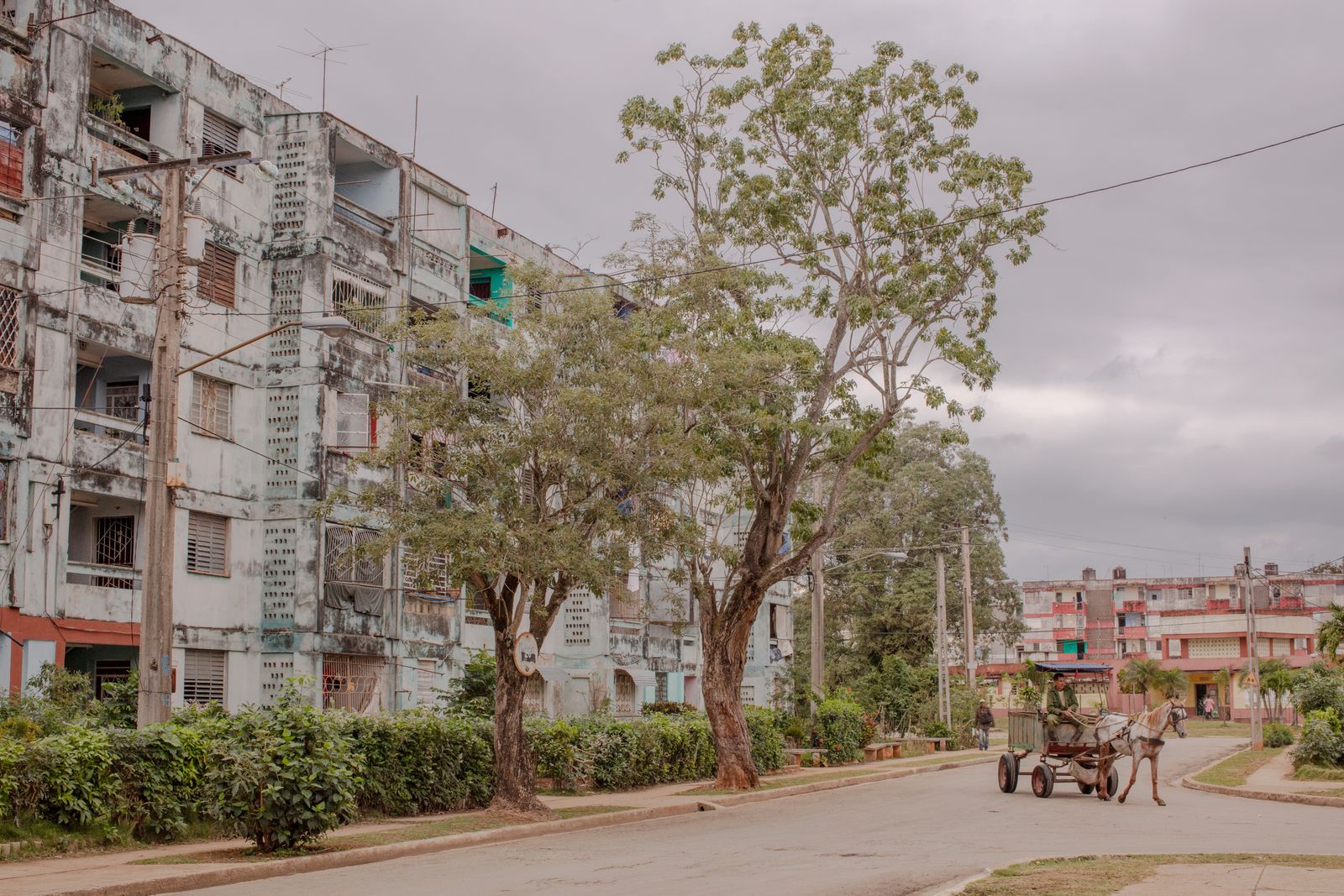
With gasoline scarce, residents use horse-drawn carts for transportation.Photograph by Natalie Keyssar for The New Yorker
Meanwhile, Trump issued a series of celebratory messages. “Cuba looks like it is ready to fall,” he told reporters. Asked whether he intended to intervene there, he demurred. “I don’t think we need any action,” he said. “It’s going down.” A few days later, he was back to posting threats on Truth Social: “THERE WILL BE NO MORE OIL OR MONEY GOING TO CUBA – ZERO! I strongly suggest they make a deal, BEFORE IT IS TOO LATE.” He insisted that Cuba was desperate to negotiate. “They have no money,” he said at one point. “They have no anything right now.”
The President of Cuba, Miguel Díaz-Canel, issued a defiant statement. “Those who turn everything into a business deal, even human lives, have no moral standing to call out Cuba,” he said. The Communist Party newspaper, Granma, ran a photograph of a crowd waving Cuban flags under the headline “Nobody Tells Us What to Do.” This turned out to be bluster, just as Trump’s statements were. Representatives of the Cuban government were already in negotiations with the U.S. about the countries’ relationship, and about the future of the island. In March, Díaz-Canel finally acknowledged the talks, describing them as a diplomatic exchange between two sovereign nations. He said that the goal was to “identify the bilateral problems that need a solution,” adding, “This is a very sensitive process that is being approached with responsibility and great sensitivity.” Trump cast the talks instead as a matter of personal domination. “I do believe I’ll be having the honor of taking Cuba,” he said. “I think I can do anything I want with it.”
When I visited Cuba earlier this year, the formerly bustling old city of Havana was nearly deserted. Since 2021, an estimated one in five Cubans has left the island, seeking a better life. Tourism has collapsed, too, removing a main source of foreign revenue and leaving a listless, despondent air. The Plaza de Armas, a sixteenth-century square that once drew crowds of visitors, was virtually empty, occupied by an elderly woman sitting alone, a man blowing softly into a trumpet, and a legless man in a wheelchair, staring into a fenced-off garden in the middle of the square. The stillness was broken only by the arrival of a local character known as La Marquesa, who strode across the plaza, wearing a cream-colored skirt and blouse and a white sun hat, shouting that he was the “boss of everything.”
Everyone I talked with was organizing their days around dealing with the crisis. Leonardo Padura, Cuba’s best-known novelist, told me about his frustrated efforts to buy a home power station for his elderly mother-in-law, to provide light when the electricity goes out. Many of the island’s young people have left, and the elderly struggle to care for themselves. One friend couldn’t secure enough fuel to drive to the market for food, and couldn’t find medicine for a heart condition, so I brought some with me. Another, a widow in her late seventies, was hobbled by chikungunya, a mosquito-borne disease that causes painful swelling of the joints and extremities. (An anti-inflammatory was available on the black market, but at an unthinkable price.) Malnutrition and a breakdown in public-health services have led to an increase in viral illnesses. Since last autumn, tens of thousands of Cubans have been afflicted by chikungunya, along with dengue fever and Oropouche.
Amid the crisis, President Díaz-Canel could offer only more of the same. Díaz-Canel took office in 2018, as Raúl Castro’s handpicked successor. He is sixty-five, a burly man with the slicked-back silver hair of a college basketball coach. Before Raúl elevated him, he was a provincial Party boss in Villa Clara—an unassuming apparatchik, so humble that he sometimes rode a bicycle to work. As the first President in half a century who is not a member of the Castro family, he has been careful to present himself as a loyalist. He routinely refers to Raúl—who remains the island’s crucial political voice, despite being ninety-four and officially retired—as his jefe máximo. When he ran for election, his campaign put up billboards with an image of Díaz-Canel and the Castro brothers alongside the slogan “Continuity.”
As President, Díaz-Canel has widely been seen as hapless and jinxed. The month after he took office, a plane crash in Havana killed a hundred and twelve people. A devastating tornado landed the next year, and in 2022 an explosion from a suspected gas leak destroyed Havana’s historic Hotel Saratoga, killing forty-seven people. There was the COVID-19 pandemic, which vitiated the health-care system and the tourism sector; there was also a string of explosive nationwide protests, in 2021, which the government harshly put down, helping to spur the exodus. The electrical grid was decrepit, and blackouts were commonplace. Díaz-Canel blamed Cuba’s economic struggles, as the Castros had, on crippling U.S. sanctions, which have been in place since 1962.

A huge exodus of Cubans from the island, along with a precipitous drop in tourism, has left Havana feeling all but abandoned.Photograph by Natalie Keyssar for The New Yorker

A vender sells chicks in the city center.Photograph by Natalie Keyssar for The New Yorker
By early this year, Cuba was clearly weakened, and Trump always likes to negotiate from a position of strength. (As his Defense Secretary, Pete Hegseth, recently said about the U.S. bombardment of Iran, “We are punching them while they’re down, which is exactly how it should be.”) But Republicans were divided over the approach. America’s policy toward Cuba has been influenced for decades by Cuban American leaders in Miami, who have insistently ruled out negotiating with the Castro government. Last year, I saw Representative Carlos Giménez, an influential figure in Florida politics, and he likened the regime to a cancer, which needed to be forcibly extracted from the body.
Trump’s Secretary of State, Marco Rubio, grew up in Florida, the son of Cuban immigrants. For most of his career, he held a similarly uncompromising position on the regime. In 2015, he wrote, “We must never forget that the only true form of independence for the Cuban people is freedom and democracy, and we must recommit our state and nation to the goal of helping them achieve that vital objective.” But, now that Rubio works for a President whose foreign policy is almost entirely transactional, he has often been willing to amend his old views. Rather than force out the Cuban government, the U.S. would try to choke it into submission. “We would love to see the regime there change,” Rubio told the Senate Foreign Relations Committee this winter. “That doesn’t mean we’re going to make a change.”
During my visit, everyone I talked to was worried about the country’s vulnerability, but few were worried about whether the government would survive. As I arrived to visit one friend, who had spent decades in the service of the Revolution, he peered around the door and cracked, “Where’s Delta Force?”—a reference to the military unit that had snatched Maduro a few weeks earlier. He laughed bitterly. “I don’t care anymore how it happens, but this situation has to end.”
As the oil blockade dragged on, Trump sometimes talked about “being kind” to Cuba. If this meant anything, it seemed to mean that he wasn’t rushing to launch a military strike. There was little incentive for one, especially when the U.S. had a large share of its military forces tied up in the war in Iran. Cuba has no unifying leader to remove, and not much oil to seize; its most valuable resources are cobalt, tobacco, nickel, and waterfront real estate. (One friend there asked, half joking, whether an attack could be averted by offering Trump beachside property in Varadero, the island’s most famous resort destination. “El Trump Varadero,” he said. “It has a ring to it.”)
Last spring, Trump’s special envoy for Latin America, Mauricio Claver-Carone, called for “surgical” and “creative” measures to reshape Cuba. (Claver-Carone has since left the Administration, but several sources told me that he remains a key White House intermediary in Latin America.) Along with the oil embargo, the “surgical” measures included restricting tourists’ access to the island and deterring other countries from hiring Cuban doctors, a major revenue source for the regime. These efforts were augmented with a series of “creative” interventions. After Hurricane Melissa devastated eastern Cuba, in October, Ambassador Mike Hammer arranged for humanitarian aid—but he delivered it through the Catholic Church, circumventing the Cuban government and undercutting its own relief efforts. This winter, the Trump Administration enabled several American firms to sell fuel oil to companies in Cuba. Rubio made clear that they were forbidden to offer the oil to the government; the goal was to empower private enterprise at the expense of the state. At a dinner in January, Hammer gleefully predicted that the regime would fall before the year’s end.
Cuba has been through hard times before. The mythos of the Revolution is built around the people’s ability to endure. In the nineties, I lived in Havana with my family during the Special Period in the Time of Peace, as Fidel Castro called the ruinous years after the collapse of the Soviet Union. With Cuba’s main patron gone, the economy imploded and oil imports plummeted. Unable to find fuel, Cubans rode Flying Pigeon bicycles that Castro had imported from China, or they walked. In the countryside, oxen replaced tractors; horse-drawn cabs became common in towns. Eventually, the government jury-rigged transport by welding together buses to create long vehicles called camellos—camels—for their distinctive humps. But there weren’t enough camellos to go around, so people often had to wait hours for one to arrive.

Amid frequent blackouts, only those who can afford generators can keep their lights on.Photograph by Natalie Keyssar for The New Yorker
As the government lost its ability to provide, people who had jewelry or antiques sold them to whoever would pay. Prostitution, long considered a bygone evil of the capitalist era, became rampant again. Malnutrition encouraged an epidemic of a blinding disease called optic neuropathy. Several people I knew died by suicide, and one day a young woman leaped in front of my car, trying to kill herself; I managed to swerve away just in time.
In 1993, Fidel Castro took emergency steps to ameliorate the crisis: he legalized the U.S. dollar, allowed limited private enterprise, and grudgingly tolerated an increase in tourism, which he despised. It wasn’t enough to assuage the tensions. In the summer of 1994, rioting broke out along Havana’s seawall. For a few hours, the unrest threatened to spread through the city, until Castro appeared before the rioters, and his near-mythical presence—along with a detachment of stick-wielding loyalists—calmed the mob.
That evening, Castro announced on television that anyone who wanted to leave Cuba could do so. In the next three weeks, as many as thirty-five thousand Cubans took to the sea in improvised boats, trying to reach Florida. It was a chaotic exodus. From my neighborhood, we could see entire families setting off on precarious rafts. Hundreds of migrants are believed to have drowned on the way, but thousands of others were rescued by the U.S. Coast Guard. The son of a Cuban friend made it to Key West on a Windsurfer, after nineteen hours on the water.
Cuba’s emergency truly subsided only after Hugo Chávez was elected President of Venezuela, in 1998. Chávez and Castro signed a pact in which Venezuela agreed to provide Cuba with oil, in exchange for thousands of Cuban doctors, teachers, sports instructors, and security agents. Chávez once described Castro to me as “a beacon”—a father figure who had convinced him that socialism was the way forward for humanity. The alliance grew so close that people joked that Venezuela and Cuba had merged into a new revolutionary entity, “Cubazuela.” After Maduro succeeded Chávez, who died, from cancer, in 2013, a downturn in global oil prices devastated Venezuela’s economy. Maduro continued sending oil, but far less of it—by 2025, about a third of what Cuba imported, with Mexico supplying much of the rest. Since Maduro’s capture, in January, Cuba has been on its own again. This time, there is no charismatic leader to pacify the angry citizens.
On January 27th, Díaz-Canel joined several thousand student loyalists, soldiers, and senior leaders at La Escalinata, a grand stone staircase that leads to the entrance of the University of Havana. They were there for the March of the Torches, an annual tribute to José Martí, Cuba’s ultimate nationalist hero. Martí, a journalist and a poet, was an essential figure in the nineteenth-century war of independence, in which Cuban élites revolted against the Spanish colonists. As the fighting stretched on for decades, Martí helped rally his peers. “How beautiful it is to die when one dies fighting in defense of the fatherland,” he once wrote. In 1895, he took part in a cavalry charge on the Spaniards and was killed on his first day in battle.
Spain was finally forced out in 1898, when the United States took the side of the Cubans—only to deny them sovereignty, by making Cuba a de-facto U.S. protectorate and then by intervening repeatedly to prop up friendly autocrats. But the legend of Martí endured; he became Cuba’s “Apostle,” and a bust of his image had a prominent place in schoolyards across the island. Cuban politicians are still careful to present themselves as devotees of Martí, and sacrificing for la patria is a consecrated ideal. In 1953, six months before Fidel Castro launched his insurrection against the U.S.-backed dictator Fulgencio Batista, he led a torchlight procession in Havana, to commemorate the centenary of Martí’s birth. It has been replicated ever since.

“It’s a plague—don’t overthink it. Just grab a frog and throw.”
Cartoon by Daniel Kanhai
This year’s march—dubbed the Anti-Imperialist Centenary March of the Torches, because 2026 is the hundredth anniversary of Castro’s birth—had an air of defiance. Flags billowed. A young crooner sang a patriotic ballad, and the crowd swayed along. Litza Elena González Desdín, the head of the government-aligned student federation, gave an impassioned speech from the top of the stairs, rallying whatever remained of the Revolution’s true believers. “Compatriots, we are living through very turbulent times, in which the empire and its emperor, Donald Trump, want to impose an order of bombs, kidnappings, persecution, destruction, and death, and intend to drag us back to destructive fascism,” she said. She denounced “the cowardly military aggression of the United States against Venezuela” and “the kidnapping of the President of that sister nation.” She reminded the marchers that their country had also paid a blood sacrifice: dozens of Cuban bodyguards, secretly assigned to protect Maduro, had been killed. “We will never forget that on January 3rd, in the darkest hours of the early morning, Cubans physically lost thirty-two of our bravest sons,” she said.
In the past half century, Cuba and the U.S. have engaged in many proxy battles—in Grenada, Bolivia, Nicaragua, Angola, Ethiopia, and the Congo—but the last time that their soldiers fought directly was in 1961, during the Bay of Pigs invasion, a disastrous American defeat that encouraged a profound schism between the two countries. The killing of the guards in Caracas felt similarly momentous. This time, though, the Cubans had lost, undermining the long-standing myth of their battlefield invincibility. The U.S. forces had killed more than eighty people, including Cubans and Venezuelan service members, while sustaining no losses. Trump later crowed that Maduro’s defenses had been overwhelmed with a top-secret weapon that he called the Discombobulator.
González Desdín, the student leader, acknowledged none of this when she talked about the fallen guards. “They are a constant inspiration for our generation,” she said. “They are paradigms of the history of the struggle for a united America, for an ever more sovereign homeland. To them, honor and glory forever.” A military band played a patriotic tune, and the marchers began to make their way through the city, bearing torches and chanting old revolutionary slogans: “Socialism or Death,” “I Am Fidel.” As they sang and shouted about honor, sacrifice, and the fatherland, they seemed like adherents of a religion in which the rewards are realized only in the hereafter.

Fidel Castro fostered a revolutionary mythos based on resilience and hope. Now there is no unifying leader to rally people.Photograph from AP
Other Cubans were less able to sustain themselves on faith. When the lack of electricity interfered with classes at the university, angry students gathered on La Escalinata for a sit-in. Across Havana, people protested the lack of food and power by banging on pots and pans—a noisy, time-honored tactic known as the cacerolazo. In the city of Morón, which has been afflicted by long stretches without electricity and by an outbreak of chikungunya, a peaceful march turned violent when it reached the offices of the Communist Party. Residents stormed the building and threw furniture from a second-floor window. Out on the street, they set a bonfire with the furniture, while people chanted “Freedom!”
The remains of the thirty-two guards were flown to Havana’s José Martí International Airport and received in a solemn military ceremony, presided over by Raúl Castro, who rarely appears in public nowadays. The ashes of four officers from Havana were interred in the Necrópolis Cristóbal Colón, an ornate nineteenth-century cemetery where many of Cuba’s leading figures are buried. Four simple nameplates on stone plaques marked the men’s graves. Bouquets of flowers piled up nearby.
A few days later, Russia’s interior minister, Vladimir Alexandrovich Kolokoltsev, came and paid his respects to the fallen soldiers. Kolokoltsev’s visit was a gesture at the persistence of old Cold War affiliations. Cuba’s Army continues to use Russian-made weapons, and the two countries’ security services have maintained relationships. Near the cemetery, a bronze plaque marks the place where Fidel Castro gave a historic speech on April 16, 1961. The day before, seven Cubans had been killed in Havana, when U.S. warplanes attacked an airfield in preparation for the Bay of Pigs invasion. Castro had always described himself as a “secular humanist.” Now he declared “the socialist nature of the Cuban Revolution.”
The most visible legacies of Cuba’s Soviet era are bleak Moscow-style apartment blocks that serve as Havana’s version of social housing and the ancient Ladas that rumble through the streets, when there is gas to run them. Near the gritty port of Regla is a park where a huge bronze sculpture of Vladimir Lenin’s face, installed in 1984, stares out from a hillside. Below it are eleven sculptures of pale, faceless figures, with arms outstretched as if in homage. Today, the park is visited mostly by lovers who use its overgrown grounds for trysts. Russian tourists come to Cuba, but flights were suspended in February because there wasn’t enough fuel for their planes to get home.
Russia has behaved cagily in the current conflict. Perhaps because Vladimir Putin wants to avoid provoking Trump into giving more aid to Ukraine, he refrained from condemning Maduro’s removal, and he responded to the blockade of Cuba with a tepid statement calling the policy “unacceptable.” In February, Russia dispatched a tanker, the Sea Horse, but then diverted it as the U.S. tightened the blockade. Last week, with the conflict in Iran depleting American military resources, another Russian tanker, the Anatoly Kolodkin, headed across the Atlantic in Cuba’s general direction.

Near the port of Regla, a sculpture of Lenin peers down from a hillside. Installed in the nineteen-eighties, it endures mostly as an oddity.Photograph by Natalie Keyssar for The New Yorker
Cuba has few other allies that might come to its aid. For a short time after the raid on Venezuela, Mexico sent oil, but in January it abruptly cancelled a scheduled shipment. Mexico’s President, Claudia Sheinbaum, claimed that the change of plans resulted from a “sovereign decision” by the state oil company, Pemex—never mind that Pemex operates under Sheinbaum’s control. She emphasized that she would continue sending humanitarian aid, and the next month the Mexican Navy delivered two shiploads of supplies: powdered milk, beans, and hygiene products, but no oil.
The Cuban government’s desperation has encouraged actions that further alienated influential friends. In November, it froze the bank holdings of foreign embassies and businesses with hard-currency accounts, apparently because it needed the cash. One acquaintance who is close to the Party élite told me that he had seven million dollars sequestered, crippling his business. It was worse for others, he said: he’d heard of companies that lost access to tens of millions. He shrugged. “You know what?” he said. “I’m not expecting to get the money back.” At the end of our meeting, he pulled me into a tight hug and whispered a prognosis for the regime: “This is over.”
When I talked to Cubans about the crisis, many spoke euphemistically about “change.” Some referred to the U.S. incursion in Venezuela, where Vice-President Delcy Rodríguez and other regime leaders had been allowed to stay in power as long as they assented to Trump’s demands. One influential Cuban said that the Venezuelan model had had a huge psychological impact, showing that there could be pragmatic change without displacing the regime. “I don’t mean that they should do something similar to what they did in Caracas, coming in with helicopters and shooting people,” he said. “But the fact that they found people to work with there plants the idea that perhaps something similar could be possible here.”
A former senior aide to Chávez and Maduro suggested that the situation in Venezuela was nothing to aspire to. He told me wryly, “Venezuela is quickly becoming the Puerto Rico of the twenty-first century”—a virtual American colony, led by an avowed socialist in coöperation with a right-wing American President. “Who could have imagined this outcome?” he asked. “It’s so bizarre.”
Still, it offered powerful Cubans hope that their lives could be improved without too much upheaval. A European diplomat on the island told me, “Because of Venezuela, guys here now think that they can hang on after all.” But, the diplomat asked, “who’s going to run this country in a pro-capitalist, pro-U.S. fashion? Who’s our Delcy?” His colleagues were placing bets. One candidate was Oscar Pérez-Oliva Fraga, who was recently made Deputy Prime Minister and given a seat in the National Assembly—a prerequisite for Presidential candidates. Pérez-Oliva, who also serves as the minister of foreign trade, is a grandnephew of Fidel and Raúl Castro. The diplomat reasoned, “If Raúl tells the Army and security services, ‘He’s the one who is going to do the transition,’ they’ll go along with it.” On the other hand, a link to the Castros would be an impediment with the Americans. Perhaps the smarter bet was the Prime Minister, Manuel Marrero Cruz—a pro-development former head of tourism, with ties to the military. “Even though he’s not well liked, he’s in an interesting position,” the diplomat said. “I’ve tried him out as an option on the Americans, and they haven’t pushed back.”
Rubio has said that the transformation of Venezuela will have three parts: stabilization, recovery, and a transition to functional democracy. This model seems difficult to apply to Cuba. Even if negotiations with the U.S. yield an agreement to hold elections, Cuba has no organized political opposition that could run against the Communist Party, let alone take over the country. As a friend in Havana pointed out, there is no local equivalent of María Corina Machado, the opposition leader who helped encourage the intervention in Venezuela. The best-known dissidents are dead, imprisoned, or in exile, too far removed from recent politics to be taken seriously. The likelier scenario is that the next ruler will come from within the existing power structure—which, my friend suggested, means that little will change.
The Trump Administration’s main counterpart in negotiations is Raúl Guillermo Rodríguez Castro, Raúl Castro’s grandson and personal bodyguard. Rodríguez Castro is known as El Cangrejo—the Crab—reportedly because he was born with six fingers on one hand. El Cangrejo is forty-one, with a boxer’s build and the Roman nose and square jaw of his great-uncle Fidel. Despite the Castro clan’s preference for maintaining an austere life style in public, images have emerged of Rodríguez Castro at parties, travelling abroad on private jets, and hanging out on yachts with women in swimsuits. The air of abandon is not limited to partying. In 2022, he allegedly drove his car into a young mother and toddler who were standing on a rural roadside in eastern Cuba. Their injuries required emergency surgery and follow-up care, and though Rodríguez Castro promised to look after them, the mother has denounced him on social media for abandonment.
Around Havana, Rodríguez Castro is rumored to be involved in a variety of money-making schemes. He is also understood to look after the family interests in GAESA, an opaque entity that is among the country’s most powerful institutions. GAESA is the Spanish-language acronym for the Business Administration Group—an all-encompassing conglomerate owned and operated by Cuba’s armed forces. Raúl Castro created GAESA during the Special Period to give the military a way to sustain itself; El Cangrejo’s father took over in 1996 and ran it until his death, in 2022. Over the years, it has grown to include dozens of businesses, involved in everything from construction, hotels, and tourism to port logistics, fishing, and commercial imports, as well as retail stores and financial services—notably, the hard-currency remittances on which many Cubans depend. It is also thought to own an array of companies and properties in Panama, where El Cangrejo often visits.

Across from Havana’s Museum of the Revolution is a memorial to the Granma, the boat that Fidel Castro and his comrades sailed to Cuba in 1956.Photograph by Natalie Keyssar for The New Yorker

At the Fidel Castro Ruz Center, in the Vedado district, multimedia installations tell the deceased leader’s story.Photograph by Natalie Keyssar for The New Yorker
Analysts estimate that GAESA controls at least forty per cent of Cuba’s economy, and has revenues equal to three times the state budget. Last year, the Miami Herald published leaked documents indicating that it had billions of dollars stashed in foreign bank accounts, beyond the reach of the civilian government. By all appearances, Díaz-Canel leads a rubber-stamp administration, while Raúl acts as the shadow President and El Cangrejo as his aide-de-camp. According to someone who knows Díaz-Canel personally, he would like to open up Cuba’s economy, but has repeatedly been thwarted by GAESA, which does not want competition.
In mid-February, a senior Administration official downplayed the meetings with Rodríguez Castro, telling Axios, “I wouldn’t call these negotiations as much as discussions about the future.” A few days later, sources confirmed to the Herald that U.S. officials had met with Rodríguez Castro in St. Kitts, on the sidelines of a security conference for Caribbean nations. Afterward, Rubio suggested that some lingering influence from the old regime could be acceptable for a time. “Cuba needs to change,” he said. “It doesn’t have to change all at once.”
The same day as the conference in St. Kitts, a speedboat stolen from a Florida marina entered Cuban waters, carrying ten heavily armed exiles on a mission to overthrow the regime. As the boat approached the shoreline, it was intercepted by a Cuban Coast Guard cutter, and a firefight broke out. Four of the men were killed, and the others were injured; one died a few days later. Cuban officials decried the episode as a terrorist attack but refrained from blaming the U.S. Rubio avoided accusations, too, and said that the U.S. would conduct its own investigation.
Both governments seem conscious that the relationship between the two countries has often turned on isolated, almost flukish incidents. In Bill Clinton’s first term as President, his efforts to improve relations were disrupted when an anti-Castro organization in Florida flew two Cessnas into Cuban airspace. Cuban MIGs scrambled and shot the planes down, killing four people, including three U.S. citizens.
Amid the uproar that followed, Clinton was obliged to sign the Helms-Burton Act—a law sponsored by right-wing Republicans to codify their opposition to Communist Cuba. Among its measures, it made displacing the Castro regime the official policy of the United States, extended the 1962 trade embargo indefinitely, and placed sanctions on foreign companies that did business with Cuba. Helms-Burton could be repealed only with approval from Congress, but Clinton suspended its most punitive provision, Title III, by invoking “waiver authority” every six months—a routine carried on by George W. Bush and Barack Obama. In 2019, Trump allowed this provision to proceed, and two years later he reinstated an old measure declaring Cuba a state sponsor of terrorism.

Five years after Heidy Sánchez came to Florida, she was arrested at an immigration check-in and led away in shackles to be deported. Her seventeen-month-old daughter was left behind with her husband, a U.S. citizen.Photograph by Natalie Keyssar for The New Yorker

Sánchez, now back in Cuba, tries to call her daughter twice a day, when the electricity is working.Photograph by Natalie Keyssar for The New Yorker
In discussions about the Trump Administration’s policy on Cuba, Rubio has repeatedly invoked Helms-Burton, which specifies that there cannot be a transitional government if Fidel or Raúl Castro still hold power. Yet the Administration is evidently willing to allow Raúl to exert influence through his grandson. It did, however, suggest in March that Díaz-Canel resign to facilitate negotiations—a gesture that would allow Trump to claim victory while leaving the regime essentially intact.
Ric Herrero, the head of the Cuba Study Group, a policy and advocacy organization based in Washington, D.C., argued that Rubio’s immediate priority is to stabilize Cuba’s economy, which means making a deal with the existing power structure. This has historically been an unpopular prospect in Florida’s Cuban community, but Trump was helping change perceptions. “Every day, Trump is saying, ‘We’re talking to the Cuban leaders,’ and by doing that he’s normalizing the idea,” Herrero said. “A month ago, the Miami Cubans were, like, ‘Don’t negotiate with Communists! Patria o muerte!’ Now they’re, like, ‘In Marco we trust.’ ”
Herrero went on, “No one wants to precipitate a collapse in Cuba, because that would require sending in troops—the whole nine yards. What the blockade is about is ‘We have a bigger dick than you,’ and pushing them to the negotiating table. They want to make it clear to the Cubans that ‘It’s game over, guys—you have become a dependency of the United States. Your money comes from remittances from Miami, and your food is mostly imported from the United States. Now your oil is going to be administered by the United States, too.’ ”
Ever since the Revolution, Miami Cubans have dreamed of returning to Cuba and reversing its effects. Trump has encouraged their ambitions—or has at least facilitated acts of symbolic revenge. Title III of Helms-Burton allows lawsuits against companies that knowingly use property that was seized during the Revolution. The U.S. Supreme Court is now considering a series of suits enabled by the law. These include a billion-dollar claim by ExxonMobil for the confiscation of its assets in Cuba and another, for four hundred million dollars, against Florida-based cruise ships for using expropriated port facilities. Many other suits are pending on behalf of families that lost businesses or homes. In response to pressure from Miami lawmakers and exile groups, Florida has reopened a criminal investigation into Raúl Castro’s role in shooting down the two Cessnas in 1996.
Last Monday, Pérez-Oliva, the foreign-trade minister, announced that the island would open its economy to the Cuban diaspora. “This extends beyond the commercial sphere,” he said. “It also applies to investments—not only small investments but also large investments, particularly in infrastructure.” It is unclear how many investors will see attractive opportunities in a largely defunct state where the military fiercely guards its control over a substantial part of the economy. Tourism is the most viable way for Cuba to make money quickly, but the island is far from being able to support major development. The Cuban economist Ricardo Torres, a research fellow at American University, said, “The big difference with Venezuela is that Cuba has nothing. In Venezuela, however much was ripped off by those in government, at least it always had oil. But Cuba is truly bankrupt, and it needs everything. Whoever enters the government there is going to have to sit down on the first day and wonder, Who is going to give me a billion dollars so that the whole country doesn’t go dark next week?” Torres predicted that Cuba’s power plants would have to be razed and rebuilt; it could cost ten billion dollars to reconstruct the grid. Housing was another huge problem. About half of the island’s Soviet-built public apartment blocks were decrepit and would have to be knocked down. “Who’s going to pay for it?” Torres asked. “Some will have to be paid by the American taxpayer.”
Despite the regime’s sacralization of the past, the Revolution is fading, as private enterprise takes over for the failing state. In the new Cuba, there is less concern about keeping up the appearance of class solidarity. During the Special Period, Fidel Castro was said to have filled in his swimming pool, convinced that he should not enjoy luxuries while the people were struggling. His ministers were expected to be equally austere; in the nineties, I saw one of his Vice-Presidents crossing Havana at the wheel of a rattletrap Lada. Nowadays, rich Cubans drive imported Audis and Ram trucks. Their homes have large generators that supply electricity, while their poorer neighbors’ homes remain unlit.
Around Havana, there are still a few old billboards with slogans that exalt the common good, but they seem increasingly like expressions of nostalgia. “Together we can build a better world,” one reads on the way to José Martí airport. From there, a flight to Miami takes about an hour, but it is a journey to a different world.
For half a century, Cuban immigrants who managed the trip to the U.S. were regarded as fugitives from Communism and granted special legal status. Since Trump returned to office, thousands of Cubans have been deported, treated almost as contemptuously as “illegals” from other nations. Last April, Heidy Sánchez, a forty-four-year-old Cuban living in Tampa, was forcibly separated from her seventeen-month-old daughter when she showed up for an immigration check-in. Sánchez was taken away in shackles, and her daughter was left behind with her husband, a U.S. citizen. Sánchez had entered the country illegally five years earlier, but had been working to gain legal status. At the time of her deportation, she was employed as a nursing assistant.
I visited Sánchez at her current apartment, in a housing complex in San José de las Lajas, southeast of Havana. She wept several times as she recounted her ordeal. During her deportation flight, she said, she had continued producing breast milk, but no one would give her a towel, so her shirt grew soaked. In Cuba, she developed a routine: she made video calls to her daughter several times a day, if the electricity allowed, talking to her when she woke up in the morning and again at bedtime, to read her a story. Her daughter didn’t understand where her mother had gone and sometimes cried out for her. Sánchez tried to explain that she was just away at work, but her daughter wasn’t reassured. During my visit, Sánchez called, but the girl was upset and wouldn’t talk. On the screen, I could see her standing across the room, holding a toy in one hand.

Thirty-two Cuban guards were killed when U.S. forces abducted the Venezuelan President, Nicolás Maduro. Four of them were buried in the Necrópolis Cristóbal Colón, in Havana, where many of Cuba’s leading figures are interred.Photograph by Natalie Keyssar for The New Yorker
In Cuba, the United States no longer represents much more than the freedom to get by, or maybe one day get rich. And Cubans hoping for change—in their own country, and in its relationship with the U.S.—are conscious that efforts at renewal have failed repeatedly since the Revolution. A decade ago, Obama negotiated an economic opening not unlike the one that the Trump Administration is calling for now. His aides held protracted talks with Raúl Castro’s only son, Alejandro Castro Espín—known as El Tuerto, or One Eye, because his eye was injured during a military exercise in Angola. After Obama and Raúl Castro spoke directly, the two countries restored diplomatic relations in 2014.
The opening was not without complications. Obama, in a triumphal visit to Havana in 2016, spoke expansively about the power of private enterprise and told the Cubans that they could have whatever people in Miami had. The regime, alarmed at the possibility of precipitous change, began to shut down coöperation and reassert control.
It is hard to know whether Obama’s opening would have succeeded in time. Trump abruptly ended the détente at the beginning of his first Presidential term. Still, his Administration seemed to find something worth emulating in the experiment. According to one account, Trump’s early outreach to the Cuban regime included talks in Mexico City between the C.I.A. and Alejandro Castro Espín.
Ricardo Zúniga, who helped negotiate Obama’s opening as a senior National Security Council official, saw similarities and differences in the two Administrations’ efforts. “Obama was unwilling to contribute to the kind of humanitarian disaster we see unfolding in Cuba today,” he said. “These guys have a different outlook, to say the least.” Yet the harshness of Trump’s tactics, along with shifting world politics, had changed Cuban leaders’ calculus. “They are in much worse shape domestically,” Zúniga said. “Cuba’s international backers in Russia and China may see strategic value in the U.S. asserting control over its neighboring states, since they want to do the same thing. I don’t think they’re going to put a lot of oomph into keeping the regime afloat.”
Zúniga doesn’t think that Cuban officials believe in the reforms they’re announcing, but they understand that they need to demonstrate flexibility. “Events in Cuba are less and less in the hands of the Cuban leadership,” he said. “Private companies are gradually taking over and doing what the government can’t. Imagine if they’re allowed to operate under more normal conditions.”
Yet there were profound risks. “If the current negotiations go nowhere and Cuba is left like a boiling pot, there could be horrific outcomes,” Zúniga said. “It’s easy to imagine a scenario where revolutionary oligarchs take a page from the Russians and turn state assets into personal assets. And, without oil, they’d use that other resource—developing Cuban beaches—and finance national and personal wealth through the largest money-laundering operation in the history of the region. How does any of that help the United States, or the Cuban citizens we’re supposed to be trying to help?”
Close observers of the island suggest that the negotiations are caught in an intractable dynamic. Rubio seems knowledgeable and committed to long-term political change, but Trump’s bullying rhetoric makes it difficult for Cuban leaders to compromise. In March, after Trump spoke about “taking” the island, Díaz-Canel responded with a warning. “In the face of the worst scenario, Cuba is accompanied by a certainty: any external aggressor will clash with an impregnable resistance,” he wrote.
Joe Garcia, a former Democratic congressman from Florida who has been involved in Cuba-U.S. relations for decades, believed that the regime’s leaders would not easily accept the image of their country as a vassal state. “The Cubans have history,” he said last week. “They have fought all over the world. Thousands of their men fought and died in Central America and in the anti-colonial wars in Africa. And, for a little island in the Caribbean, they punch above their weight—or they did, at one point.” The Cuban officials hadn’t withdrawn from talks, but they were signalling that the political model was not subject to change. Like the Americans, they seemed more immediately concerned with their own prerogatives than with the suffering of the Cuban people. “They’re trying to figure out how to get through this,” Garcia said. “They’re dealing with Trump’s unpredictability on one side and their own imminent collapse on the other. But countries don’t collapse. They simply continue to go down.”
Last week, one of the Latin American diplomats in Cuba described a tenuous situation. “Not a drop of oil is entering the country,” he told me. Rationing had grown more severe, and it was not unusual for Havana to have electricity for only ninety minutes a day. “Health care, education, transportation—everything is in shambles,” the diplomat went on. “We’ve been living in uncertainty; now we’re entering a phase of danger. There’s a risk of famine, new viruses, environmental hazards, widespread uprisings, and that the Americans will take advantage and do something crazy. People are truly exhausted, weary, at the height of despair. But I think they love Cuba.” ♦