

NORTHAMPTON — When Gaurav Jashnani was offered a position as an assistant professor at Hampshire College, he saw it as a good move: Even though the iconoclastic liberal arts school doesn’t have a tenure system, the job would put him on a forward-moving track at a forward-looking institution. So in 2024, he relocated his family from Belmont to Northampton, where he became a first-time homeowner.
Now, less than a month after Hampshire announced it would close, he’s staring down unemployment. Like most of the school’s roughly 250 employees, he will have no paycheck, no severance, and few job prospects after June, since the hiring cycle for the coming academic year has already closed.
Advertisement:
“It’s been kind of a train wreck,” said Jashnani, who teaches psychology, Black studies, and disability studies. For some faculty members, “we just don’t know how we’re going to pay our bills.”
Like students, many Hampshire faculty and staff thought the college was on the upswing after nearly closing in 2019. The school, however, was not able to recruit enough students to stabilize its finances, and it failed to secure much-needed debt refinancing and a crucial land sale in recent months.
Administrators nevertheless remained optimistic, inviting alumni to brainstorm on Zoom about Hampshire’s “next three to five years” as recently as March 25. Less than three weeks later, on April 14, Hampshire announced it would close.
Advertisement:
Now some faculty wonder how Hampshire went from projecting confidence to pulling the plug so quickly — with nothing left to offer its employees.
Several employees hired in recent years said that when they pressed administrators about the possibility of closure under former president Ed Wingenbach, they were told about a teach-out plan that would afford them 18 months to prepare — plenty of time to go on the job market, if it came to that.
“I was told that Hampshire was in a sustainable upward trajectory . . . and there was not a danger of shutting down,” said rl Goldberg, an assistant professor of queer and trans studies who joined Hampshire in 2024.
“If I’d had a sense that things were so close to closure,” Goldberg said, “that certainly would have given me pause before uprooting my life, and my partner’s life, moving to a new place.”
Sarah E. Jenkins, an assistant professor of animation, creative arts, and visual culture who joined the faculty in 2023, said Hampshire administrators likely did too much budgeting with “the best-case scenario” in mind.
“So if the land sale goes through, and if enrollment is this high . . . this is what we’re working with,” Jenkins said, “whereas, many of us believe that the budgeting should have been done assuming the worst-case scenario.”
Advertisement:
Hampshire had been scraping by long before 2019. Before Wingenbach stepped in, the college’s board and previous president, Miriam “Mim” Nelson, considered a merger amid declining enrollment and opted to not accept a first-year class — triggering an uproar and waves of resignations.
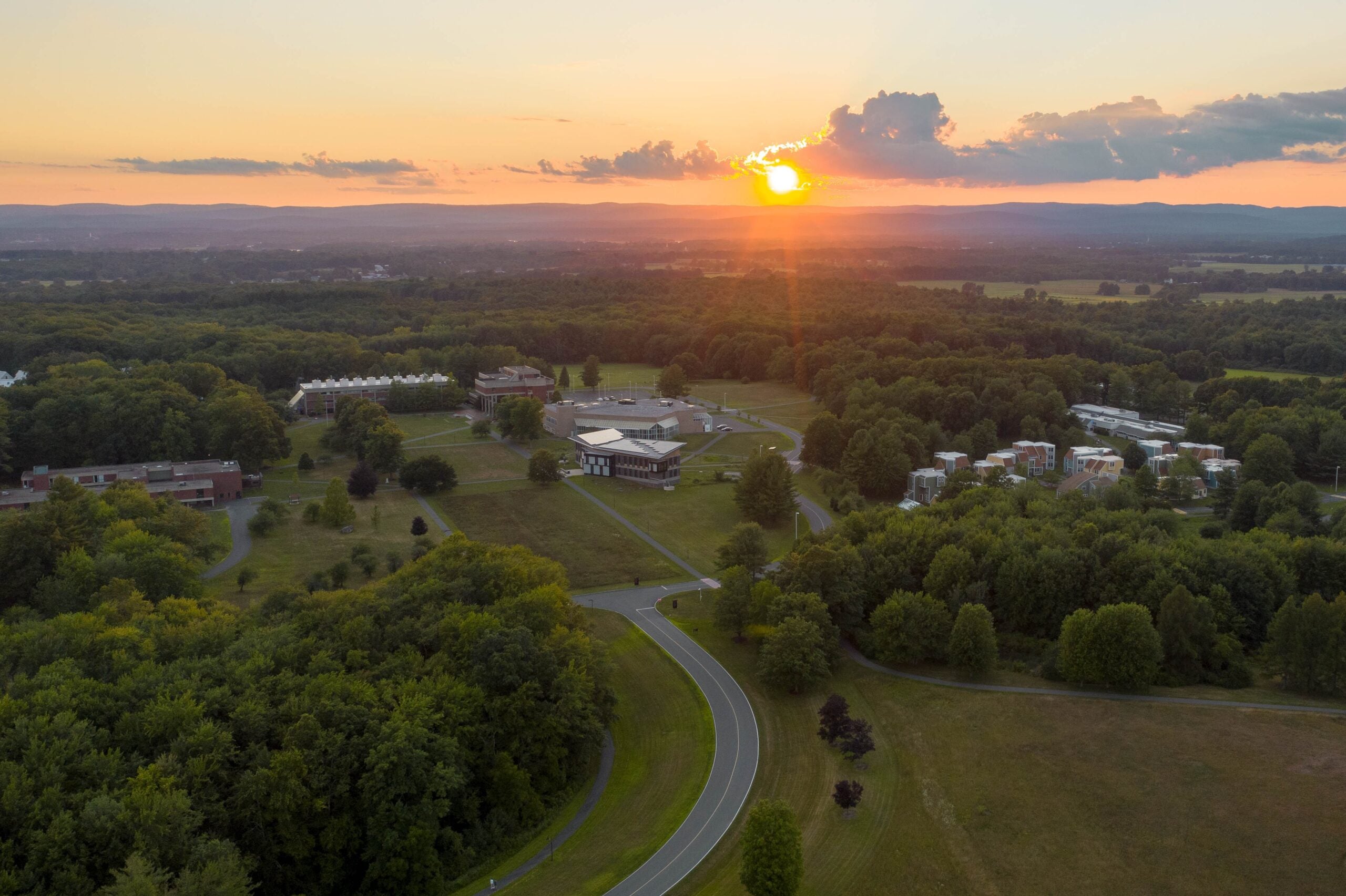
Wingenbach took the helm at Hampshire that summer and set out to put the college on a path to financial stability by launching a campaign to raise $60 million, growing enrollment, and leveraging land and other assets.
A skeleton class eventually came through, but the college still struggled. Wingenbach, meanwhile, left Hampshire last year to become the president of the American College of Greece.
Wingenbach declined to comment.
Leaving Hampshire employees with nothing seems “fundamentally wrong,” said employment lawyer Michael Aleo, especially when the college’s own employee manual states that “eligible employees who are laid off without recall will receive severance pay based upon their years of service and signing a release of claims agreement.”
But Hampshire simply doesn’t have enough money left for severance, a situation that’s common when colleges close, said Larry Ladd, an expert on college finances.
“It was a perfectly rational and sound business decision for the college to close, but hope prevailed in 2019 — and it lasted for another seven years,” he said. “They truly believed that they would be able to figure it out.”
Advertisement:
Administrators aren’t being “heartless,” he added, it’s just “highly likely that they had no choice.”
Hampshire already tapped more than $20 million from its endowment to support its budgets from 2021 to 2024, according to an internal financial update for faculty members dated Dec. 5, 2023, and reviewed by the Globe.
And like many small colleges around the country, it failed to meet its enrollment goals. In the academic year ending in 2025, it came up around $6 million short of its forecasted net tuition and board revenue, bringing in $20.5 million, instead of $26.6 million. Only 667 students were enrolled as of April 15, far fewer than the college’s 1,173 target, according to a 2024 financial update to the faculty.
Some professors want to know why the board chose to vote on the closure only in April, after the academic hiring cycle had passed.
“Pulling the rug out in the middle of the spring term after all of the jobs are gone is a very surprising move,” said Goldberg.
Terence Burke, an external spokesperson for Hampshire, said the school tried its best to make the decision “in a timely fashion” before the May 1 student enrollment deadline that exists at many institutions.
Burke added the school “understands the challenge created by the lack of severance while balancing a range of resource utilization needs.”
But Hampshire “should have declared financial exigency long ago and given faculty full view of the institution’s outlook,” said Lukas Moe, an organizer with the American Association of University Professors.
When Hampshire’s president, Jennifer Chrisler, briefed faculty last fall, “she went over the numbers and said, basically, we have a tough row to hoe, but the board and I have worked out a path that can get us there,” said James Wald, an associate professor of history who has taught at Hampshire for nearly 40 years. “She never said it was an absolute certainty, slam dunk.”
Advertisement:

Still, Jenkins said, faculty members did not get a true sense of “how dire” the college’s finances were until a week before the closure was announced.
A web page from last January reads: “Is Hampshire College closed? Nope. No way. Not by a long shot.” In an interview with the Globe this January, Chrisler said reports of the school’s demise had been “greatly exaggerated,” paraphrasing Mark Twain.
The message to the campus community was also relentlessly hopeful, with repeated prompts from leadership to both faculty and alumni from fall through late March to imagine what Hampshire might become “‘if money were no object’ . . . which was a clue that it was kind of farcical,” said Faune Albert, a Hampshire alum and co-director of the school’s Writing Program.
A week or so before the closure announcement, “Jenn told us how all these different things had just kind of failed, and that, unless a miracle happened, things were looking really not good,” Jenkins said. “And that was a really big shift from how things had been presented.”
There’s a lesson here for other struggling colleges, Albert said. “They should be honest with themselves and their communities.”
Burke said Tuesday that Hampshire’s leaders “communicated regularly with faculty and staff that the College’s finances were in a challenging position and that we needed to pursue multiple paths to financial sustainability.”
He added that the board and administration took “every step possible” to try to save the college, and they “consistently shared the seriousness of the challenges and provided regular updates.” The decision to close was made and communicated as soon as it was clear “that none of the proposed steps would be successful,” he said.
Advertisement:
Leadership at the college declined to answer many of the Globe’s questions, such as how much remains of the school’s endowment, who the school’s creditors are, and whether the college’s assets, once liquidated, could be used to pay severance to eligible employees.
Despite increasingly worrisome signs of problems over the last year, including heavier workloads, missed enrollment targets, and dwindling resources, Goldberg said faculty were sustained by the sense that “what we’re doing is meaningful.” On winter days when their office had no heat, “five students would come in, and it would be a lot warmer, and we’d all have tea.”
While the college will wind down all of its operations by the end of the year, only a small number of faculty members will be hired back to teach this fall, though it’s still not clear how many. Students who choose to return in the fall will likely need to take classes off campus at one of the other schools in the Five College Consortium, which includes Amherst, Mount Holyoke, and Smith colleges as well as the University of Massachusetts Amherst.
The community is rallying to raise money to help employees. The Emergency Relief Fund, organized by Hampshire faculty and staff, has collected $90,000 out of a goal of $500,000.
The American Association of University Professors and Hampshire Workers for a Just Closure also co-organized a petition to the Five College leaders asking the other members of the consortium to offer jobs to Hampshire faculty and staff and automatic acceptance to students wishing to attend their schools. They said they have not received a response.
Advertisement:
Many people are still processing the news.
“One day we were planning for what the next academic year looked like,” said Lorenzo Conte, director of the Hampshire College Art Gallery, “and the next day we were trying to understand what closure looks like.”
Wald recently mixed a cocktail called Burnt Fuselage in honor of Hampshire’s passing. He plans to retire at the end of this semester.
Goldberg, 36, had hoped to stay at Hampshire until retirement. They’re now on the job hunt in a cutthroat academic market during a highly unstable period for higher education.
“For those of us who either can’t get jobs here, or can’t get jobs period, I think it really is the end,” Goldberg said. “It’s a crushing situation.”