
Lake Forest College’s 107-acre campus seems a bit more crowded this fall for a good reason. The school is welcoming the largest incoming class in its 169-year history.
This year’s 1,794-member student body includes 423 first-year students and 116 who are transferring from other institutions. In comparison, there were 394 freshmen and 89 transfers on the first day of class last fall and 422 and 92 in 2024.
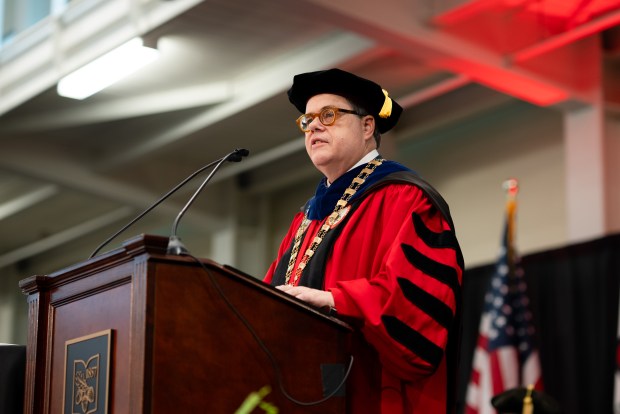
“I think the headline is ‘The Secret is Out,'” said College President Michael J. Sosulski.
“Lake Forest College is not a best-kept secret any longer,” he added. “Our applications numbers are growing, and our acceptance rates are improving.”
Key reasons for this, cited by Sosulski, include the college’s location by Lake Michigan and proximity to Chicago, its affordability, and its post-graduate outcomes.
“Within six months, 97% of our graduates are either employed in career-type jobs or they’re in graduate school,” he said.
The four-year graduation rate is 70% and, six years after graduation, the median salary for alumni is $51,324, according to U.S. News & World Report.
This is not by accident, Sosulski said.
“We know our students by name,” he said. “So we write some of the best letters of recommendation you can even imagine because we really know our students well and we can attest to what their strengths are and we help nurture their ambitions all along the way.”
This quality has been recognized by The Princeton Review, which ranked Lake Forest College 14th best in career services (along with including it on their “best value colleges” list).
The school is also actively recruiting transfer students — particularly from the College of Lake County and the College of DuPage.
“We’ve turned into one of the most transfer-friendly liberal arts colleges in the country,” Sosulski said, explaining that removing barriers to the transfer of credits is a major reason for of this.
“If you get an associate’s degree from the College of DuPage or the College of Lake County, you’re going to transfer with pretty much all those credits — and that’s a big deal,” he said. “We tell potential transfer students “You’re going to be welcomed at Lake Forest College and you’re going to thrive.”
About 45% of Lake Forest students are from out of state, with 44 states represented. Approximately 20% are international, coming from 119 different countries.
“It is really exciting to teach a classic text in a room that is filled with people from all over the world,” Sosulski said. “It creates a vibrancy.”
This includes discussing The Grapes of Wrath in a classroom with students from Africa, Asia, and the Middle East along with the college’s “traditional catchment area” from the Great Lakes states.
The college’s location and positive word-of-mouth free advertising have helped recruit students from outside the region, as has Lake Forest’s excellence in Division III sports — particularly with several players from Arizona on the football team’s roster.
Sosulski said the Foresters played a game last fall in Chandler, Arizona, which was supposed to be a neutral site, but he said it felt like a home game as Lake Forest players’ family members filled the stands.
The school’s soccer teams have also excelled in recent years, with the women Foresters going undefeated in their conference for the last three years and finishing last season with a 21-1 overall record.
“I love Division III because it’s probably the only division anymore where you can say with a straight face ‘student-athlete,'” Sosulski said. “D3 is about putting the students’ academic interests first while maintaining competitiveness in athletics.”
The most popular majors at Lake Forest are in the economics, business, and finance areas, Sosulski said, but the school is also attracting students with new majors in neuroscience and artificial intelligence that are not typically offered at traditional liberal arts institutions.
https://www.lakeforest.edu/academics/majors-and-minors/neuroscience
https://www.lakeforest.edu/academics/majors-and-minors/artificial-intelligence
The school’s health professions program is also attracting students. The program provides pathways toward healthcare administration, nursing, public health, and other careers. It also includes an affiliation with the nearby Rosalind Franklin University Medical School.
Other enrollment drivers touted by Sosulski included the school’s “In the Loop” summer internship program, which includes housing in a downtown residence hall, and the college’s low 13-to-1 faculty-to-student ratio.
“We have the ratio of faculty and staff that permits us to know everyone by name,” he said. “You’re not going to be anonymous.”
Sosulski would not, however, predict that enrollment records would continue to be broken. But he said continued growth in applications is anticipated.
“The trend in our enrollment has been positive — even during the pandemic,” he said. “When you pick up steam that way, people hear about what’s going on — that we’re offering an elite educational experience here at an affordable price. The secret’s out.”
Andis Robeznieks is a freelance reporter for Pioneer Press.