
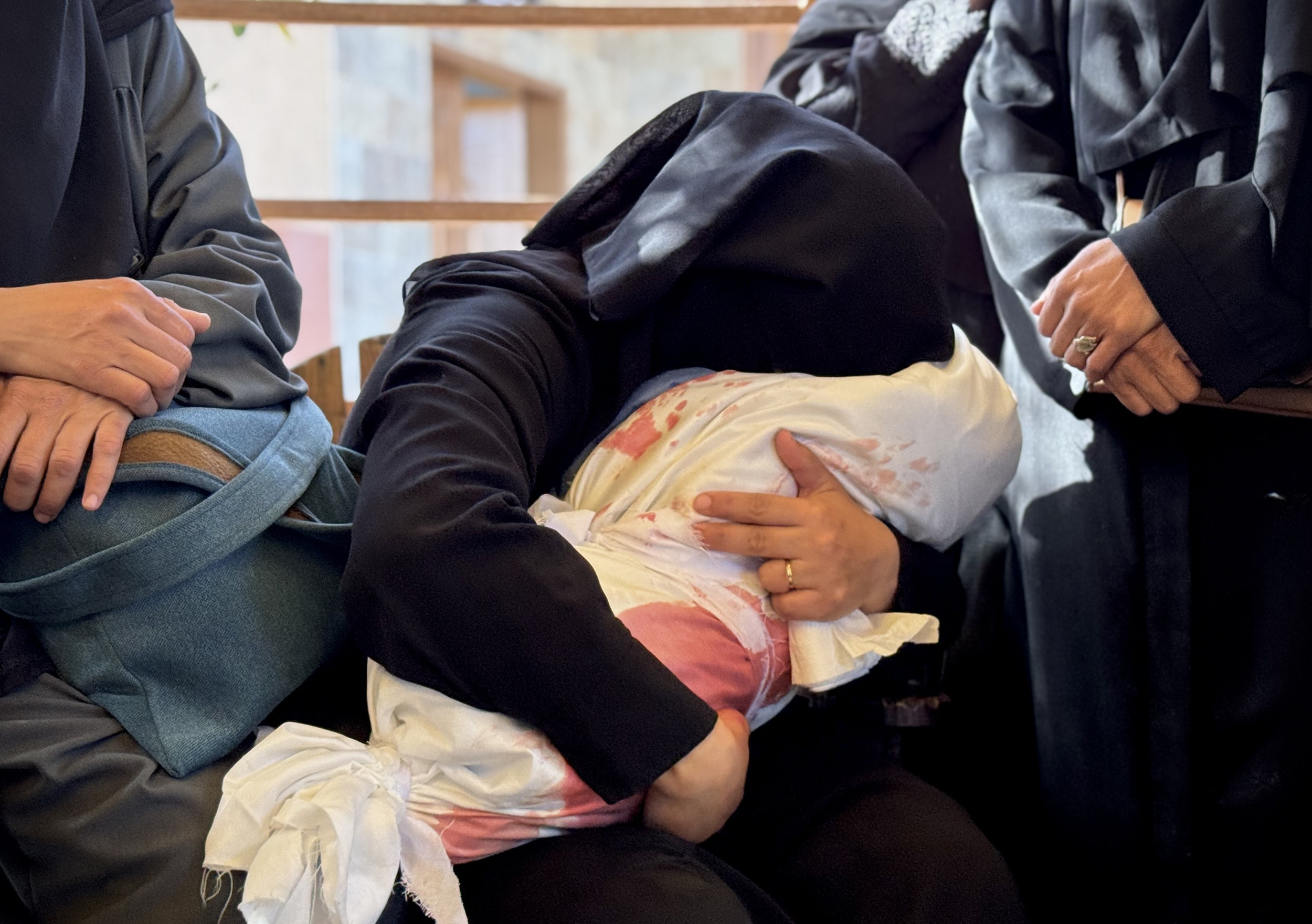
“Please, don’t put him in the fridge!” she said. “He can’t bear the cold.”
Her voice cracked as she pleaded with medics not to place her 2-year-old son Omar in the morgue. She had tried for nine years to have a child. Then, in the instant it takes an airstrike to crash into a building in Khan Younis, in the Gaza Strip, he was gone.
We often hear that the genocide in Gaza that began in October 2023 has taken the lives of so many innocent people. And though men in Gaza are also entitled to a presumption of innocence, the killings of women — over 20,000 Palestinian women and 15,000 children have been killed — have demonstrated to the world how Israel is targeting not just Palestinians, but also their future.
On May 15, Palestinians mark Nakba Day, a commemoration of their collective dispossession, expulsion, and displacement at the hands of the Zionist project and the state of Israel. Today, more than ever, it is obvious how this catastrophe is not just an event of the past in 1948, around the time of Israel’s declaration of independence, but rather an ongoing effort to destroy the Palestinian people.
This war, after all, is not just about death. It is about making life impossible.
Palestinians are now forced to live, give birth, and bury their children in the same space.
This is especially visible in not just the attacks on children, but also on women’s access to reproductive care. Maternity wards have been shut down, neonatal care all but wiped out, and literally embryos at a fertility clinic destroyed by the thousands. UNICEF reports a 300 percent increase in miscarriages. Eight infants died of hypothermia in January of this year.
To destroy reproductive capacity is to erase the future of a people.
Palestinians are now forced to live, give birth, and bury their children in the same space.
The all-out assault on children puts parents in a constant panic. “It’s like an apocalypse,” one father said. “You have to protect your children from insects, from the heat. There is no clean water, no toilets, and the bombing never stops. You feel subhuman here.”
That is the point.
Genocide is not just about bodies. It is about condition. The attack on the Palestinian future is part and parcel of Israel’s assault. It is part of the ongoing Nakba. Don’t believe me? Just look at what Israel’s Agriculture Minister Avi Dichter said as the war was intensifying in its early days: “We are rolling out the Gaza Nakba. … Gaza Nakba 2023. That’s how it’ll end.”
The Toll
The specifics of the toll on women, reproductive care, and children are staggering.
When Gaza’s health ministry released a 1,516 page document listing the names of confirmed Palestinian deaths, the first 27 pages were comprised of names where the age was listed is 0: children under 1 year old.
An average of 37 mothers have been killed each day. And, for the last 19 months, Israel has killed an average of 30 children per day.
The first 27 pages were comprised of names where the age was listed is 0.
At least, 50,000 pregnant women remain without medical care. Women are giving birth in rubble and tents, without anesthesia. Gaza’s largest fertility clinic, housing 3,000 embryos, was bombed to the ground. Maternity wards were shelled. Incubators shut down after fuel was cut off. And then there are the unnecessary hysterectomies: Doctors removing wombs to prevent infections when there are no antibiotics, no equipment, no clean tools. Lives are saved by ending the ability to give life.
Article II of the Genocide Conventions defines one form of genocide as “imposing measures intended to prevent births within the group.” Article 16 of the Fourth Geneva Convention demands particular protection for expectant mothers, while Articles 55 and 56 compel occupying powers to provide food and maintain medical services. Israel is in flagrant violation of all of these.
The destruction of every hospital in Gaza capable of delivering babies was intentional; a U.N. panel found in March that Israel was targeting health care infrastructure.
The human toll, too, is harrowing.
Dina Hani ‘Eleiwa was nine months pregnant when white phosphorus was dropped near her shelter.
“The doctor told me the baby was not moving,” she said. “He told me it was already dead.”
She was not alone. According to the U.N. and human rights reports, women across Gaza have suffered late-term miscarriages after exposure to phosphorus, trauma, and starvation.
Hadil Isma’il Sbeihat, eight months pregnant, survives on a single daily plate of rice.
“There’s nothing for the baby,” she said. “Not even water.”
Destroying Survival
If the intention of genocide is to destroy the conditions under which a group can survive, then what is left to argue?
Gaza’s medical system has been collapsed. Al-Shifa
to feed their babies. They breastfeed under bombardment.Gaza is a womb being emptied. It is a place where birth is a death sentence and motherhood is a target. And the world watches as if Palestinian death were an abstract thing. But Omar was not abstract. Omar had a name. Omar couldn’t bear the cold.