
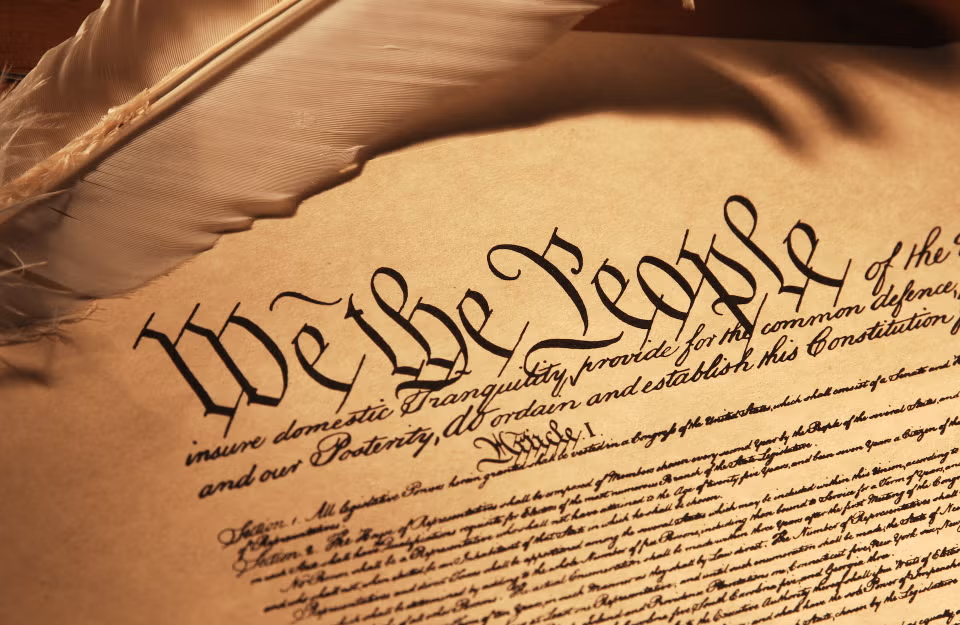
Article II Below is a detailed article on Article II of the U.S. Constitution, which establishes the executive branch of the federal government, followed by an analysis of key Supreme Court decisions that have shaped its interpretation. This article draws on constitutional text, historical context, and Supreme Court rulings, with references provided at the end. Article II of the U.S. Constitution: The Executive Branch and Its Judicial Interpretation Article II of the United States Constitution establishes the executive branch of the federal government, vesting its authority in the President of the United States. Ratified in 1788, this article outlines the president's powers, duties, election process, qualifications, and mechanisms for removal
. While relatively concise compared to Article I (which details the legislative branch), Article II has been the subject of significant interpretation by the U.S. Supreme Court, shaping the scope of executive authority in American governance. This article explores the structure and provisions of Article II and examines landmark Supreme Court decisions that have clarified—or, at times, expanded—its meaning. Overview of Article II Article II is divided into four sections, each addressing distinct aspects of the executive branch: 1. Section 1: The Presidency, Election, and Qualifications - Clause 1: Vests executive power in the President, specifies a four-year term, and mandates an oath of office: "I do solemnly swear (or affirm) that I will faithfully execute the Office of President of the United States, and will to the best of my Ability, preserve, protect and defend the Constitution of the United States." - Clauses 2-4: Establishes the Electoral College system for electing the President and Vice President, granting states the power to appoint electors equal to their congressional representation. - Clause 5: Sets eligibility requirements: the President must be a natural-born citizen, at least 35 years old, and a U.S. resident for at least 14 years. - Clauses 6-8: Address succession, compensation, and the oath of office. 2. Section 2: Powers of the President - Clause 1: Designates the President as Commander-in-Chief of the armed forces and empowers them to seek opinions from executive department heads and grant pardons (except in cases of impeachment). - Clause 2: Grants the power to make treaties and appoint major public officials (e.g., Supreme Court justices, ambassadors) with the advice and consent of the Senate. - Clause 3: Allows the President to fill vacancies during Senate recesses. 3. Section 3: Duties of the President - Requires the President to deliver a State of the Union address, recommend legislation, convene Congress in emergencies, receive foreign ambassadors, and "take Care that the Laws be faithfully executed." 4. Section 4: Impeachment - Provides for the removal of the President, Vice President, and other civil officers for "Treason, Bribery, or other high Crimes and Misdemeanors." Article II reflects a delicate balance struck by the Framers at the Constitutional Convention of 1787. They sought to create a strong executive capable of unified action—unlike the weak executive under the Articles of Confederation—while preventing the emergence of a monarchy. The vague phrasing of certain clauses, such as the "executive Power" vesting and the "take Care" duty, has invited judicial interpretation to define the boundaries of presidential authority. Supreme Court Decisions Interpreting Article II The Supreme Court has played a pivotal role in clarifying and, at times, expanding the scope of Article II through landmark cases. Below are key decisions that have shaped its interpretation: 1. Marbury v. Madison (1803) - Context: This case arose from a dispute over judicial appointments made by outgoing President John Adams, which incoming President Thomas Jefferson refused to honor. - Ruling: While primarily known for establishing judicial review under Article III, Chief Justice John Marshall’s opinion also touched on Article II by affirming the President’s role in executing laws. The Court ruled that the executive branch could not be compelled to deliver a commission unless mandated by law, reinforcing the separation of powers. - Impact: This decision indirectly bolstered the President’s discretion in appointments under Article II, Section 2, Clause 2, while affirming that executive actions must align with statutory authority. 2. McCulloch v. Maryland (1819) - Context: Maryland attempted to tax the Second Bank of the United States, raising questions about federal supremacy and implied powers. - Ruling: Though primarily an Article I case, Chief Justice Marshall’s opinion referenced the President’s role in enforcing federal laws under Article II, Section 3. The Court upheld the constitutionality of the bank, implying executive authority to implement congressional acts. - Impact: This decision supported a broad view of executive power when acting in concert with Congress, setting a precedent for interpreting Article II flexibly. 3. Youngstown Sheet & Tube Co. v. Sawyer (1952) - Context: During the Korean War, President Harry Truman seized steel mills to prevent a strike, claiming inherent executive authority under Article II. - Ruling: The Court, in a 6-3 decision, struck down Truman’s action. Justice Hugo Black’s majority opinion held that neither the Commander-in-Chief clause (Article II, Section 2, Clause 1) nor the "take Care" clause (Article II, Section 3) authorized the seizure absent congressional approval. Justice Robert Jackson’s concurrence introduced a three-tier framework for evaluating presidential power: (1) maximum power when acting with congressional authority, (2) a "zone of twilight" when Congress is silent, and (3) lowest power when acting against Congress. - Impact: Known as the "Steel Seizure Case," this ruling limited inherent executive authority and emphasized the interdependence of Article II powers with legislative action. 4. United States v. Nixon (1974) - Context: During the Watergate scandal, President Richard Nixon resisted a subpoena for White House tapes, asserting executive privilege under Article II. - Ruling: In a unanimous decision, the Court rejected Nixon’s claim of absolute privilege, ruling that the President’s Article II powers do not override the judiciary’s need for evidence in criminal proceedings. Chief Justice Warren Burger emphasized the "take Care" clause, requiring the President to uphold the law, not obstruct justice. - Impact: This case established that executive privilege exists but is not absolute, reinforcing checks and balances on Article II authority. 5. Bush v. Gore (2000) - Context: The contested 2000 presidential election hinged on Florida’s vote recount, raising questions about the Electoral College process under Article II, Section 1, Clause 2. - Ruling: In a 5-4 decision, the Court halted the recount, citing equal protection violations and affirming state legislatures’ plenary power to appoint electors (per McPherson v. Blacker, 1892). The majority leaned on Article II to argue that Florida’s process deviated from legislative intent. - Impact: This controversial ruling underscored the Supreme Court’s role in interpreting Article II’s electoral provisions, though it drew criticism for judicial overreach. 6. Trump v. United States (2024) - Context: Following former President Donald Trump’s actions related to the 2020 election, this case addressed presidential immunity from prosecution. - Ruling: In a 6-3 decision, the Court granted broad immunity for official acts within the President’s "core" Article II powers (e.g., pardons, appointments) but not for unofficial acts. Chief Justice John Roberts cited the need to protect executive discretion under Article II, Section 2. - Impact: This recent decision expanded the scope of presidential immunity, sparking debate over accountability versus executive independence. Analysis and Contemporary Relevance Article II’s brevity has allowed the Supreme Court significant latitude in defining executive power. Cases like Youngstown and Nixon illustrate limits on presidential authority, emphasizing congressional and judicial oversight. Conversely, decisions like Trump v. United States reflect a trend toward broadening executive protections, particularly in national security and official duties—a view rooted in earlier cases like Korematsu v. United States (1944), where emergency powers were upheld (though later criticized). The Electoral College provisions in Article II, Section 1, have also evolved through judicial interpretation. Chiafalo v. Washington (2020) affirmed states’ authority to bind electors, reinforcing the balance between state and federal roles in presidential elections. Meanwhile, Bush v. Gore highlighted ongoing tensions over electoral processes in a polarized era. Today, Article II remains a focal point in debates over executive overreach, emergency powers, and accountability. As of April 7, 2025, the Supreme Court’s evolving jurisprudence continues to shape how this article governs an increasingly complex political landscape. Conclusion Article II of the U.S. Constitution establishes a presidency that is both powerful and constrained, a balance refined by over two centuries of Supreme Court rulings. From Marbury v. Madison’s affirmation of executive discretion to Trump v. United States’ expansion of immunity, these decisions reflect the dynamic interplay between constitutional text and judicial interpretation. Understanding Article II requires not only studying its provisions but also appreciating how the judiciary has molded its application to meet the challenges of governance. References 1. U.S. Constitution, Article II. Available at: [https://www.law.cornell.edu/constitution/articleii](https://www.law.cornell.edu/constitution/articleii). 2. Marbury v. Madison, 5 U.S. (1 Cranch) 137 (1803). 3. McCulloch v. Maryland, 17 U.S. (4 Wheat.) 316 (1819). 4. Youngstown Sheet & Tube Co. v. Sawyer, 343 U.S. 579 (1952). 5. United States v. Nixon, 418 U.S. 683 (1974). 6. Bush v. Gore, 531 U.S. 98 (2000). 7. Trump v. United States, 603 U.S. ___ (2024). 8. Chiafalo v. Washington, 591 U.S. ___ (2020). 9. McPherson v. Blacker, 146 U.S. 1 (1892). 10. Korematsu v. United States, 323 U.S. 214 (1944). 11. "Article Two of the United States Constitution," Wikipedia, [https://en.wikipedia.org/wiki/Article_Two_of_the_United_States_Constitution](https://en.wikipedia.org/wiki/Article_Two_of_the_United_States_Constitution). This article provides a comprehensive overview of Article II and its judicial evolution, supported by primary sources and case law. Let me know if you’d like further elaboration on any section!