
“The majority of us, we don’t necessarily come to these types of events for the speakers because generally they dish out the same slop over and over,” said Jack Moore, 19, a board member of the Georgia Teen Republicans.
They had come hoping to briefly escape the politics of their social media feeds and interact directly with the conservative apparatus at this year’s conference, once a marquee event on the conservative calendar. Last year’s meeting struck a triumphant tone, as Elon Musk cranked a chrome chain saw onstage and President Donald Trump gleefully recounted the tale of his political comeback. But for the past several years a younger crowd has declared the event passé.
At the four-day conference in Grapevine, Texas, last week, young conservatives willing to take a gamble on this gathering found themselves marooned in a listless and, with the exception of Shirley, older gathering of Trump loyalists: MAGA B-listers who preferred to avoid the white-hot debates about the future of the party.
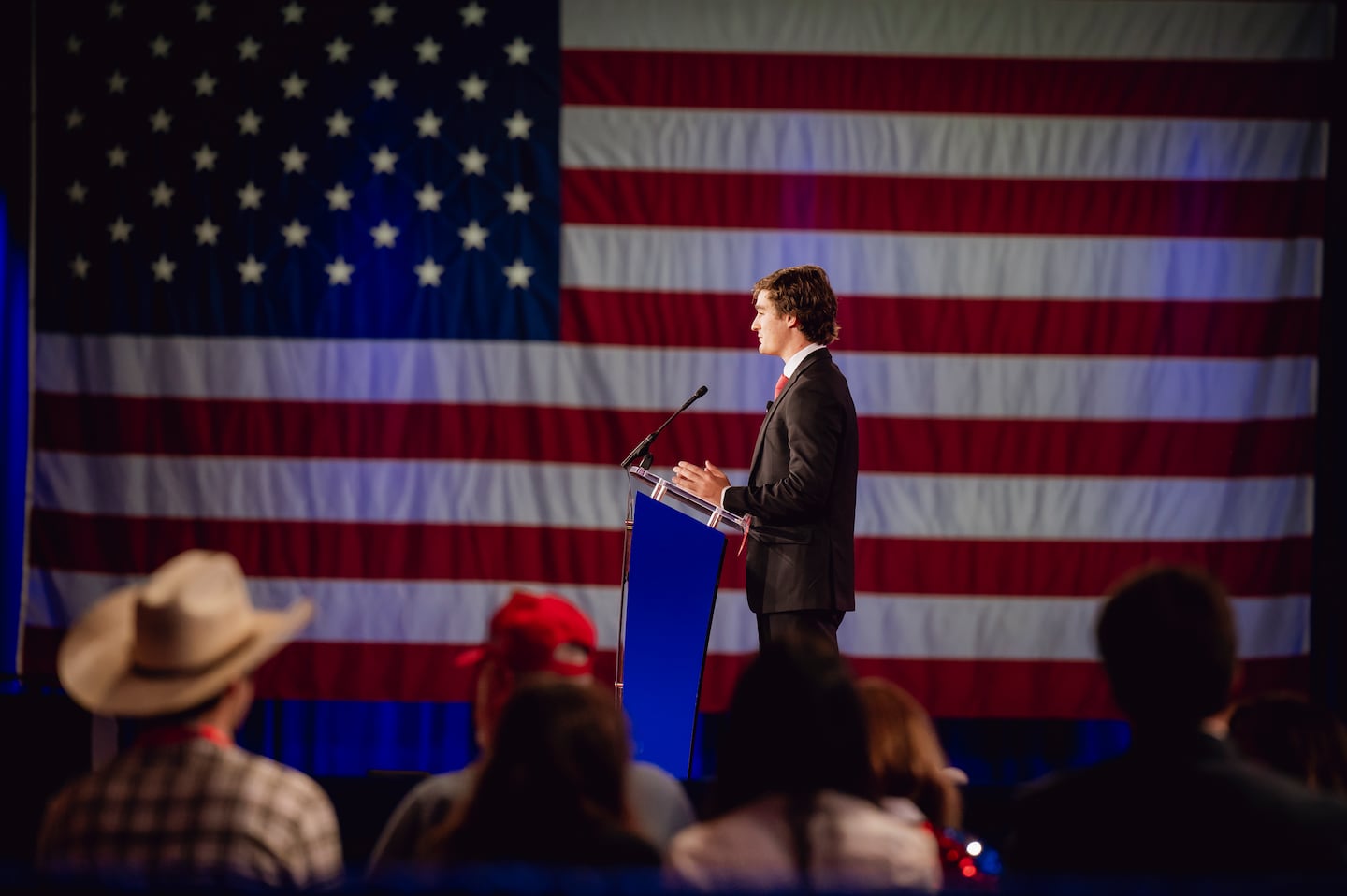
These speakers largely stuck to a tame script -- sounding their support for the president’s war in Iran, whipping up culture-war reactions over things like Shariah, and denouncing the infighting being stirred up by high-profile figures in the MAGA movement.
Even Steve Bannon, the former Trump adviser known for his fiery attacks against fellow conservatives, alluded only obliquely to the glaring issues hanging over the conference. In a short speech on Thursday, Bannon downplayed Trump’s abandonment of his “no new wars” campaign pledge and the conference’s low-wattage conservative lineup, which most noticeably was missing Trump.
“Yes, there are many great people who couldn’t make it,” Bannon said in his remarks. “They either didn’t want to come or they’re tied up running wars and looking after the country. It doesn’t matter. You came. This is the power of this movement.”
For all the talk of MAGA infighting and rifts, including over subjects like the investigation into Jeffrey Epstein and Israel, many young people in attendance seemed to feel that the starkest split in the party was generational.
“There is a divide between the young and old in the party,” said Aiden Hoffses, 19, who had traveled from Maine to attend his first CPAC. “We keep hearing these talking points that we’re all united and in the same movement. That couldn’t be further from the truth. I feel like I have closer views with liberals than more conservatives at this point.”
Those views, Hoffses noted, revolved around issues such as education and health care. “It’s not fair for someone to graduate college and have $100,000 of debt,” he said. “We’re sending billions of dollars to other countries. Why can’t we help our own people?”
As he avoided the scheduled events and dodged the throngs of older conservatives in MAGA-themed regalia, Hoffses had met some fellow disillusioned peers along the way.

One of them was Joseph Bolick, an Army veteran wearing a bright blue “America First” hat, a loud symbol in conservative spaces that one is a supporter of Nick Fuentes, the 27-year-old white nationalist known for making racist and antisemitic remarks.
“It’s very cultish here,” said Bolick, 30, who was attending CPAC for the first time. “It seems like boomers are just on this Trump train,” he added.
After talking with other young attendees at the conference, Hoffses said most appeared to be aligned with Fuentes, who has become a pariah within the conservative movement for, among other reasons, his recent declaration that young conservatives should express their displeasure with Trump’s military strikes on Iran by voting for Democrats.
“I’d say at least 60% of the young people here are fans of Nick,” Hoffses said.
The subject of the war in Iran -- a source of consternation for many young people in the crowd -- was engaged with lightly on the main stage and otherwise relegated to exhibition hall gimmicks, such as gauging support for the conflict with piles of pinto beans.
Matt Gaetz, the former member of Congress from Florida, offered one of the loudest moments of dissent with Trump in the event’s official proceedings.
“A ground invasion of Iran will make our country poorer and less safe,” said Gaetz, who is now the host of a nightly show on the conservative One America Network. “It will mean higher gas prices, higher food prices. And I’m not sure if we would end up killing more terrorists than we would create.”
The speech, though, drew a muted response from the crowd, and some remained frustrated.
“Those conversations are just not happening here,” said Samantha Cassell, a 27-year-old Republican strategist. She was wearing a “Fishback for Florida” hat in support of the rage-baiting Florida candidate for governor who has energized a coalition of young voters in that state. “There’s no serious discussion going on. It’s just flat. I’ve gone to a lot of these events, the RNC, the DNC, and this is probably the worst one I’ve ever been to.”
Some on the far right saw in this generational division an opportunity to claim a young cohort looking for an outlet. Joel Webbon, an online influencer who promotes a brand of nationalism infused with Christianity, wrote that his attendance at CPAC last week revealed one major finding: “The youth are ours,” he wrote in a post on X.
Elijah Schaffer, a far-right commentator, who could be seen roaming the halls at CPAC on Friday in an all-black suit, wrote on X that “CPAC 2026 has given me hope for the American youth. Every young man & woman here are all radicalized / based.”
Among the young Republicans, there were cases of people expressing forms of cautious optimism (about the coming midterm elections) and tentative support (for the president’s abrupt choice to attack Iran), but these views were expressed, for the most part, by attendees with professional aspirations to work in GOP circles.
The yawning alienation shared by CPAC’s young conservatives extended to those with more moderate taste as well, however. Like their more extreme peers, these traditional conservatives expressed an exhaustion with MAGA’s culture-war provocations, Trump’s penchant for chaos and the new class of content creators, like Shirley, whom they saw as offering a shallower mode of conservatism.

“They need to go touch some grass,” said Jack Greenberg, 23, who participates in social meet-ups hosted by the Dallas Young Republican club.
Greenberg, a Trump supporter who works as a real estate developer, expressed dismay that policy had largely been abandoned in favor of rage bait. He laughed as he recounted his meeting with a young content creator at CPAC who claimed to have infiltrated Antifa.
“I just want politics to be boring again,” Greenberg said woefully.
One thing discussed by many young attendees was how Turning Point USA, and its yearly gathering, AmericaFest, appeared to have displaced CPAC as the movement’s center stage for hashing out the party’s future.
Last year’s event, held in Phoenix, was the scene of dramatic infighting between conservative influencers over subjects ranging from Israel’s influence to the place of nativism within the party. While many of AmericaFest’s young attendees found those squabbles to be similarly distracting, CPAC’s attendees yearned for some of that energy.
Without it, people like Cassell felt that there was only one obvious conclusion to reach about the state of Trump’s conservative movement after this past week.
“I think that MAGA is dying,” she said. “I do.”
This article originally appeared in The New York Times.