

Economists have talked about it as the greatest wealth transfer in history.
Baby boomers - boosted by decades of rising house prices, strong stock markets and economic growth - control more than half of U.S. household wealth. When they die, a lot of that wealth is expected to go to their descendants. Estimates have predicted that $68 trillion to $84 trillion in money and assets will change hands over the next two decades.
But those estimates might not sufficiently account for the costs of growing old.
A Washington Post analysis of the finances of thousands of seniors in the last decade of their lives found that, for many families, the cost of care eats away much of what they had hoped to pass on. And within a growing segment, elder care costs are not just diminishing their savings, but obliterating them.
Adult children, rather than being the beneficiaries of generational wealth, are in some cases spending down their own savings to pay for their parents’ care.
The Post’s data analysis was reinforced by interviews and by submissions from hundreds of readers.
“It just eradicates any generational wealth unless you’re very, very well off,” said Bill Roggenkamp, 68, of Ohio.
ADVERTISEMENT
His 96-year-old mother, Edith Bare, has dementia and has been in an assisted-living facility for the past seven years. Her care costs $15,000 per month. But her savings are gone. So her three children took out a loan against the life insurance policy she held jointly with Bill’s late stepfather. If that runs out, they may have to sell part of the Kentucky farm that has been in the family since the 1960s.
Roggenkamp and his wife, Sharon, also a baby boomer, have discussed what would happen if one of them gets a similar diagnosis.
“You do those numbers, especially for long-term care and dementia, and you’re going to need $1 million, $2 million to keep yourself going,” Sharon Roggenkamp said.
They expect they’d spend nearly everything they have, leaving little behind for their adult children.
ADVERTISEMENT
Calculating the cost of aging
That’s the picture that emerged for many when The Post examined data from the Health and Retirement Study. Since 1992, the federally funded survey has been following thousands of Americans from their early 50s until death, recording their finances every two years (regardless of whether they ever retired).
The Post focused on those who died between 2006 and 2022, totaling what they spent out of pocket on care in their final decade and assessing the impact in terms of categories of wealth.
The analysis found that the median American spent $19,179. One in 6 spent more than $50,000. One in 20 spent more than $100,000.
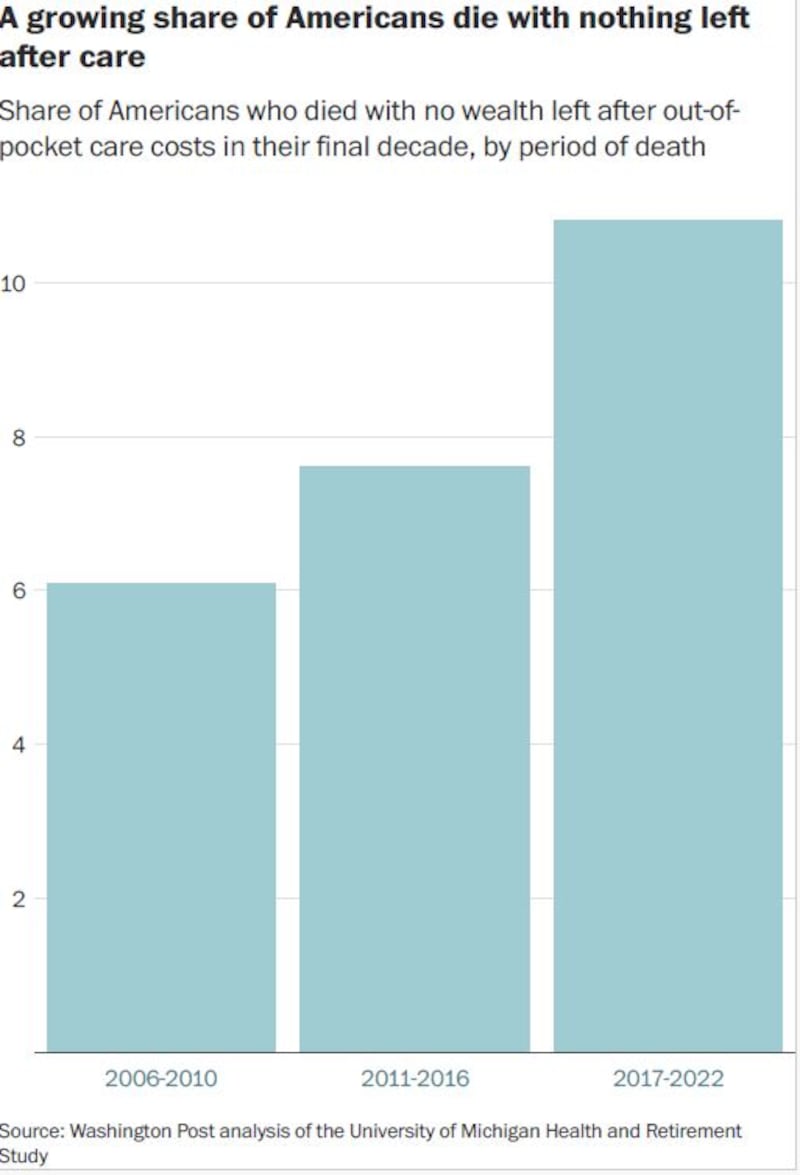
Within the time period The Post examined, the costs of aging grew more consuming. The share of people left with nothing after paying for elder care rose from 6% among those who died between 2006 and 2010 to nearly 11% among those who died between 2017 and 2022.
The costs fell hardest on those with the least: Among the poorest fifth of Americans in the analysis, 41% were left with nothing after accounting for their care costs in the years before death. Overall, this group spent nearly a third of their wealth on out-of-pocket care costs in the last decade of their lives - more than 20 times the share spent by the wealthiest fifth.
ADVERTISEMENT
All the figures are almost certainly underestimations, as they don’t fully account for housing, such as room and board at assisted-living facilities. Those costs often make up the bulk of what families pay.
Most Americans in their later years are homeowners, and many have paid off their mortgages. When they need more care, they may make money from selling their homes.
But assisted-living bills can be a destabilizing shock compared with what seniors were paying toward property taxes and home upkeep. Nationally, the median cost of a private room and basic services was about $74,400 a year in 2025, according to a CareScout Cost of Care Survey. For those who need the more extensive services of a nursing home, the annual median cost was $129,575 for a private room. Seven years of that for someone with dementia, and the bills would add up to nearly $1 million.
“Most Americans - many more than may appreciate it - will have little left to pass onto future generations after depleting assets to pay for long-term care costs,” economic policy researcher Jessica Forden wrote in a study published in April by the liberal Roosevelt Institute.
The idea of a massive wealth transfer is misleading for that reason, said Forden, a PhD candidate at the New School. Her analysis of nationwide data from 1992 to 2022 found the typical middle- and low-income family never financially recovered after working through a lifetime of savings in retirement, widening the gulf between rich and poor.
“It’s going to be the folks at the very top end who are passing on inheritance,” Forden said in an interview. “The rest of us are going to be spending our assets on retirement and probably on monthly care costs so we can get Medicaid eligibility.”
What’s driving the cost of aging
While elder care has long been expensive, economists and retirement experts say a confluence of factors has made it an increasingly urgent concern for many Americans.
Compared with past generations, people today have fewer children to help support them, and their families are more likely to live in different cities and states, meaning they need to outsource care.
Also, lifespans have lengthened. Medical advances have made it possible to successfully manage many chronic diseases. But that has people paying for more years of care than in the past.
Meanwhile, the costs of senior living facilities have soared. The median assisted-living rate increased 44% in five years, according to the CareScout surveys, nearly double the rate of inflation.
Experts and industry officials say the sheer size of the baby boomer generation is increasing the demand for resources and contributing to rising labor costs and, in turn, the price tag of long-term care.
There is “a growing caregiver shortage across health care,” said John Kane, senior vice president of reimbursement policy at the American Health Care Association and National Center for Assisted Living.
“Frankly, it’s not overreaching to say that funding for long-term care in this country is broken,” Kane said. “It’s too expensive for most people, yet it needs further investment to ensure frontline caregivers receive a competitive wage.”
How to cover long-term care?
Financial planners use models to help people map out how much money they should save for their retirement years. But as anyone who has gone through that process knows, there is inherent uncertainty. Will someone die of a heart attack at age 75? Or will they need 10 years of the most intensive and expensive care?
Nearly 1 in 5 people will require high-intensity care for more than three years, according to 2025 research from Boston College’s Center for Retirement Research. And yet many people don’t want to contemplate, let alone budget for, that possibility.
Several analyses have suggested that despite the aggregate wealth of their generation, many baby boomers are ill-prepared for the costs of aging.
ADVERTISEMENT
Experts say many people are particularly surprised to learn that Medicare, the federal health insurance program for older adults, doesn’t normally include long-term care. Only 3% of adults - 15% of those 65 and older - have long-term care insurance, according to the Center for Retirement Research.
That means that much of the cost of elder care falls squarely on families.
Tim and Amy Dillon are helping to support her mother and his father, both living at the same assisted-living facility in Ohio. They help finance her mother’s $8,700-per-month bill by drawing on Amy’s inheritance from her father – her mother’s ex-husband.
But they’ve had to cobble money together for Tim’s 79-year-old father, Jimmy, who is receiving care for dementia that goes well beyond what his Social Security payments and small pension can cover.
They sold Jimmy’s house and belongings. Then, along with Tim’s sister and brother-in-law, they agreed to contribute $1,000 per couple each month. Amy Dillon is a public school teacher. Tim Dillon, who retired from firefighting in 2017, went back to work as a medical courier.
“We have liquidated everything my dad worked for his entire life, and we’re going to give it to the corporation,” he said.
He is grateful his dad is getting good care, but thinks the U.S. “could do more to help take care of our aging population.”
The catch with reliance on Medicaid
When families run through their savings, many turn to Medicaid, which covers nursing home care for people with low incomes -- commonly about $2,000 or less in the bank.
But signing up carries a catch that few families understand until it is too late. Since 1993, federal law has required states to try to posthumously recoup money spent on a person’s long-term care by claiming their assets - often, the person’s house.
Amanda Spishak-Thomas, a Rutgers University assistant research professor who studies estate recovery, spent years as a social worker filling out Medicaid applications without knowing the program could later come for an applicant’s home.
The practice recovers little for the government, but it can be a huge setback for families, she said.
“If your home’s worth $50,000,” she said, “$50,000 is a meaningful amount of money for an adult child.”
ADVERTISEMENT
Marlene Klein said her baby boomer brother could face estate recovery any day now, because he jointly owned a house with their mother, who died last year at age 97.
“I expect that they will come calling at some point,” said Klein, 70. “I will handle it from there. I will tell them, ‘Look, [my brother] doesn’t have any money. The only asset is really’” the house. (States have discretion to waive estate recovery if it would prove an “undue hardship” to heirs, for example by leaving them homeless.)
Klein is uniquely qualified for the task: Her last job before retiring in 2018 included supervising Idaho’s Medicaid Estate Recovery program. In principle, she is not against this recoupment, because it makes funds available for others’ care. But she said many Americans have no choice but to go on Medicaid - and risk estate recovery - because of the prohibitively high cost of long-term care.
“This is a wealthy country,” she wrote to The Post. “Why are the elderly and their families subjected to these cruel options for caring for family members?”
Conrad Miles saved about $200,000 for his retirement years, as well as earning a pension with the Santa Fe Railroad. But after he moved into assisted living, his savings were “gone in a heartbeat,” his daughter Marion Miles said.
When he died at age 93, he had about $30,000 - enough to cover less than three months.
“He kept saying, ‘I’m not going to be able to leave anything to you girls. I’m so sorry,’” Marion Miles recalled.
She said she told him to spend every penny. “Then nobody fights over it. You earned it.”