
Robert Hamlin looks forward to his hospice nurse’s visits.
Homemade party decorations with “Happy Birthday Grandpa” still hung on the wall when Hannah LaVine stopped by the 90-year-old’s Suffolk home on a Friday afternoon to find him reading at the kitchen table. He didn’t look up and as he often does, pretended not to notice her.
“Aren’t I the best nurse?” she said loudly.
“Best what?”
“Best nurse!” she said.
He shrugged, half rolled his eyes. She threw her head back into a full-bodied laugh.
“Best pain in your butt?” she teased.
Hamlin, diagnosed with cancer, has been on hospice for over a year. In addition to Hamlin’s vitals, LaVine checks his medicines and helps him shower twice a week. She’s heard all about his career as a real estate agent, raising his family and bygone adventures skiing in Oregon.
She slipped a blood pressure cuff on his wrist and gently raised his arm level with his heart. The top of his shirt was unbuttoned.
“You drink your coffee black?” she said, searching for a grin. “Is that why you have so much hair on your chest?”
Hamlin lives with his son, Rick, and his daughter-in-law. The son said his father going on hospice was the best decision the family ever made. It’s given his dad comfort in his final days.
Hamlin said he isn’t afraid to die: “What’s there to be afraid of?”
LaVine hugged him tight around his back before she left for the home of another patient. She said her dream is one day to be a national advocate for hospice care. She wants to break the stigma of hospice, and many health care providers share in her frustrations.
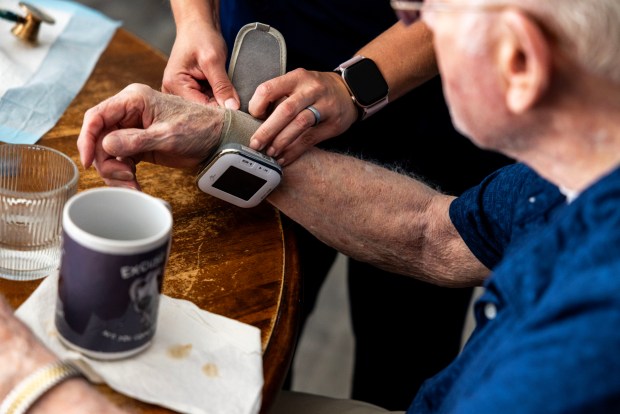
Hospice workers say there are myriad misconceptions about end of life care. To work in hospice, they say, must be a calling. It’s emotionally taxing. But the mission, for those who have it, is too important. Good deaths, they know, do exist. It’s their job to deliver dignity to the dying. And the country is rapidly aging.
Between 2010 and 2020, the census found that people in the U.S. aged 65 or older grew by 38.6% — at the fastest rate in over a century. And Hampton Roads is aging faster than other places, according to the 2025 State of the Region report, conducted by Old Dominion University’s Dragas Center for Economic Analysis and Policy. The study found, between 2019 and 2023, the population of Hampton Roads residents aged 65 or older increased by 10.5% compared with the state, which saw an overall 10.4% increase, and the nation, which experienced a 9.7% increase.
Baby boomers are entering retirement, and hospice workers wish more people knew to take advantage of their services.
Lavine is one of about 23 nurses in Hampton Roads working for Sentara Hospice Services, which provides care at home, the hospital or in assisted living or nursing facilities. As the region’s largest healthcare provider, Sentara provides care for roughly 210 hospice patients among its Chesapeake, Suffolk and Newport News locations. Dozens of private hospice agencies in Virginia also provide facility-based or in-home care.
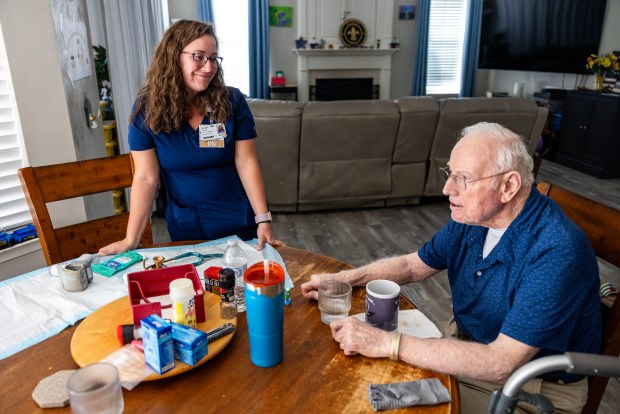
“We’re all going to die of something, right?” said Katrina Melton, Sentara’s vice president of post-acute and palliative care.
It’s important for anyone who knows their death is imminent, she said, to consider what quality of life they’ll live going forward. And that’s what hospice is about.
For many people, the word hospice is associated with a few final days or weeks of life and conjures images of hospital rooms and bedridden, perhaps even incoherent, loved ones in their final hours. And that’s the reality for many people and families.
“I think as a nation, most people come to hospice too late when they’re transitioning towards death with hours to days left,” Melton said, before adding, “So, people don’t get the full benefit.”
Anyone can go on hospice with a diagnosis of six months to live, based on eligibility guidelines, though care isn’t limited to six months. And to choose hospice requires a shift in mindset.
Treatment goes from curative to managed. Curative therapies, many of which can sacrifice quality of life, such as chemotherapy, are stopped. Doctors are no longer trying to cure a person, but help the pain. To go on hospice is to accept death.
And it doesn’t have to be dreary.
‘A good death’
“People think that you’re the angel of death and dying,” said Dr. Brooke Thomas, a Sentara hospice and palliative care specialist. “But hospice is about freedom.”
Americans have embraced a fighting culture when it comes to medicine, she said. For instance, people “battle” cancer. And she’s witnessed patients refuse hospice to avoid any feeling of having “given up.” But many patients, who continue aggressive curative care such as clinical trials, live their last months or days in and out of hospitals, getting sicker and making desperate midnight drives to the emergency room.
“I think a lot of us know what a good death is,” she said, “but we’re afraid to let ourselves take that step to say, ‘OK, it’s time for me to go ahead and admit that I’m dying, so I can plan out a good death — so I can live.’ ”
She tells diabetics to have a little bit of cake, anglers to get fishing and Francophiles to catch a flight and climb the Eiffel Tower. She’s had patients who wanted to spend their last moments sitting on their couch eating hot dogs with their cats and dogs and others who wanted to go to the beach. Her job is to give them the choice.
A primary care physician or disease specialist in addition to a hospice agency doctor have to agree it’s time to go on hospice. Then the patient is visited by three people: a nurse, social worker, and religious figure of the patient’s choosing.
The social worker explains and helps to provide resources such as family and medical leave protections. The chaplain or pastoral care provider offers spiritual counsel, and the nurse assesses the patient’s health, pain levels and medications.
“Everybody thinks that hospice is going to take all the things that they like, all their drugs, away,” Thomas said.
Only medications that don’t improve one’s immediate quality of life are reduced.
In the medical profession, Brooke Thomas said, the probability of drug interactions increases when a person is taking eight or more pills. And some, such as certain cholesterol medicines, are beneficial only if taken consistently for a span of years. So if a person only has six months, she said, why risk the side effects?
And it’s not uncommon for new hospice patients to still be taking the same dosage of drugs they originally were prescribed before a recent and significant weight loss due to fatal illness, Thomas said. When she starts to deprescribe and take away medicines that aren’t necessarily providing benefits, a lot of people will start to feel better.
Then other medications are added. Hospice doctors and their teams have a comfort level with end-of-life symptoms that others in the medical world might not have. They aren’t shy with the pain pills.
Pharmaceuticals such as methadone, morphine, Dilaudid and fentanyl are often associated with abuse, but were made for clinical purposes. Thomas prescribes opioids and tailors cocktails and drug combinations to her patients’ needs to get them to France or the beach or well enough to enjoy time with their dogs or people they hold dear. When it comes to managing pain, she and her peers are experts. But even pros can turn nervous when the situation is personal.
Last year, Thomas’ 90-year-old grandmother was diagnosed with a brain bleed and placed on hospice.
“I will admit, it was the most intimidating thing I’ve ever done,” she said. “I’ve brought kids home from the hospital, but bringing my grammie home from the hospital seemed so much harder.”
Her grandmother moved out of her home on the Outer Banks into Thomas’ house in Smithfield and for the first 48 hours, the older woman remained unresponsive. She couldn’t get out of bed and wasn’t passing urine well. It was unnerving to see a relative in such shape, but Thomas’ husband eventually asked: “Well, aren’t you going to get in there and do your thing?”
“Yeah,” she said.
Thomas sat next to “Grammie” and helped her drink a cup of tea. Thomas and her husband tended to her — providing everything she needed and couldn’t get herself — and on Day 5, she was on her feet and walking again. After six months living with Thomas while on hospice care, the grandmother “got kicked out of hospice,” Thomas said.
“Because she was doing so well, she was no longer dying,” Brooke Thomas said. “It happens.”
The grandmother moved back to the Outer Banks. On average, according to Sentara specialists, of two people who are the same age with the same disease, the one who goes on long-term hospice will live 30 days longer.
‘It was her choice’
Iris Morgan of Virginia Beach was on hospice for two years before she died Sept. 5. She was 89.
“It was her choice,” said daughter Chris Triplett. “And in the end, she didn’t want any machines. She doesn’t want anything like that. Hospice is comfort.”
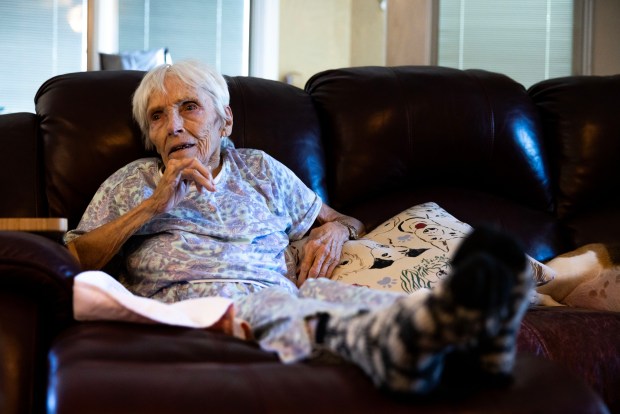
In the last two years of her life, Morgan often enjoyed dancing with Triplett, listening to her son-in-law play music at local venues and taking shots with her daughter at the bar. She lived in her daughter and son-in-law’s house and spent time at the Dozoretz Hospice House of Hampton Roads in Virginia Beach. It’s the larger of only two freestanding in-patient medical facilities devoted solely to hospice in Hampton Roads.
The Dozoretz Hospice House is equipped with 12 patient suites on its first floor and private rooms for visiting family members on its second floor. Medicare and Medicaid hospice benefits cover five-day stays at the facility. After five days, the out-of-pocket cost to stay in the house is $900 per day. Many families use the hospice house as a temporary respite.
Emily Legner, who oversees all operations at Dozoretz, explained that it’s hard to take care of someone every minute of every day for weeks on end. Patients check in to the hospice house and their caregivers get a well-deserved break. For her two years on hospice, Morgan was a frequent guest at the house.
“She had the most exciting little personality. So much fun. She was always talking about partying and going to the bar and taking shots,” said Anne-Malone Thomas, a hospice house nurse.
-

Chris (left) and Jeff Triplett, Iris Morgan’s daughter and son-in-law, speak about the care Morgan has received while on hospice at the family’s home in Virginia Beach on Monday, August 31, 2026. Morgan was in hospice care for two years and died on Sept. 5, 2026. (Kendall Warner/The Virginian-Pilot)


1 of 4
Chris (left) and Jeff Triplett, Iris Morgan’s daughter and son-in-law, speak about the care Morgan has received while on hospice at the family’s home in Virginia Beach on Monday, August 31, 2026. Morgan was in hospice care for two years and died on Sept. 5, 2026. (Kendall Warner/The Virginian-Pilot)
Morgan used to be an administrator at an assisted living facility, and when Thomas learned of the older woman’s former career, the nurse put Morgan to work. On one of Morgan’s stays, another patient with dementia kept getting out of bed, circling the lobby and trying to get out of the building — and Morgan calmed her.
“Iris would take her out in the lobby in the common area and keep her busy while we worked,” Thomas recalled.
A good hospice nurse must be able to care and connect with their patient while simultaneously and consciously maintaining an emotional distance, Thomas said. It’s a balancing act. It can be difficult. And dementia patients are often the most difficult.
“I’ve got one in there that she hits, spits, bites, kicks,” she said.
Some patients are lucid one moment and not there the next. Thomas once tended to a woman who on her good days would chat, be friendly, tell the nurse: “I know I have dementia.”
On bad days, the patient would become enraged, yelling at Thomas: “You get out. I don’t ever want to see you again. Get out!”
Thomas talks to herself at the end of every shift. She tries not to take work home with her, but couldn’t shake that patient.
The nurse had to call her then boyfriend, now fiancé, to talk about it on the way home from work.
“It’s not her fault. It’s not personal. But there’s still part of us as human beings that can’t, you can’t help the way it makes you feel,” Thomas recalled.
The staff is well acquainted with death in the building.
‘It heals you’
When applicants apply to work at the house, Mattie Kilmer, a registered nurse and the hospice house administrator, asks them extensively about their experiences and comfort levels dealing with and being around death. Her career began in the emergency room where she saw instances of child abuse, child deaths and violent injuries. Working primarily around older people as they die, she said, is much easier.
“Part of this place is healing because after you see people pass away in such horrific and traumatic ways, and here you can bring them comfort and peace, it literally — it heals you,” Kilmer said.
-
Mattie Kilmer, RN, talks to the family of a potential intake at the Dozoretz Hospice House of Hampton Roads on Thursday, September 17, 2026. (Stephen M. Katz / The Virginian-Pilot)


1 of 2
Mattie Kilmer, RN, talks to the family of a potential intake at the Dozoretz Hospice House of Hampton Roads on Thursday, September 17, 2026. (Stephen M. Katz / The Virginian-Pilot)
Many patients come to the house in pain. They transform into calmer people when staff adjust their medication. The occasional young patient can affect staff morale, Kilmer said.
Morgan’s death affected most of the staff. Kilmer recalled their final visit.
“I said, ‘Hey, Miss Iris. It’s Mattie. Just want to come in and check on you,’ ” Kilmer recalled.
Morgan perked up. She sat up in bed.
“She was like ‘My Mattie,’ ” Kilmer recalled.
They hugged. They chatted. Morgan asked if she was going to die.
“Yes, Miss Morgan. You are based on your clinical presentation,” Kilmer said.
“‘Well, I don’t want to,’ ” Kilmer recalled Morgan saying. “ ‘I don’t want to go alone.’
“And, so I told her, ‘Well I’m sitting here with you. I’ll hold you.’ And she’s like, ‘Will you go with me?’ And I was like, ‘I’ll go with you.’ ”
Morgan relaxed and went back to sleep.
The nurse sat on the bed for 20 minutes, holding the dying woman’s hand.
Colin Warren-Hicks, 919-818-8139,