
Sign up for the Slatest to get the most insightful analysis, criticism, and advice out there, delivered to your inbox daily.
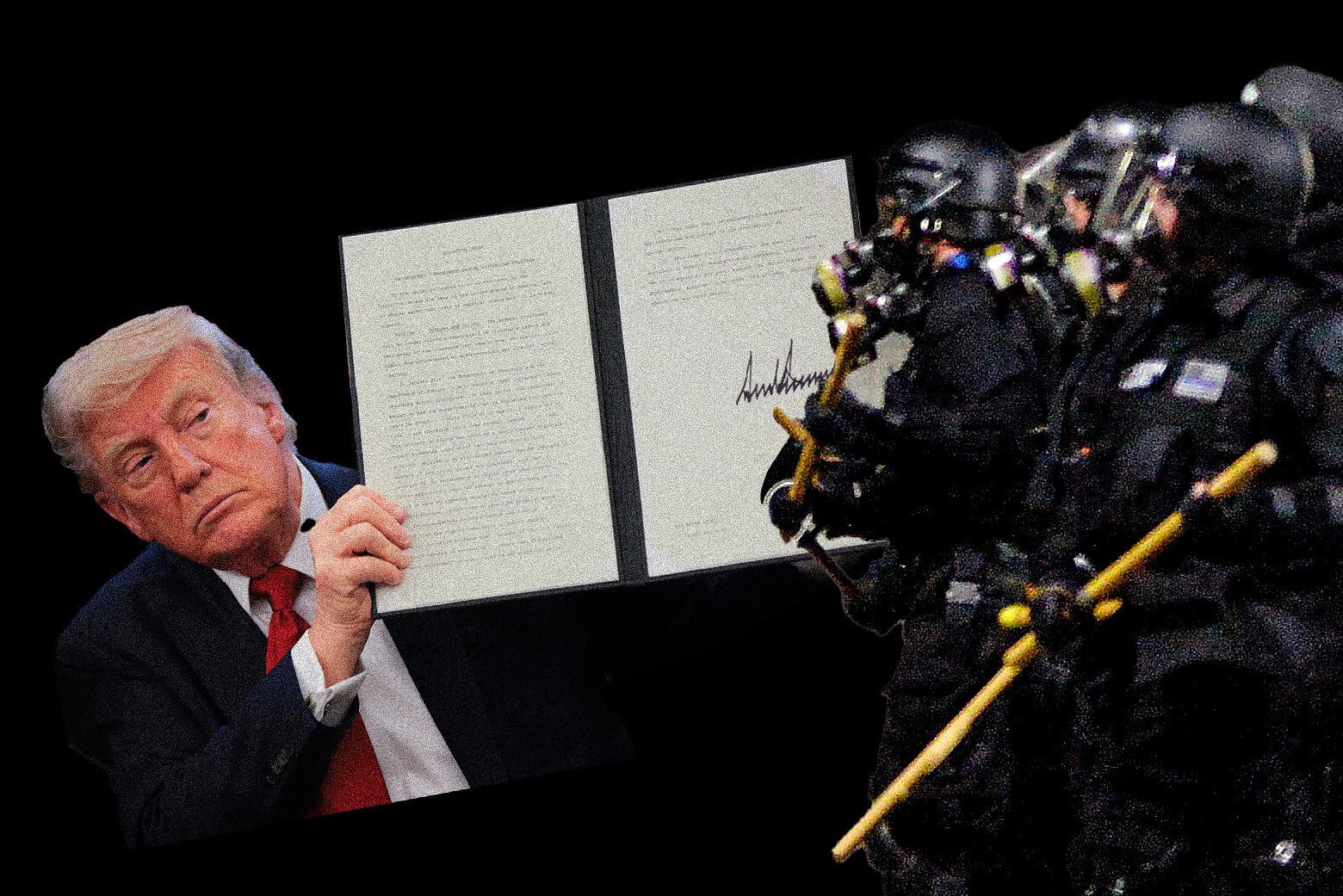
It reads like a declaration of war, but with no named enemy and no battlefield. President Donald Trump’s April 2025 executive order titled “Strengthening and Unleashing America’s Law Enforcement to Pursue Criminals and Protect Innocent Citizens” is written in the language of emergency, where words like “lawless violence” and “injustice” gesture toward chaos while carefully avoiding the word. It offers no data, no thresholds, no limiting principle. Just one claim, repeated in various forms: that the state is under siege, and only unrestrained police and prosecutors, controlled by Trump, can rescue it. Joined with Trump’s newly extorted pledges of legal service from the country’s most powerful firms, this order does more than expand state power—it unleashes one of Trumpism’s core doctrines on the public: a police state sanctified, weaponized by law, upheld by lawyers who mistake résumé lines for moral courage, and placed entirely under the command of a man who bends the system to his will and answers only to himself.
The order echoes the emerging judicial logic that once the state claims fear, its violence need not be explained, only accepted. There is no room here for nuance, discretion, or error. There is only the sanctioned arc of force, pre-cleared and pre-excused. And it relies on the same professional choreography seen in Big Law’s response to Trump’s attempted extortion: not overt endorsement, but strategic accommodation. The same lawyers and firms that pledged millions to one man will now provide the cover for this project of expanded police power. Not by defending the order outright, but by lending their credibility to the system that enforces it. They will not bring the batons, but they will explain why no lawsuit can be filed once the bruises fade.
Previous executive orders signed by Trump have spoken in the clipped dialect of bureaucracy, dense with statutory references and procedural nudges. This one does not. It uses few words to do maximum harm, cloaking its structural violence in the appearance of simplicity or administrative focus. Beneath it lies a lattice of unspoken assumptions, a worldview so entrenched it does not need to be said, only enforced. To read the order without that context is to miss its meaning entirely.
It does several things at once, each reinforcing the others.
First, it directs the attorney general to review whether local prosecutors are “adequately enforcing the law”—a phrase that appears neutral but functions as a political indictment. It reframes prosecutorial independence in the name of criminal justice reform, however minimal or shallow, as defiance. Those who decline to seek maximum penalties, who choose diversion over incarceration, or who investigate police officers for misconduct in the line of duty are now on notice and flagged as threats to order.
Second, the order instructs the attorney general to “review all ongoing Federal consent decrees, out-of-court agreements, and post-judgment orders” involving state or local police departments and to “modify, rescind, or move to conclude such measures that unduly impede the performance of law enforcement functions.” These reforms are binding, court-enforced frameworks created after Department of Justice pattern-or-practice investigations uncovered systemic constitutional violations. Each of these departments was subject to a federal investigation that uncovered a sustained pattern of lawless policing—constitutional violations so routine they became institutional habit. They include the Minneapolis Police Department after the murder of George Floyd and the Louisville Metro Police Department after the killing of Breonna Taylor. The order treats federal oversight of these structurally broken arms of the state not as a safeguard for civil rights, but as an obstacle to law enforcement’s unfettered power.
Third, the order directs the Department of Justice to “strengthen and expand legal protections for law enforcement officers.” The structure of American law, however, already treats police officers as presumptively justified, legally insulated, and professionally untouchable.
Civil plaintiffs suing officers for abuse face the barrier of qualified immunity, a doctrine that forecloses suit unless a precedent exists condemning nearly identical facts. As Judge Carlton Reeves wrote in Green v. Thomas, qualified immunity was “invented by the Supreme Court in 1967”—not by Congress, but by judicial fiat. “A cynic might say,” Reeves observed, “that with qualified immunity, government agents are at liberty to violate your constitutional rights as long as they do so in a novel way.”
And while civil suits are stymied by doctrinal barricades, the criminal system offers no more promise of justice. Even when violence is captured on video—when bodies are battered or breath is stolen in plain sight—criminal prosecutions of police remain vanishingly rare. Prosecutors, often politically and professionally aligned with law enforcement, bring charges sparingly. Juries defer. Internal reviews disappear. And the doctrines of deference cloak not just the violence officers inflict, but the fears they invoke to justify it.
This legal order of protection is layered atop a large, long, and uninterrupted line of Supreme Court precedent that has reinforced police power like a vault—locked tight against accountability, sealed off from public redress. By promising more of the same, Trump’s order implies that what limited accountability for police violence currently exists will go by the wayside.
Fourth, the order “promotes investment in the security and capacity of prisons.” In other words, the federal government is preparing for more incarceration, more surveillance, more bodies behind bars. This provision builds the infrastructure for a legal order in which harm is synonymous with control, and punishment is the state’s primary form of social management.
And finally, the order does not merely target crime—it targets the concept of equity itself. By directing law enforcement agencies to abandon what it calls “race- and sex-based equity policies,” it casts diversity, equity, and inclusion not as commitments to fairness, but as threats to public safety. In doing so, the order collapses the distinction between bias and justice, framing any attempt to correct historical imbalance as an obstacle to law enforcement. It doesn’t just criminalize conduct. It pathologizes care.
All of this is not just a White House project. Its survival depends on a legal profession already positioned to serve it. Some of the most powerful firms in the country pledged tens of millions of dollars and legal services to the Trump administration—not under pressure, but as deliberate alignment. Those pledges came before this executive order, but they anticipated what it would require. These firms offered their institutional weight, their lawyers, their reputations, and a standing legal apparatus to translate power into policy and shield it from challenge.
Firms that once branded themselves as defenders of democracy will craft the arguments that excuse police violence, justify racialized surveillance, and shield officers from liability. They will challenge consent decrees, legitimize prosecutorial crackdowns, and sanction the expansion of carceral power as lawful and necessary. The legal work will not look like force, but it will function the same. It will close off remedies, foreclose resistance, and ensure that the state’s most violent impulses arrive dressed in precedent and procedure.
The manifestation of this executive order’s line items will not look like violence in its final form. It will look like memoranda. Like sealed indictments. Like consent decrees quietly withdrawn. It will move through policy manuals and U.S. attorney strategy meetings. It will spread not through rage, but through paperwork—absorbed into the ordinary rhythm of federal law enforcement, until it becomes indistinguishable from neutral governance. That is the danger; not just what the order says, but how easily it will blend in.
This executive order is worth our attention not because it is exceptional, but because it is ordinary. Because it will pass through the bloodstream of government as if it belongs there. Because its violence will erupt and accumulate with the steady rhythm of officialdom. This is how power masks itself: by folding extremism into function and calling it law, all with the help of the most pedigreed attorneys in the land.
We are not, ultimately, being asked to ignore what’s happening. We are being asked to understand it as normal. This is not a season for caution for those who refuse that understanding. It is a crucible—of enduring loyalties, sacrificed lives, and a legal profession fractured into two camps: those who will legitimize this order and future orders like it, and those who will confront them. Many of the nation’s most resourced firms have already declared themselves—not with fire, but with filings; not with allegiance, but with availability.