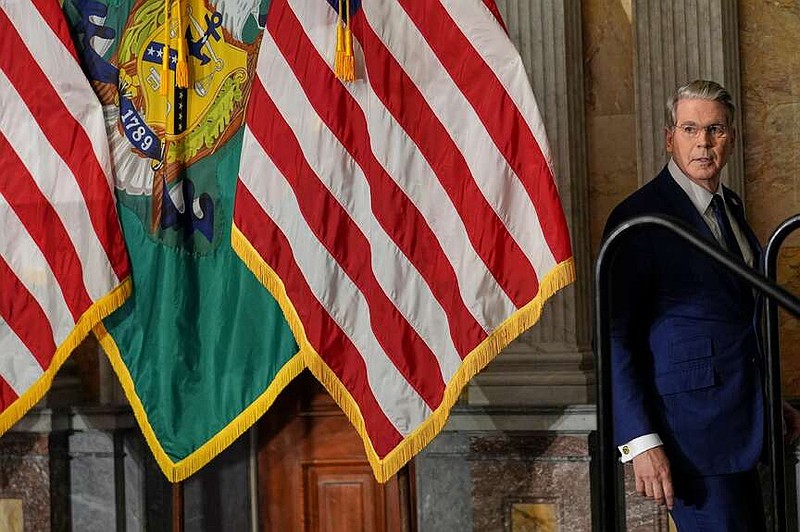
WASHINGTON -- Treasury Secretary Scott Bessent announced a new round of sanctions aimed at Iran on Monday and warned every country that does business with the Islamic Republic to sever those financial ties or face retaliation from the United States.
President Donald Trump's pledge last week to unleash an "economic D-Day" against Tehran turned out to be new warnings to cut off Iran from the rest of the global economy. Asked why the U.S. was not imposing secondary sanctions on Iran's trading partners, Bessent told reporters he wanted countries to have an opportunity to shift away from Iran before it was too late.
"Why would I want to blow up the global financial system?" Bessent said.
The Trump administration is struggling to find an off-ramp nearly six months into an unpopular war with an increasingly obstinate Iran. Diminishing stockpiles of key weapons appear to have forced U.S. officials to pivot to economic warfare, though Defense Secretary Pete Hegseth said late Monday that he was not ruling out resuming strikes to hit Iran during a lull in hostilities.
Washington had promised new sanctions would put even more pressure on an Iranian economy already battered by previous penalties and a U.S. naval blockade.
Iran's Foreign Ministry spokesperson warned that Tehran would respond harshly to expanded U.S. sanctions, including measures against countries it sees as cooperating with Washington.
"Any escalation of this situation will undoubtedly bring about consequences," Esmail Baghaei said. "Our hands are not tied."
The U.S. announcement Monday provided little detail and did not name which countries could face secondary sanctions. China, Turkey and the United Arab Emirates are Iran's largest trade partners.
"We are level-setting with every country to tell them our expectations. We know who they are. They know who they are," Bessent said. "So when the hammer of U.S. Treasury actions falls upon them, they will have no one to blame but themselves."
Dubbing the campaign "Operation Economic Outcast," Bessent said Trump has been "making phone calls to world leaders with specific requests to cease their interactions" with Iran and has already seen results.
The UAE announced last week that it was suspending all trade, commercial exchanges and financial transactions with Iran until further notice after a reported missile attack on the Gulf country. Bessent said the UAE decision was "not a coincidence."
Shortly before the announcement, Iranian parliamentary Speaker Mohammad Bagher Qalibaf said the U.S. is not in an economic position to further restrict Tehran's relations with other countries.
"Iran's trading partners, both in the media and through messages sent to us, have made it clear that they don't take these statements into account anywhere," wrote Qalibaf, who has been Iran's lead negotiator over the past six months, in a post on X.
CHINA INVOLVEMENT
Asked whether the U.S. would target China, Bessent said that "no one is above the reach of U.S. sanctions," despite the fragile trade truce in place between the world's two largest economies.
"If they facilitate transactions and are part of the ecosystem that turns Iranian oil into money, into repression, they will be targeted," he added.
Experts say the U.S. is likely to carefully calibrate its actions on China, just a month before Chinese leader Xi Jinping is expected to visit the U.S.
How much the announcement matters "depends on the aggressiveness with which President Trump is willing to enforce it," said Ali Wyne, senior research and advocacy adviser for U.S.-China relations at the International Crisis Group. "Thus far, despite threatening severe economic consequences for countries that do business with Iran, he has largely given China a pass."
China said Monday that sanctions and additional pressure "will not help resolve the issue," as the U.S. has threatened to impose secondary sanctions on countries that trade with Iran.
"They will only exacerbate tensions and escalate the situation, which is in no one's interest," said Foreign Ministry spokesperson Lin Jian during a daily briefing in Beijing.
The Treasury Department said Monday that it was imposing sanctions on nearly 60 Iran-linked entities, accusing them of roles in Iran's nuclear and missile programs, cyber activities and oil shipments.
That includes Hong Kong-based Sweet Ocean Industrial Limited and associated people and businesses, which were accused of helping Iran acquire sensitive goods such as laser optics equipment. Also penalized was China-based Shenzhen Huamei, which is a service provider for the Iran-based logistics company BRE Line, as well as BRE Line's branch in Hong Kong, over claims it supported the missile and nuclear programs.
CURRENCY DROP
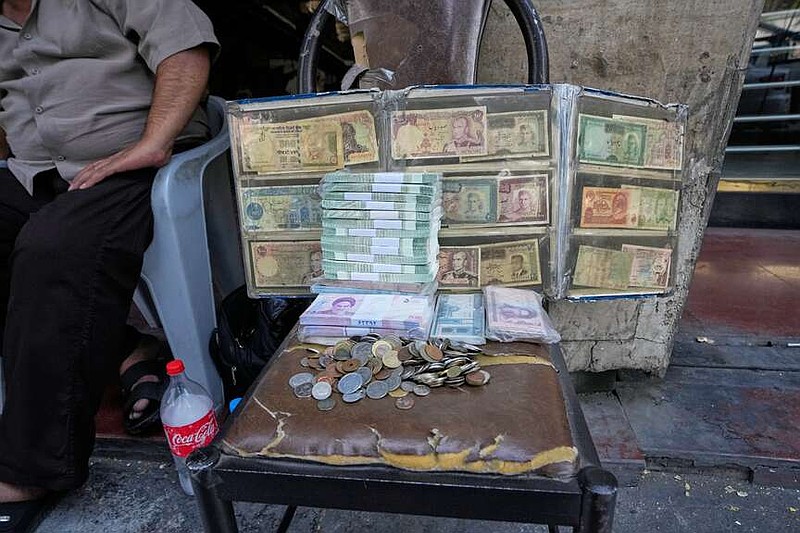
Hours before Bessent's announcement, Iran's currency hit a record low.
The rial dropped to 2.02 million to the U.S. dollar as trading opened on currency markets. Iran's official Central Bank rate stood at around 1.5 million rials to the dollar, but the market rate is what most Iranians pay.
The currency had already been under pressure before the U.S. and Israel attacked Iran on Feb. 28, as Iran faced double-digit inflation and negative growth.
Iranians find daily staples increasingly unaffordable. Since the war began, rice is up some 60% and beef prices are more than 150% higher. The International Monetary Fund forecasts that gross domestic product will contract more than 5%.
Still, economic pressure has not yet translated into political pressure. Iran retains a key strategic advantage through its attacks and threats on ships in the Strait of Hormuz.
Iran and Oman, which is on the opposite side of the strait, are reportedly in the final stages of agreeing on a plan for joint management of the waterway. Oman's foreign minister is set to visit Iran on Tuesday.
PAKISTAN URGES NEGOTIATIONS
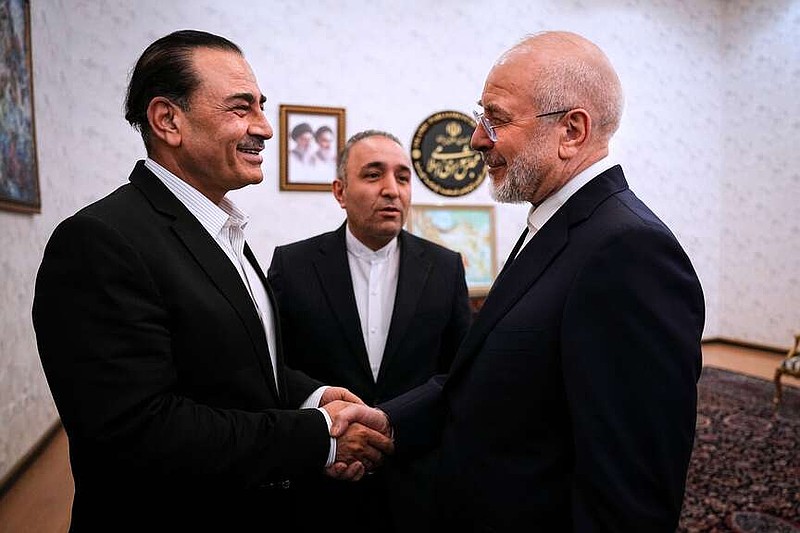
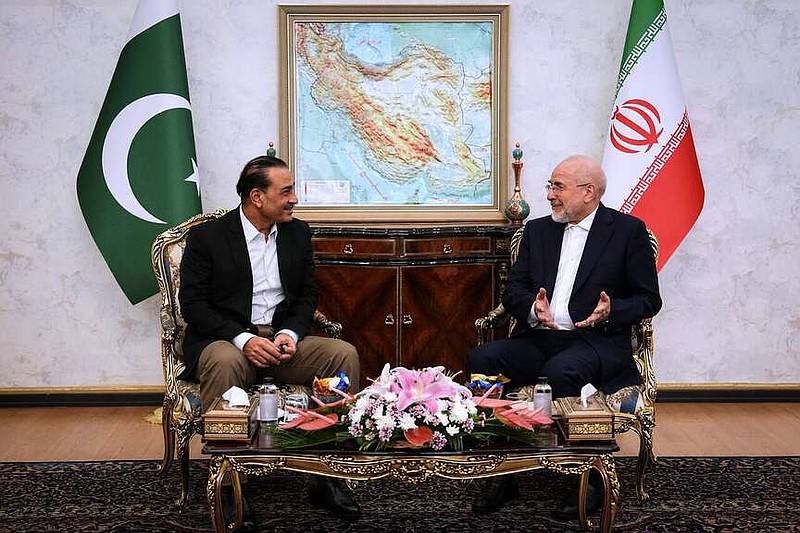
Pakistan, which played a key role in brokering a 60-day ceasefire in June, sent a high-level delegation to Iran on Monday to encourage the U.S. and Iran to return to negotiations, two senior officials said. The officials spoke on condition of anonymity because they were not authorized to speak to the media.
The military confirmed only Field Marshal Asim Munir's visit, saying it was aimed at de-escalating tensions in the region.
Trump spoke with Munir ahead of the army chief's visit to Iran, according to a person familiar with the discussion who spoke on condition of anonymity to confirm a private conversation. Reuters, citing Pakistani sources, first reported the call.
Munir met Iranian Interior Minister Eskandar Momeni in Tehran, according to the two senior officials. Munir was accompanied by Pakistani Interior Minister Mohsin Naqvi and other officials. Munir was expected to remain in Iran overnight and meet the Iranian president and other senior officials before returning to Pakistan.
His previous visit to Tehran in May helped pave the way for a memorandum of understanding signed by the U.S. and Iran in June.
In downtown Tehran, 73-year-old Sadegh Mahmoudi did not hold out hope for a resolution. He joined a line of about a dozen people to purchase U.S. dollars with his remaining savings to hedge against further declines.
"There is no hope for a deal and peace," he said.
NETANYAHU CLAIMS
Israeli Prime Minister Benjamin Netanyahu said on Monday that Iran had tried to kill one of his sons, but gave no details about when the accused plot took place, which son was targeted or how close it came to being carried out.
Netanyahu, whose coalition is trailing in opinion polls two months before an Oct. 27 general election, made the claim in a telephone interview with Israel's Channel 14. He was responding to reports that one of Israel's security agencies had refused to provide protection for a political rival ahead of the nationwide vote.
"As for my sons. Here, I think there is something quite unbelievable, yes. Iran targeted one of my sons. Iran tried to kill, to murder one of my sons," Netanyahu told the conservative channel known for its favourable coverage of the government.
It was not immediately clear which of his sons he was referring to. Netanyahu's elder son, Yair, lives in Miami.
ISRAEL STRIKES GAZA
Israeli strikes killed at least four people Monday in the war-torn Gaza Strip, including two children, hospital officials said.
In the Bureij refugee camp in central Gaza, a strike hit a building after residents said they received an evacuation warning. A 4-year-old child was killed after his family was unable to flee, according to Awda Hospital. His mother and sister were wounded.
Four other structures, including mosques, were hit after residents said they received evacuation warnings, sending scores of already displaced Palestinians fleeing again.
The Israeli military said it struck Hamas weapons storage facilities in mosques after issuing warnings, but provided no evidence.
Separately, Israel said it killed a militant affiliated with Hamas' special forces unit in an overnight airstrike.
Meanwhile, Palestinian American Loui Ridi says he can't freely leave his West Bank home.
Ridi had traveled from Ohio a week ago to join his relatives at his home in the village of Qusra, which was besieged this month by Israeli settlers. The Israeli military declared the area a closed zone to restore order in Qusra.
The siege and Israel's response have sparked condemnation from Israeli rights groups and foreign officials, including U.S. Ambassador to Israel Mike Huckabee, who called the violence terrorism.
Information for this article was contributed by Farnoush Amiri, Christopher Rugaber, Aamer Madhani, Didi Tang, Nasser Karimi, David Rising, Seung Min Kim, Konstantin Toropin and Munir Ahmed of The Associated Press, and by Andreea Popescu and Alexander Cornwell of Reuters.