
How NYU Langone Transformed Into a Leading Healthcare Institution
On a rainy afternoon in May, the 96 members of New York University Grossman School of Medicine, Class of 2025, gathered with their families in Carnegie Hall. They crossed the stage, collected their degrees, and all together recited the Hippocratic oath. But while their graduation into the ranks of medical doctors was the point of the ceremony, in some ways it did not feel like the day’s main event.
That belonged to another pair on stage, Dr. Robert Grossman and Ken Langone—graduates of a different sort, who as dean and board chairman respectively were presiding for the 18th and last time over the graduation ceremony. This was their swan song, or maybe something more of a victory lap.
Grossman spoke of his hard-fought path to the top of NYU Langone—“I had no sponsors, no mentors, no coaches. No one was there to introduce me to any ‘important’ people or direct my career”—before imparting 15 nuggets of wisdom he had collected. (No. 1: “It doesn’t matter where you come from, it does matter how high you aim.” No. 5: “Depth of knowledge is very important.” No. 14: “Find the right partner.”)
His business partner, Langone, gave him a warm embrace and in his own speech, remarked that his association with Grossman was “one of the most rewarding of his life.”
The audience was well-disposed to share the spotlight: Thanks to Langone and Grossman, their medical educations had all come tuition-free. And Grossman’s lessons were on point—since they encapsulated the ambition and tenacity that made NYU Langone an enviable success story in American health care.
Two decades ago, NYU’s academic medical center was a troubled institution, treading water; today, it’s one of the country’s most efficient providers of high-quality care, with 53,000 employees, roughly $14 billion in revenue—up from $2 billion in 2007—and more than 320 locations. Its innovations in medical-school education—introducing an accelerated three-year curriculum, and that free tuition—have made its programs models for others around the country. NYU Langone has wooed world-leading talent while scaling the ranks of federally funded research hospitals. And while it has taken place in a health care setting, the NYU Langone recovery has been driven by two interlinked factors—a disciplined reliance on data and a relentless culture of accountability—that wouldn’t feel out of place on Wall Street or in Silicon Valley.
The turnaround is a source of much pride for the somewhat unlikely pair that presided over it: Grossman, a neuroradiologist who had no formal business training when he became CEO and dean of the medical center in 2007; and Ken Langone, the billionaire co-founder of Home Depot who has chaired its board—and given so much time and money to the institution that it now bears his name—since 1999. (Langone, who is also a major Republican donor, later honored Grossman by naming NYU Langone’s two medical schools after him.)
It’s a story the two men, 78 and 89 respectively, are eager to tell as they prepare to hand over their roles to carefully selected successors come September 1. NYU Langone granted Fortune access to its executives and inner workings to better understand the organization and its transformation. For a reporter who has written extensively about the nation’s often dysfunctional health system, it was an opportunity to learn what it took for one American health system to succeed—and what others can learn from it.
It’s also a time when many hospitals need help—stat. In 2023, 48% of the nation’s rural hospitals operated at a financial loss. More than one-third of them—some 700—were at risk of closure, according to a 2024 report by the Center for Healthcare Quality and Payment Reform. And this year’s cuts to Medicaid and National Institutes of Health (NIH) funding have imposed serious turbulence on hospitals of all kinds.
NYU Langone has been blessed by geography—headquartered amid the concentrated wealth of midtown Manhattan—and supported, in time and generous donations, by a board that reads like the guest list of a Davos cocktail party. Beyond Langone, and to name just a few, trustees include board co-Chair and BlackRock CEO Larry Fink, Ken Chenault (former CEO of American Express), and former Goldman Sachs exec and Trump advisor Gary Cohn. Overseers include JPMorgan Chase’s Jamie Dimon, billionaire hedge funder Paul Tudor Jones, and David Zaslav, president and CEO of Warner Brothers.
NYU Langone is a non-profit health system, but make no mistake, it’s run like the big business that it is. (By 2024 revenues, it would rank No. 308 on this year’s Fortune 500.) Grossman earned $22.8 million in total compensation in 2023, and its doctors rank among New York’s highest paid—as Tom Murphy, founder and partner at private-equity fund Crestview Partners and another trustee, proudly pointed out to me, “We pay our people well to do a good job.”
Many are uncomfortable with the notion of non-profit hospitals operating more like Fortune 500 companies than charity wards. But Ge Bai, a professor of accounting and health policy at Johns Hopkins, says, “That’s the reality nowadays.” She notes that NYU Langone has been uniquely successful in the industry because of its strengths generating patient revenue and controlling expenses. “Their operations are amazing,” Bai adds.
$14 billion
Approximate revenue for the NYU Langone health system in 2024.
You may wonder if NYU Langone is successful simply because it is charging more. But an analysis of Turquoise Health data, showing rates charged by New York’s five large hospital systems for eight frequently performed procedures found that NYU’s prices, on average, ranked second-lowest, behind Mount Sinai.
Indeed, the operations are where the learnings are. And while it’s tempting to ask how transferrable lessons from a wealthy, well-connected hospital system can be in other parts of the country, NYU Langone in recent years has expanded into more difficult markets—that is, ones with poorer and sicker patients—generating evidence that its turnaround playbook can work outside of the rarified confines of Manhattan.
What then is NYU’s secret sauce, and how can others replicate the formula?
Inheriting a medical mess
Things were not good when Grossman arrived at New York University Medical Center to run the radiology department in 2001. He was days into the role when a pipe burst in his office, leaving a pile of plaster and unsightly debris. It took eight weeks to get someone from the organization to fix it, because no one would take ownership: Was the medical school responsible for the wall, or the hospital?
To Grossman, who had come from Penn, the absurd situation symbolized the inefficiency and dysfunction that ailed NYUMC and academic medicine more broadly. When he became dean and CEO in 2007, Grossman vowed to run the school and hospital as a single integrated entity. He also boldly committed to make the institution “world-class”—“an academic medical center competing successfully with the Hopkins, the Harvards and Penns,” he wrote in his investiture speech.
Langone, a self-made business titan who, before co-founding Home Depot, had taken Electronic Data Systems public with Ross Perot, shared Grossman’s lofty goals. He had joined the board in 1999 when his friend, Martin Lipton, an M&A attorney and NYU trustee, told Langone he needed help with a mess at the medical center. (A graduate of NYU’s business school, Langone says he didn’t even realize NYU had a medical center.)
That mess: a 1998 merger with Mount Sinai that had gone so badly that the hospitals broke up a few years later. By 2003, the combined entity had racked up three straight years of losses, $670 million in debt, and a junk-bond rating. The institution was independent again, but not profitable, when Grossman got promoted in 2007.
Langone and Grossman had bonded several years earlier when Grossman, wanting to replace his department’s radiology equipment, had put out a request for proposals. Showing some raw business talent, he negotiated an unthinkably good deal with Siemens: The medtech company agreed to give NYU the technology, plus $100 million for NYU to serve as a showroom. Those terms impressed Langone, who happened to be on the board of General Electric, a losing bidder. That Langone didn’t let that conflict—or his friendship with GE’s then-CEO Jack Welch—interfere with the Siemens deal, meanwhile, impressed Grossman.
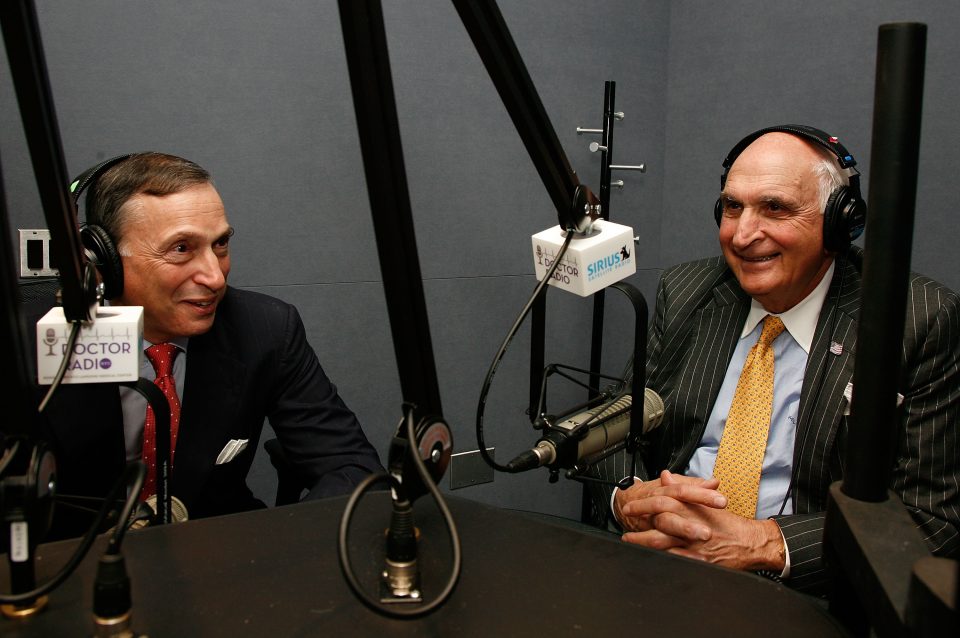
Joe Kohen—WireImage/Getty Images
Over the years, the two have become incredibly close, trading regular phone calls and referring to each other as “brothers from different mothers.” Grossman attributes their kinship to their hardscrabble childhoods and the resilience it fostered. He was a scholarship kid who described his mom to me as “an illegal immigrant.” Langone’s parents, also immigrants, worked as a plumber and a cafeteria worker, and didn’t get schooling beyond junior high.
Langone, 11 years Grossman’s senior, plays the gregarious and protective older sibling in the relationship. When I met him at his Park Avenue office, he heaped praise on Grossman—“He’s brilliant…values beyond reproach…this guy could take my job doing deals!” (When it comes to himself, Langone’s prone to absurd self-effacement: “I’m not the brightest bulb,” he tends to say, emphasizing his science education ended in 8th grade.) The big-brother vibe plays out practically too: Grossman, who described Langone as “the best guy in the world,” says he’s a keenly intelligent sounding board, and some extra muscle. “We deal with politicians, and he’s connected, and that’s very important as well.”
The board sees the duo’s dynamic as a key to NYU Langone’s success. Murphy describes Grossman as the transformation’s visionary, and Langone as its enabling force. Fink, who points out his firm owns 5%-10% of virtually every major company in the world, says, “I see some really good leadership and some really crappy leadership, but it was very clear, very early on that the chemistry between Bob and Ken was something very unique.” He adds, “Bob grew into the CEO role—a lot of it was the trust he had with Ken, and maybe a little bit with me.”
Grossman’s leadership was a shock to the broader system, however. He fired most of the executive team before his first day. Not long after, he ripped out a relatively new $35 million electronic health-record system, telling the board he needed to install the more expensive Epic system instead.
Rather than acquiring hospitals—the go-to strategy for health systems at the time—Grossman committed to building a network of outpatient facilities, correctly anticipating that technology would allow an increasing share of procedures to be performed outside of hospitals. (That strategy has paid off: Ambulatory facilities don’t require 24/7 staffing and are more profitable.)
Relaying the events to me 18 years later, Grossman still seemed tickled by his own audacity, and the fact that he has shown up naysayers, like a McKinsey consultant who told him he was doing too many things too fast.
Satisfying too, was his experience watching a class at Harvard Business School discuss NYU Langone, the case study. The students struck Grossman as timid: They’d all viewed his early management purge—“Black Wednesday,” as it became known—as cataclysmic. “I didn’t think it was any big deal,” he told me. “I just didn’t think the institution was functioning.”
Dr. Andrew Brotman, NYU Langone’s outgoing chief clinical officer, recalls that Grossman fired people he was friendly with that day, with no apparent anguish. That sort of compartmentalization is “characteristic of Bob,” he told me. “He does what’s best for the organization.”
Fiona Druckenmiller, a former portfolio manager who joined NYU Langone’s board in 2006—and who will succeed Langone as chair on Sept. 1— describes Bob “as one of the most decisive people I’ve ever met.”
Inheriting a medical mess
Things were not good when Grossman arrived at New York University Medical Center to run the radiology department in 2001. He was days into the role when a pipe burst in his office, leaving a pile of plaster and unsightly debris. It took eight weeks to get someone from the organization to fix it, because no one would take ownership: Was the medical school responsible for the wall, or the hospital?
To Grossman, who had come from Penn, the absurd situation symbolized the inefficiency and dysfunction that ailed NYUMC and academic medicine more broadly. When he became dean and CEO in 2007, Grossman vowed to run the school and hospital as a single integrated entity. He also boldly committed to make the institution “world-class”—“an academic medical center competing successfully with the Hopkins, the Harvards and Penns,” he wrote in his investiture speech.
Langone, a self-made business titan who, before co-founding Home Depot, had taken Electronic Data Systems public with Ross Perot, shared Grossman’s lofty goals. He had joined the board in 1999 when his friend, Martin Lipton, an M&A attorney and NYU trustee, told Langone he needed help with a mess at the medical center. (A graduate of NYU’s business school, Langone says he didn’t even realize NYU had a medical center.)
That mess: a 1998 merger with Mount Sinai that had gone so badly that the hospitals broke up a few years later. By 2003, the combined entity had racked up three straight years of losses, $670 million in debt, and a junk-bond rating. The institution was independent again, but not profitable, when Grossman got promoted in 2007.
Langone and Grossman had bonded several years earlier when Grossman, wanting to replace his department’s radiology equipment, had put out a request for proposals. Showing some raw business talent, he negotiated an unthinkably good deal with Siemens: The medtech company agreed to give NYU the technology, plus $100 million for NYU to serve as a showroom. Those terms impressed Langone, who happened to be on the board of General Electric, a losing bidder. That Langone didn’t let that conflict—or his friendship with GE’s then-CEO Jack Welch—interfere with the Siemens deal, meanwhile, impressed Grossman.