
It’s also attached to Mooo…. Beacon Hill, a steak house that my colleague Devra First swooned over: “There’s something about the place that feels right,” she wrote.
But I’ve never been wowed by XV Beacon, with its tiny lobby, postage stamp gym, and a bath salts menu straight out of the early 2000s, especially now that Boston has a fine new crop of luxury offerings. It was time to check again in and see if it really was best in the country, or at least Boston.
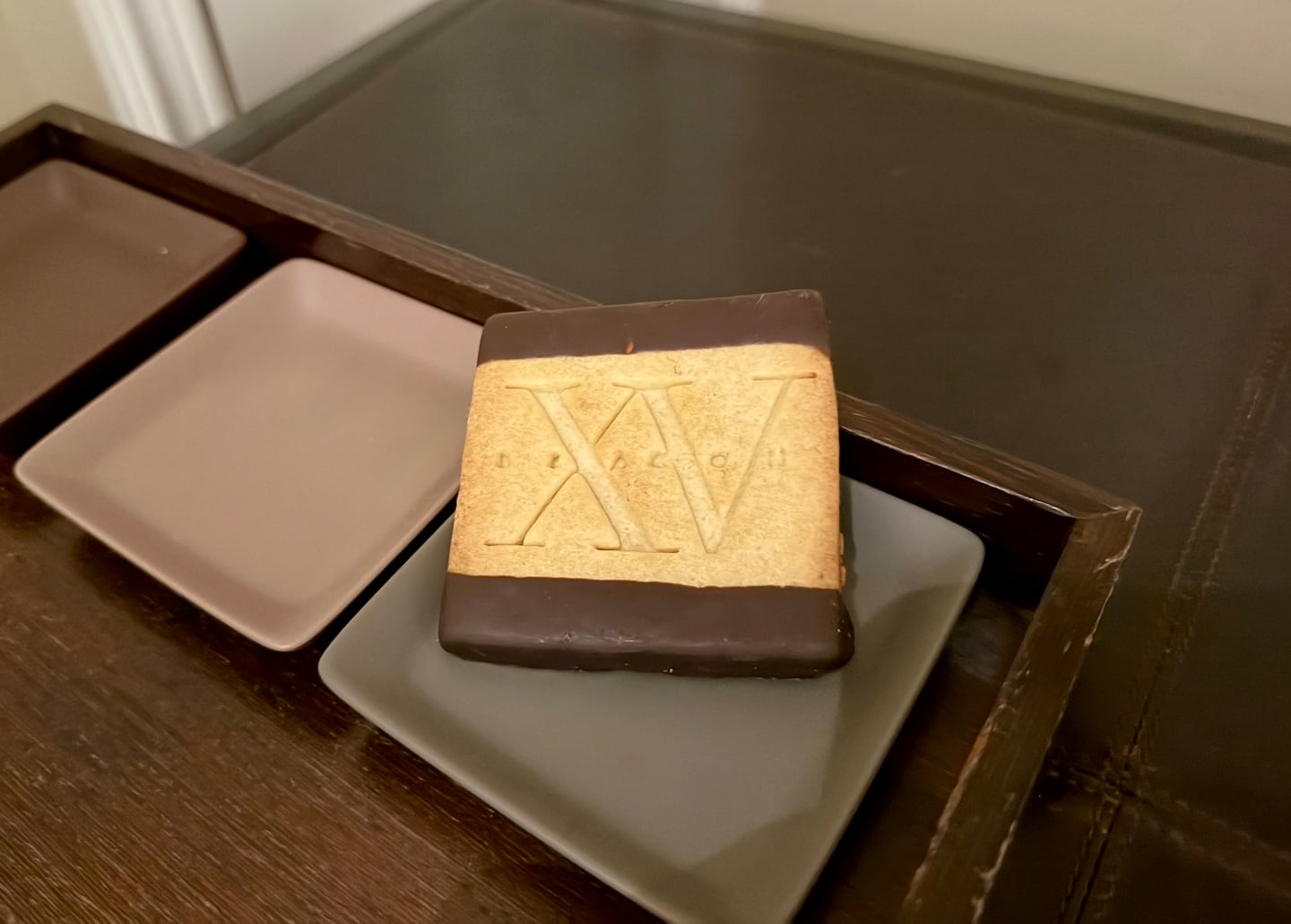
There are some things I love about XV Beacon: proximity to attractions, the architecture, the in-room gas fireplaces, the Frette sheets, and the shortbread cookies dipped in chocolate that await guests in their rooms. And then there are some things I don’t like: a color scheme that feels outdated, a stainless steel wall(!) surrounding the fireplaces, and a tall vertical glass container filled with artificial apples. Would it be so difficult to splurge on real apples? For the price point, which can range from $450 to $1,500, XV Beacon should be leaving no stone, or artificial apple, unturned.
That begins with the check-in process. The best hotel in the country should greet a guest with more than a perfunctory “hello” and “I’ll need an ID and a credit card.” It should make a guest feel as if they’re truly welcome. But perfunctory is what I encountered last month during my first check-in. I’ve stayed at hotels with much lower price points that have gone further to greet guests. Even eye contact was mostly absent.
I often worry that a hotel located in Boston might recognize my name. In this case, I clearly had nothing to be concerned about.
A best-in-the-country hotel should also have a concierge who recommends more than the Maparium, the JFK Library, and the Boston Athenaeum, along with a few attractions that happened to be closed the day I made my inquiry. I asked for rainy day recommendations, specifying that I wasn’t interested in the MFA or the ICA. Yet, there was still a lot of talk about the MFA. One recommendation included a bike tour, although the rain was coming down sideways. I also got a map for a self-guided walking tour (rain, it’s raining!) that listed the locations where five famous authors lived on Beacon Hill, including Henry David Thoreau.
“Thoreau wrote ‘On Golden Pond,’ I think,” the concierge said.
I blithely nodded, remembering that I was playing the part of a clueless tourist.
His lunch recommendation was Parish Cafe. In my head, I was screaming, “Please, at least tell me to go to Boston Public Market!”
As he was talking, I began to wonder if hotels rely as much on concierges as they once did, or if people just research it all online. (Note to self: write a story about the role of a concierge in 2026.) During the first of my two stays, I booked the least expensive room in the 63-room hotel, the classic queen, which was $686 with taxes and fees. The Globe does not accept free or discounted hotel rooms, and I paid the advertised rate. I entered the room, grabbed a sheet of hotel stationery, and furiously started writing, “I can feel the springs in the desk chair I’m sitting on. There’s another chair blocking the minibar. Why wasn’t I offered any of the fancy water sitting in the lobby when I checked in? It’s time for a new color scheme. Why does every room on the hotel’s website look nicer than this one?”

Am I sounding difficult and insolent? Absolutely, but these are things the best hotel in the country should address. Complaining aside, XV Beacon has a lot going for it. The hotel has a deep sense of place. It’s like you’re visiting a wealthy, button-down brahmin uncle. I loved the marble bathroom, the charming, funny valet, and the cashmere throw on the bed.
But best in the country? I’ve stayed in hotels in Boston, New York, Miami, and other cities that I’m far more fond of.
My first night and experience had me thinking about the Travel + Leisure survey. This is a reader survey, which means it’s different from a Forbes star rating. Forbes uses anonymous inspectors who come in with a list of criteria to give its rating. The Travel + Leisure survey is based on subjective reader responses. On the Forbes rating, XV Beacon didn’t earn any stars, but it is listed as Forbes-recommended.
And as I began to doze off on the Frette sheets, I started to wonder if Travel + Leisure requires survey respondents to stay in the hotel in order to vote?
“Only readers who have stayed at the hotel within the past three years are eligible to vote,” a spokesperson from Travel + Leisure told me. “As part of the survey, respondents are asked qualifying questions to confirm that they meet the eligibility requirements before their ratings are included.”
Still, survey results come from people who go out of their way to vote, according to Nataly Kelly, chief marketing officer at Zappi, a Boston tech company that works with more than 350 of the world’s largest brands to obtain consumer insights.
“Self-selection is key here because these are people opting in to vote,” Kelly said. “They’re usually more engaged. They may be more motivated than the average traveler. They may have the time to take surveys. That can often skew results before a single response is even counted.”
“When you’re designing a good survey, you have to actively manage who’s in the sample, balancing for things like region, demographics, frequency of use, motivations,” she said. “Rather than just opening the doors and counting every single person who shows up. ”
According to its marketing materials, the average age of a Travel + Leisure reader is 47 with a household income of $400,000. That will immediately knock every Motel 6 and Red Roof Inn out of contention and put the survey in the direction of the Four Seasons, Raffles, the Boston Harbor Hotel, and other luxury hotels. Those expensive hotel brands correlate closely with the top-rated Boston Forbes hotels.
The correlation between the Forbes and Travel + Leisure lists shows that while the methods of gathering the data are different, they’re producing similar outcomes, which Kelly said indicates the survey is authentic.
“As a researcher, I always look at other sources and try to triangulate,” she said. “Am I getting radically different results than another? If so, why? But the fact that these are spitting out similar results is actually a good thing that validates that both of them are finding similar results.”
This was also good to hear, because I often hear grumblings, mostly from those outside the industry, that hotels buy their way into best-of lists.
When I checked in for my second stay the following week, the front desk clerk began with the usual “Could I see your driver’s license and credit card, please?” As he entered information, he stopped, looked up, and said, “Didn’t you recently stay with us?” Yes, I had. He smiled. “Welcome back, we’re so glad to see you again.” This felt a little more like a best hotel kind of greeting.
I booked a better category of room for my second time at the hotel. This room had a swanky name, called the studio. It was about double the size of my previous room, priced at $886 including taxes and fees. It felt lighter and less dated, and my notes on the hotel stationery were less pointed than my previous stay. Still, I didn’t understand why the front desk never told me about services such as the free in-town luxury car service or the rooftop deck. C’mon XV Beacon, if you’ve got it, flaunt it.
I know there are plenty of hotel regulars who will take offense at my observations, but these are highly subjective experiences. There may be some people looking for a small boutique hotel with a slightly outdated, yet familiar, color scheme and a bath salts menu. But for the price, I’d trade XV Beacon for a refreshed hotel that greets you with a smile every time you check in.
Christopher Muther can be reached at