
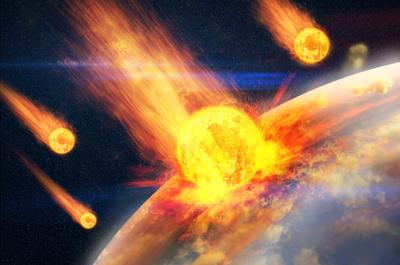
Don't expect a Hollywood-style scene, but a much-less-dramatic asteroid hit still could be earth-changing.
DreamstimeThe quest to peer beyond frontiers will always be at the heart of our nation's space policy. In NASA's own words, the agency "explores the unknown in air and space, innovates for the benefit of humanity, and inspires the world through discovery." But there is another vital, if not quite as inspiring, role for us to play in space.
Government's first job should be public safety, and there's an important role for our federal government to play in tracking and potentially deflecting asteroids that, if allowed to strike Earth, could take out a major city, or worse. We're not alone in this view. A recent opinion piece in The Washington Post by a New Mexico State University researcher notes that there are 40,000 asteroids whose paths could cross the Earth's orbit; most of these have been discovered in the past 25 years, well after "Armageddon," perhaps the most famous of the shower of Hollywood asteroid pictures.
Of these 40,000, about 1,000 are large enough, with diameters more than two-thirds of a mile, to be considered "civilization-ending." But that's just the start. Also of major concern are 25,000 smaller asteroids that still are several times larger than the 66-foot-wide meteor that exploded with no warning over Chelyabinsk, Russia, in 2013, releasing about 30 times as much energy as the atomic bombs dropped in World War II. These asteroids are large enough to take out a city should they strike us.
This is not a new concern. In 2020, we noted that a kilometer-wide rock passed within 3.6 million miles of earth — about 15 times the distance between us and our moon. Had it struck, it could have returned us to the Stone Age.
As the researcher wrote in The Post, one estimate last year concluded that asteroids that are 460 feet or larger strike Earth about once every 11,000 years — a 0.009 percent chance annually but 1,000 times more likely than a person's annual risk of dying in an airplane crash.
We need not only better monitoring, especially from our advanced telescopes in space, but also an improved plan to deflect the large asteroids heading toward us. NASA conducted a successful Double Asteroid Redirection Test in 2022, but it took years to build and plan.
"If a dangerous asteroid were discovered tomorrow, NASA would need to plan, build and launch a deflector from scratch, since NASA doesn’t keep spacecraft similar to DART in storage," researcher Venkatesh V. Ranjan wrote. "That would be like facing a charging gorilla and needing to build a rifle. NASA should have a shelf-ready fleet of impactors modeled after DART that it can quickly deploy if it detects a threat."
We agree, and fortunately, this should not cost anywhere near as much as the sums we're spending to travel to the moon and Mars. Building and maintaining a reserve of 10 spacecraft modeled after the DART would cost around $3.25 billion, less than the price of the new Washington Commanders football stadium.
The debate over how best to deflect potential city-killer asteroids also should touch on the pros and cons of launching nuclear weapons into space and detonating them to change the path of a large asteroid. While the 1963 Limited Test Ban Treaty forbids detonating nuclear weapons in space, we believe a carefully crafted exception should be considered for detonations that could save lives.
There is a separate but related problem: the approximately 28,000 pieces of space debris orbiting earth that continue to multiply and limit our vision of the sky from even the darkest corners on Earth. The United States and other countries, especially those launching satellites, must cooperate more to address this debris and clean up our skies. After all, we can't defend against what we can't see.